Sign up with Google
 Sign in with Zoho

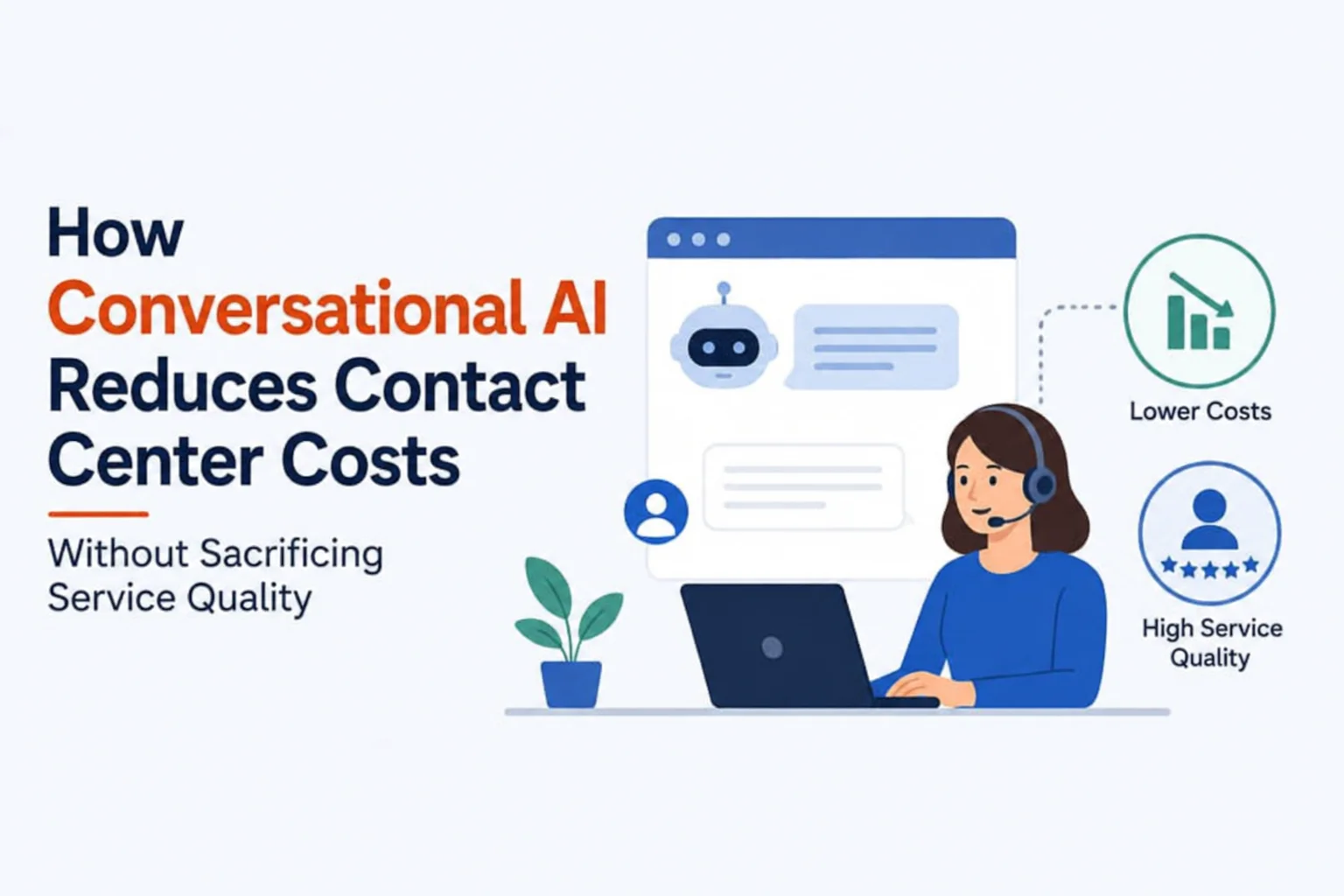
Labor accounts for up to 95% of total contact center costs. That single figure explains why conversational AI has moved from a CX innovation to a core operational strategy for enterprise contact centers. But the cost reduction story is only half the picture. The organizations getting the most durable results are the ones that improved quality at the same time as they cut costs. The ones that only optimized for cost reduction built a cheaper version of a frustrating experience.
This article covers how conversational AI platform actually reduces costs, where the quality risk sits and how to structure a deployment that delivers both. It connects directly to the broader picture of how enterprise AI agents operate across voice, chat and digital channels, which we cover in detail in our primary article on enterprise AI agents and real customer experience.
Where the Cost Reduction Comes From
The math behind conversational AI cost savings is straightforward. An average inbound human agent call costs $7.16. A conversational AI interaction resolves for under $1.00 per interaction Across a contact center handling 500,000 interactions per year, deflecting 50% of those to AI resolution saves more than $1.5 million annually before accounting for training overhead, attrition costs or compliance savings.
The Gartner figure that has become the benchmark for this conversation is clear: conversational AI is projected to save $80 billion in global contact center labor costs by the end of 2026. That is a labor cost figure, not a technology investment figure. The savings come from volume deflection, not headcount elimination.
Call Deflection
Call deflection is the most immediate cost lever. When a conversational AI system handles a query end-to-end — without a human agent touching it — the cost per resolution drops by 65 to 90%. Enterprise contact centers achieve Tier-1 call deflection rates between 45% and 60% using voice AI automation.
One telecom operator moved 20% of voice traffic to messaging within four months and reduced cost per interaction by 45. Vodafone deployed AI across customer inquiries and achieved a 70% reduction in cost-per-chat, with first-contact resolution improving from 15% to 60%. These are not projections. They are live deployment results.
Handle Time Reduction
For interactions that do require a human agent, AI-powered agent assist reduces average handle time by surfacing relevant information in real time. Teams using agent assist typically see a 45% increase in tickets handled per agent per hour. Shorter handle time means more interactions resolved per shift, which reduces the cost per interaction without reducing the number of interactions a human handles.
Reduced Attrition and Training Costs
Agent attrition is one of the most underestimated cost drivers in contact centers. When AI automation absorbs high-volume, repetitive queries, agents spend more time on complex, meaningful interactions. That reduces burnout and improves retention. Training time also decreases: it takes 6 weeks to train an AI agent on a new product line versus 12 to 16 weeks for a human agent.
Where Quality Risk Sits
The organizations that deployed conversational AI primarily as a cost-cutting exercise and saw quality decline made predictable mistakes. Understanding those failure points is as important as understanding the cost savings potential.
Deploying AI on the wrong query types is the most common error. Conversational AI excels at well-defined, high-volume interactions: order status, account balance, appointment scheduling, FAQ resolution. It struggles with emotionally charged situations, complex multi-step problems and cases requiring regulatory judgment. Routing the wrong query types to AI creates a worse experience than routing nothing.
Optimizing for deflection rate alone produces an AI that closes conversations without resolving them. The right metric is first contact resolution, not deflection rate. An interaction that deflects but requires a callback has not saved money. It has deferred the cost and annoyed the customer.
Neglecting post-deployment optimization causes quality to decay over time. Products change. Policies update. Customer language evolves. An AI system that is not continuously trained on new interactions will gradually lose accuracy. The cost of rebuilding customer trust after a period of poor AI performance consistently exceeds the cost of the optimization investment.
What Good Deployment Looks Like
The enterprises achieving both cost reduction and quality improvement share a consistent approach. They start with their highest-volume, lowest-complexity query categories and automate those first. They measure success on first contact resolution, CSAT and cost per resolution rather than deflection rate alone. They build clean escalation paths to human agents with full context transfer. And they treat the AI as a system that needs ongoing management, not a project with a completion date.
The average payback period for an enterprise voice AI deployment is 2.8 months. 91% of companies using AI voice agents for 12 or more months say they would invest again. The ROI is durable when the deployment is structured correctly.
The principles behind effective cost-reducing AI deployments connect closely to the broader omnichannel customer engagement strategy, which we explore in our article on why enterprises need unified AI conversations. The cost gains compound when the AI operates consistently across all channels from a single platform rather than being deployed in siloes per channel.