Sign up with Google
 Sign in with Zoho

Customer expectations are changing faster than traditional contact center technology can keep up. Customers no longer want to repeat information, navigate rigid IVR menus, or wait for a human agent to complete simple tasks across multiple systems. They expect businesses to understand their intent, remember context, respond instantly, and take action.
This is where Agentic AI for contact centers is creating a new model for customer service.
Traditional chatbots and even modern conversational AI are primarily designed to understand questions and generate responses. Agentic AI goes a step further. It can reason about a customer’s goal, plan the next steps, interact with business systems, execute actions, and evaluate whether the outcome was successful.
In other words, the evolution is moving from “AI that answers” to “AI that acts.”
What Is Agentic AI for Contact Centers?
Agentic AI refers to AI systems capable of operating toward a defined goal with a degree of autonomy. In a contact center, this means an AI agent can do more than provide information.
For example, a customer may want to change a delivery date. A conventional chatbot might explain the process or provide a link. An AI Agent can potentially identify the customer, retrieve the order, check available delivery slots, update the order, confirm the change, and communicate the result.
The difference is not simply better conversation. It is end-to-end task execution.
Agentic AI can connect with systems such as:
- CRM platforms
- Ticketing systems
- IVR and telephony platforms
- Billing systems
- Knowledge bases
- Workforce management platforms
- Scheduling and order-management systems
This orchestration enables AI in customer service to move beyond isolated conversations and become part of the operational workflow.
Why Traditional Bots Are No Longer Enough
Chatbots have played an important role in customer service automation. They can answer frequently asked questions, provide basic troubleshooting, and route customers to the right department.
However, traditional bots generally operate within predefined rules and intents.
This creates several limitations.
1. Limited Context
A customer may begin a conversation through a website, continue through a mobile application, and eventually call the contact center.
If each channel operates independently, the customer may have to repeat the same information.
An Omnichannel AI strategy aims to eliminate this fragmentation by maintaining relevant context throughout the customer journey.
Agentic AI can take this further by using available customer and interaction context to determine what action should happen next.
2. Limited Ability to Take Action
A conventional bot may tell a customer how to cancel a subscription.
An AI agent can potentially perform the cancellation itself.
This distinction is critical. Customers are generally interested in getting their problem solved, not simply receiving instructions.
Agentic AI is designed around the outcome, rather than just the response.
3. Difficulty Handling Complex Requests
Customer interactions rarely follow perfectly predictable scripts.
A customer might combine multiple requests in one conversation:
“My bill is incorrect, I need to change my plan, and can you also schedule a callback?”
A traditional bot may struggle to determine the sequence of actions.
Agentic AI can break a broader objective into smaller tasks, determine which systems need to be accessed, execute those actions, and escalate when human intervention is required.
Agentic AI vs. Conversational AI
A traditional chatbot is primarily designed to respond to predefined questions, recognize common intents, and guide customers through scripted conversations.
Agentic AI builds on these capabilities but adds autonomy and action.
Real-Time AI Assistance for Human Agents
Agentic AI does not necessarily mean removing human agents from the customer service process.
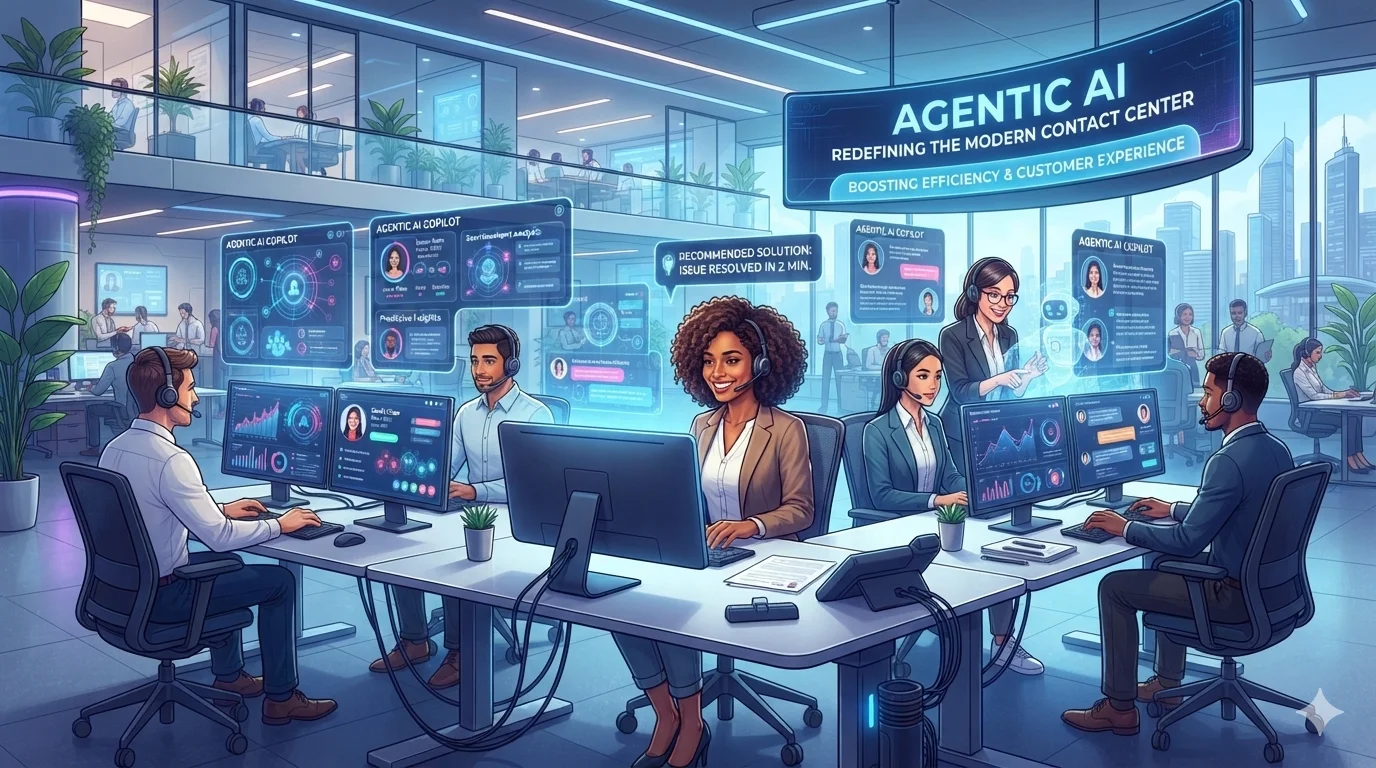
In many contact centers, one of the most valuable applications is Real-Time AI Assistance.
During a live interaction, AI can help a human agent by:
- Surfacing relevant knowledge articles
- Summarizing previous interactions
- Recommending next-best actions
- Drafting responses
- Identifying customer intent
- Highlighting compliance requirements
- Generating case notes
- Detecting potential escalation signals
This allows the human agent to concentrate on the customer while AI handles information retrieval and repetitive cognitive work.
How Agentic AI Enables Omnichannel Customer Service
Modern customers move between channels depending on convenience.
They may start with web chat, switch to WhatsApp or another messaging channel, and later contact the business by phone.
An effective omnichannel AI customer service strategy needs to connect these interactions rather than treating them as separate conversations.
Agentic AI can help coordinate the journey by using customer context across supported systems and channels.
For example:
- A customer reports a delivery problem through chat.
- AI identifies the order and checks its status.
- The customer later calls the contact center.
- The AI-powered voice experience can access relevant interaction context.
- If the issue requires a human, the conversation can be transferred with relevant information.
- After resolution, the system can update the customer record and trigger a follow-up.
The goal is a connected customer journey rather than a collection of disconnected conversations.
AI Agents Can Transform Contact Center Workflows
The biggest opportunity with Agentic AI is not limited to customer-facing chat.
AI Agents can support operational workflows across the contact center.
1- Intelligent Call Routing
Instead of relying exclusively on static routing rules, AI can consider customer context, intent, interaction history, and the complexity of the issue when determining where an interaction should go.
2- Automated Case Management
An AI agent can potentially classify a case, gather required information, create or update a ticket, and route it to the appropriate team.
3- Proactive Customer Service
Traditional customer service is often reactive: the customer experiences a problem and contacts the business.
Agentic AI can support proactive service by identifying relevant signals and initiating appropriate workflows.
For example, if a service disruption affects customers, an AI-powered system could help identify impacted customers and initiate communications according to predefined business rules.
4- Real-Time Quality Monitoring
AI can analyze interactions continuously to identify potential compliance issues, process deviations, or opportunities for coaching.
This changes quality management from a periodic activity into a more continuous process.
The Role of an Agent AI Writing Assistant
Written communication remains a significant part of contact center operations.
Agents may spend considerable time writing:
- Email responses
- Chat messages
- Case summaries
- Follow-up communications
- Internal notes
- Customer updates
An Agent AI writing assistant can use conversation context and approved knowledge to help draft these communications.
The important distinction is that the AI should support the agent rather than blindly generate content.
With appropriate controls, agents can review, personalize, and approve AI-generated responses before sending them.
This creates a practical bridge between Generative AI and Agentic AI: generative capabilities help produce content, while agentic capabilities help coordinate the broader workflow around that content.
What Businesses Need to Consider Before Adopting Agentic AI
Agentic AI introduces significant opportunities, but autonomy also introduces responsibility.
Organizations should establish:
- Clear boundaries for what AI can and cannot do
- Human escalation paths
- Reliable customer and business data
- Access controls for connected systems
- Monitoring and auditing
- Continuous testing
- Governance policies
- Performance measurement
This is particularly important because an AI agent connected to multiple business systems can potentially create consequences that a simple chatbot cannot.
Testing should therefore extend beyond checking whether an AI produces an acceptable answer. Organizations also need to test whether it chooses the appropriate action, follows business rules, handles unexpected scenarios, and completes workflows correctly.
The Future of AI in Customer Service
The future of AI in customer service is unlikely to be defined by a single chatbot sitting on a website.
Instead, businesses are moving toward interconnected AI capabilities that can understand conversations, assist human agents, coordinate systems, execute workflows, and support customer journeys across channels.
This is where Agentic AI creates its biggest distinction.
A traditional bot waits for a question and provides an answer.
A modern conversational AI system can understand that question more naturally.
An AI agent can go further by asking:
What is the customer trying to accomplish, and what actions are required to achieve that outcome?
That shift from answering to acting is what makes Agentic AI particularly relevant to the next generation of contact centers.
Conclusion: Moving Beyond the Bot
The contact center is evolving from a collection of channels and scripted interactions into an intelligent, connected service environment.
Traditional bots remain useful for straightforward, repetitive requests. Conversational AI makes interactions more natural. Real-Time AI Assistance empowers human agents. But Agentic AI for contact centers introduces another layer: autonomous orchestration.
By combining reasoning, context, system integration, and task execution, AI Agents can help organizations move from reactive customer support toward more proactive and outcome-focused service.
The real opportunity is not simply to deploy another bot.
It is to build a customer service ecosystem where AI understands the goal, coordinates the right systems, takes appropriate action, and brings humans into the loop when their expertise matters most.
ResolX.ai helps businesses move beyond traditional bots with intelligent AI-powered solutions for the next generation of customer service.