Sign up with Google
 Sign in with Zoho

The Decision Most Car Owners Face Around Year Five to Seven
My colleague Priya has been driving a 2015 hatchback that she bought secondhand . At her most recent renewal, the insurer's quote for comprehensive coverage was Rs 8,500 and for third-party only was Rs 3,416. The car's current market value is approximately Rs 2.8 lakh. She asked whether comprehensive insurance was still worth it at this point — she was starting to question whether she was paying for coverage that would never make financial sense to use. It is a question every owner of an older car eventually faces, and the answer requires a specific financial calculation rather than a general rule.
The Financial Framework: When Does Comprehensive Make Sense
The decision between comprehensive and third-party only for an older car comes down to comparing the own damage premium against the car's current value and the expected out-of-pocket repair costs without coverage. A rough rule of thumb: if the annual own damage premium exceeds seven to ten percent of the car's current IDV, the insurance may not be providing value for money on a pure expected-cost basis. For a car with an IDV of Rs 2.8 lakh, this threshold would be Rs 19,600 to Rs 28,000. Priya's own damage component at Rs 5,084 (Rs 8,500 comprehensive minus Rs 3,416 third-party) is well below this threshold — suggesting comprehensive coverage still provides reasonable value for money.
What Own Damage Insurance Covers That Still Matters
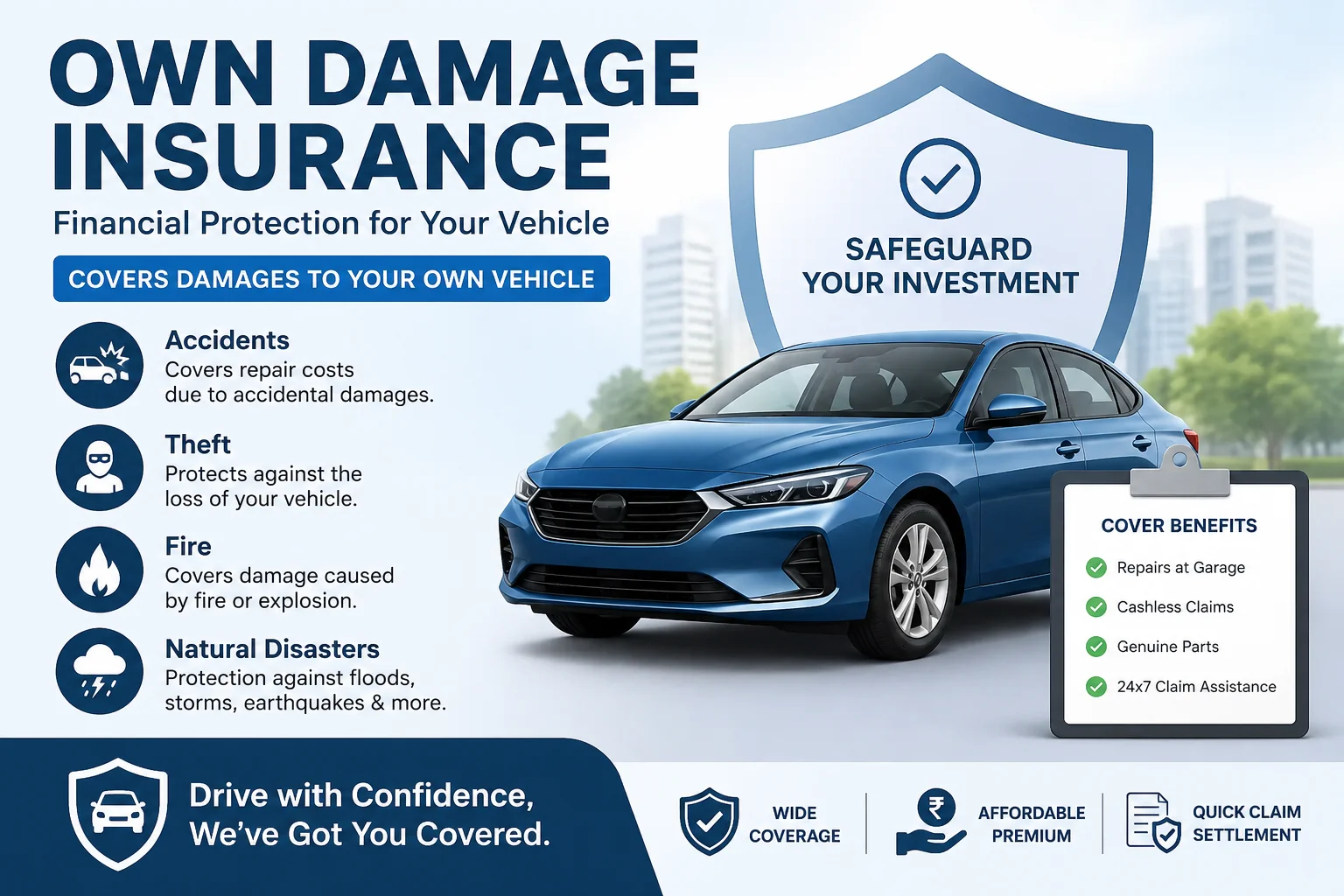
Own damage insurance for older cars still covers the scenarios that represent the largest potential financial exposure relative to the car's value. Theft — a car worth Rs 2.8 lakh can still be stolen, and without own damage coverage, the entire replacement cost is out of pocket. Flood damage — water damage can write off a car of any age, and the repair costs can exceed the car's market value. Accidents causing significant structural damage — a rear-end collision at highway speeds can total an older car, and without own damage coverage, the driver either absorbs the total loss or drives an unrepaired vehicle. These tail risks are what insurance is fundamentally designed for — and they do not disappear because the car is older.
The Depreciation Question for Older Cars
For older cars, the standard comprehensive policy's depreciation schedule has already applied significantly. A ten-year-old car has most components depreciated at 50 percent or more under IRDAI schedules. This means that in a claim involving part replacement, the insurer pays only the depreciated value of parts rather than their full replacement cost. For an older car where most parts are already heavily depreciated, the difference between the depreciated settlement and the full replacement cost is smaller than for a new car — which reduces the value of the zero depreciation add-on for older vehicles. The standard comprehensive policy without zero dep becomes relatively more cost-effective for older cars because the depreciation gap being avoided by zero dep is smaller.
When Third-Party Only Genuinely Makes Sense
Switching to third-party only insurance for an older car makes financial sense when the car's market value has declined to the point where the full own damage premium is difficult to justify against the possible recovery. Specifically: if the IDV has fallen below Rs 1 to 1.5 lakh, and the own damage premium for comprehensive coverage exceeds Rs 6,000 to Rs 8,000 per year, the own damage insurance may be covering a loss that would cost less to absorb directly. Additionally, for cars that are fully paid off (no outstanding loan requiring comprehensive coverage) and parked in secure, covered locations, the theft and environmental damage probability is lower. The combination of very low IDV, high own damage premium relative to IDV, and low environmental risk can make third-party only a rational choice.
The NCB Factor: Comprehensive Builds It, Third-Party Doesn't
An important dimension of the older car insurance decision is the NCB. The No Claim Bonus applies only to the own damage component of a comprehensive policy. A policyholder who switches to third-party only stops accumulating NCB. If the same policyholder later purchases a new car, they start the NCB from zero on the new vehicle's comprehensive policy rather than benefiting from years of accumulated NCB. For older car owners who anticipate buying a new car in the next few years, maintaining comprehensive coverage on the older car — even at declining IDV — keeps the NCB accumulation running rather than resetting it when the new car is purchased.
Practical Tips for Older Car Insurance
For cars in the five-to-ten-year range, several practical adjustments can reduce the comprehensive premium while maintaining adequate coverage. Remove the zero depreciation add-on if it is still being paid for a car over five years old — the premium saving is meaningful and the coverage benefit has declined. Take a moderate voluntary deductible, since the probability of filing small claims on an older car that might cost more in lost NCB is lower. Check whether the IDV can be reduced slightly to reflect the car's actual market value rather than the insurer's conservative estimate — a lower IDV means lower own damage premium. These adjustments maintain comprehensive coverage while optimising the premium for the older car's actual risk profile.
Conclusion
The decision between comprehensive and third-party only for an older car is a financial calculation, not a default choice in either direction. For most cars with IDVs above Rs 2 lakh where the own damage premium represents less than seven to eight percent of the vehicle value, comprehensive coverage continues to provide value against the tail risks of theft, flood damage, and total-loss accidents. The transition to third-party only becomes rational for very low-value cars where the IDV and premium relationship no longer favours the own damage premium. Understanding this calculation — rather than automatically continuing comprehensive or automatically switching to third-party because the car is old — produces the right decision for each specific vehicle and owner situation.