Sign up with Google
 Sign in with Zoho

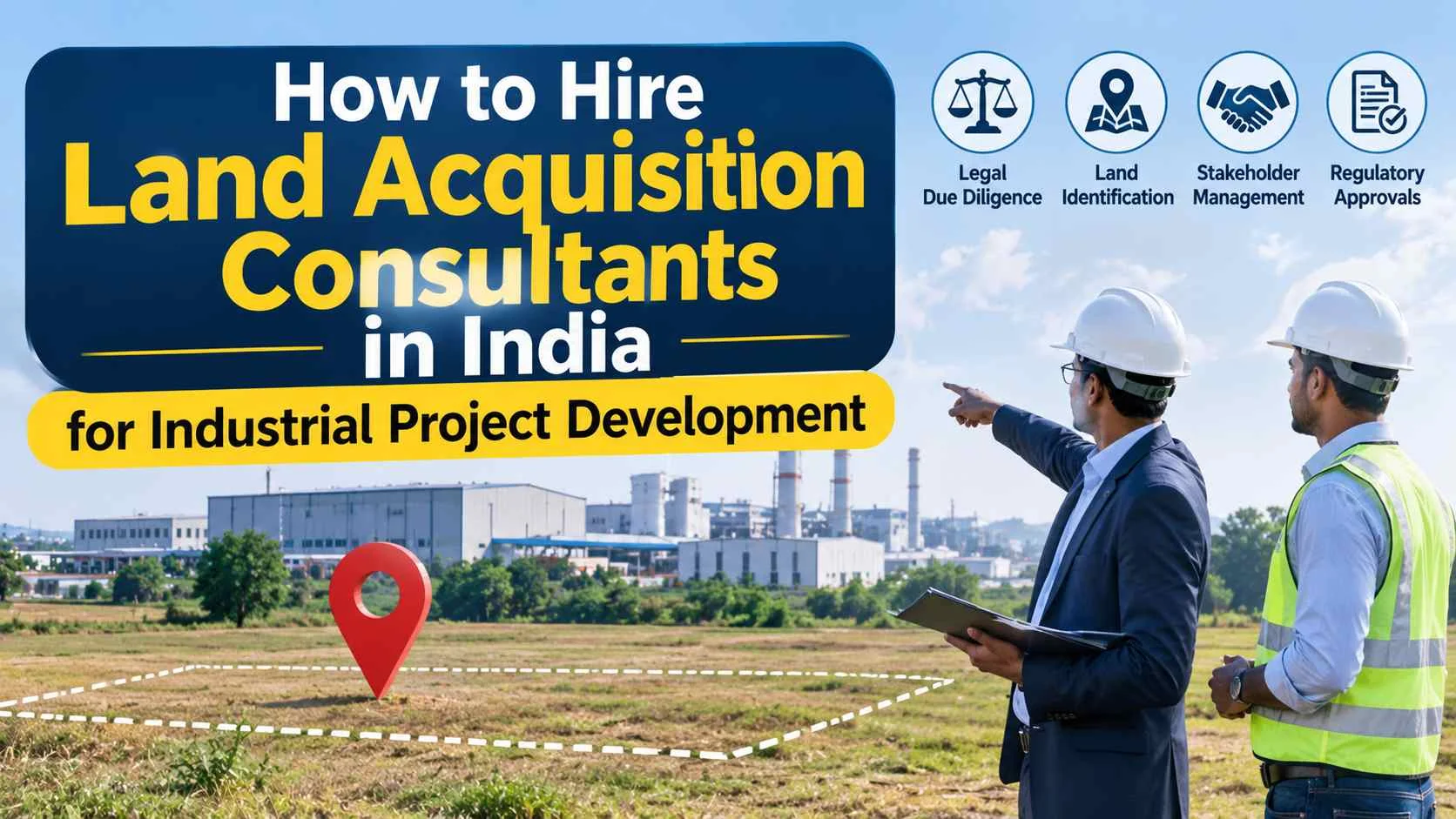
Land is the first asset an industrial project needs and often the first one to go wrong. A plot with a clouded title, the wrong zoning or an unworkable lease can stall financing, approvals and construction long before a machine is ordered.
Choosing the right partner early protects both budget and schedule. An experienced land acquisition consultanting in india verify title, tenure, zoning and statutory restrictions before capital is committed. This article explains what these consultants do, when to hire them, and how to evaluate a partner for an industrial project.
Why Is Land Acquisition the Biggest Early Risk in Industrial Projects?
Land risk is high because the supply is fragmented, the records are state-specific and the legal chain behind every plot is different. The latest government data shows how large and uneven the market is.
- India’s Industrial Land Bank mapped 4,523 industrial parks across 7.70 lakh hectares as of December 2025.
- Only 1.35 lakh hectares of that land is currently available for fresh allotment.
- The parks hold more than 6.45 lakh plots, and the platform lists 306 plug-and-play parks and 20 NICDC-led parks and smart cities.
- MoSPI’s April 2026 Flash Report tracks 1,981 central projects worth ₹42.78 lakh crore and reports a cost overrun of about ₹5.65 lakh crore. Land acquisition is among the reasons implementing agencies cite for delays, along with environmental clearances.
Available land exists, but only a fraction is suitable for a specific process, utility load and expansion plan. Matching a project to the right parcel takes verification, not just a site visit.
What Do Land Acquisition Consultants Do?
A land acquisition consultant manages the commercial, legal and technical steps between shortlisting a site and taking secure possession. The core scope covers:
- Route selection: comparing private purchase, private lease, state authority allotment, land pooling and acquisition under the RFCTLARR Act, 2013.
- Title and encumbrance diligence: reconciling registered deeds, revenue records, mutation entries and litigation searches.
- Zoning and land-use verification: confirming that the master plan, industrial-estate rules and conversion status permit the proposed activity.
- Statutory screening: checking forest, coastal, airport-height, highway-access, flood and environmental restrictions.
- Document review: reading allotment letters, lease deeds and agreements to sell against the project’s financing and expansion plans.
- Transaction support: coordinating stamp duty assessment, registration, mutation and possession handover.
- Stakeholder liaison: working with state industrial development authorities, revenue offices and lenders.
Which Land Acquisition Routes Are Available for Industrial Projects?
Each route has a different cost structure, timeline and risk profile. The right choice depends on plot size, location and project timeline.
- State authority allotment: MIDC, GIDC, SIPCOT, KIADB, UPSIDA, RIICO and similar agencies allot serviced plots. Terms on construction deadlines, mortgage rights and transfers vary by authority, so the executed documents must be read closely.
- Private freehold purchase: This gives ownership but needs full title diligence, conversion checks and correct stamp duty assessment.
- Private lease: This lowers upfront capital. Leases above one year generally need registration under Section 107 of the Transfer of Property Act, 1882, and lender acceptance depends on lease tenure and consent clauses.
- Land pooling or RFCTLARR acquisition: These suit large, multi-parcel footprints. Under the RFCTLARR Act, private projects require consent from 80% of affected families and public-private partnership projects require 70%. These routes involve social impact assessment and rehabilitation obligations, so timelines are longer.
- Plug-and-play parks: The central BHAVYA scheme has an outlay of about ₹33,660 crore for 100 industrial parks across 2026-27 to 2031-32. Parks need a minimum of 100 acres in non-hilly states and 25 acres in hilly states, northeastern states and Union Territories, and can go up to 1,000 acres. These parks will widen ready-to-use options over the coming years.
When Should an Investor Hire Land Acquisition Consultants?
The best time is before any token payment or agreement to sell. Bring consultants in when:
- The project needs a large contiguous parcel, usually 25 acres or more.
- The land is agricultural and needs conversion to industrial use.
- The site is in a state where the promoter has no prior experience.
- The plot comes through an authority allotment with construction or production deadlines.
- Lenders will take the land as security and need clean title and mortgage permissions.
- The land is government-assigned, ceiling-surplus, inam, waqf or tribal land, or has multiple co-owners.
- The project depends on state incentives linked to land cost, stamp duty or fixed capital investment.
Hiring after payment is far costlier. Defects found at that stage turn into disputes rather than negotiating points.
What Does a Strong Land Due Diligence Process Include?
A reliable process follows a fixed sequence, and each step should produce a written finding.
- Site shortlisting: screen parcels against process, utility, logistics and workforce needs.
- Title chain review: examine registered deeds, encumbrance records, revenue records and survey documents. The search period should reflect the property’s history and lender requirements, not a fixed assumption.
- Land-use and zoning check: confirm permitted use, ground coverage, setbacks and floor area ratio.
- Physical verification: run a DGPS boundary survey, check access, and review flood levels and drainage outfall.
- Geotechnical investigation: establish soil conditions and foundation design parameters from site-specific data.
- Tenure and covenant review: assess mortgage rights, transfer restrictions, resumption clauses and renewal terms.
- Cost modelling: include stamp duty, registration, conversion, development charges, rent or ground rent, and exit costs over a common evaluation period.
- Approval mapping: list registration, mutation, building plan, factory licensing, fire safety, and Consent to Establish and Consent to Operate from the State Pollution Control Board.
How Do Land Acquisition Consultants Reduce Project Cost and Delay?
Consultants reduce cost mainly by finding problems before money is committed.
- Avoided stranded assets: a plot that cannot be mortgaged or transferred can strand a fully engineered project.
- Correct duty assessment: stamp duty differs by state, instrument and concession, and under-assessment can bring additional duty, interest or penalties.
- Faster approvals: verified zoning and conversion status shortens the path to building plan sanction.
- Better financing outcomes: early lender feedback on tenure and consent avoids rework at financial close.
- Realistic incentive modelling: confirming whether land cost or duty qualifies for a state subsidy keeps the financial model credible.
- Lower idle-capital cost: interest on funds tied up during approvals is a real cost, and every month saved reduces it.
How to Choose the Right Land Acquisition Consultant in India
Evaluate consultants on capability, not on the promise of a quick deal. Use these criteria:
- Industrial focus: look for experience with factories, parks and manufacturing clusters, not only residential or commercial property.
- Multi-state knowledge: each state has its own land regime, duty schedule and allotment policy.
- Integrated legal and technical capability: title review should sit alongside survey, geotechnical and utility assessment.
- Written deliverables: ask for a diligence report, risk register and covenant summary, not verbal assurances.
- Lender awareness: the consultant should understand mortgage, consent and tripartite agreement requirements.
- Transparent scope: the engagement should state what is verified, what is assumed and what needs independent legal opinion.
- Post-acquisition support: registration, mutation and handover should be part of the plan.
How Can IMARC Engineering’s Expertise Help?
IMARC Engineering is an EPCM advisory firm based in Noida that supports industrial projects from concept to commissioning. That engineering background shapes how land is assessed, because a plot is judged against what will be built on it.
- Process-linked site screening: land needs are set from a concept layout, built-up area, storage, utilities, fire access and expansion allowance.
- Joined-up diligence: title, zoning and tenure review runs alongside survey, soil and utility readiness checks.
- Covenant-to-finance mapping: allotment and lease clauses are read against the sponsor’s debt structure and exit plan.
- Cost and incentive modelling: total occupation cost is compared across freehold, lease and allotment using verified quotations.
- Execution continuity: findings flow into greenfield project management, approvals and construction planning, so land decisions do not conflict with engineering needs.
For promoters planning a new facility, the practical next step is a scoping discussion with IMARC Engineering to compare land options and map due diligence before any commitment.
Conclusion
India has a large industrial land base, but the parcels that suit a given project are limited. Land risk sits in the paperwork, the tenure terms and the site conditions, and these are easiest to fix before payment. Hiring specialists early gives promoters verified title, a clear route, a realistic cost model and a bankable tenure.







 🌎🔒#gdupco.webp)