Sign up with Google
 Sign in with Zoho

A quality management system is only as reliable as the people checking whether it's actually working. That's the role internal auditors play within an ISO 9001 framework, and its why ISO 9001 internal auditor training has become an essential part of how organizations maintain their certification, not just earn it. For quality managers, operations lead, and anyone stepping into an internal audit role for the first time, understanding what this training covers, and why it matters, makes the difference between checking a box and genuinely strengthening how the business runs.
This article breaks down what internal auditor training involves, who typically takes it, and how the skills learned apply well beyond a single audit cycle.
What Internal Auditing Actually Means Within ISO 9001
Internal audits are systematic, planned reviews conducted by an organization's own personnel to determine whether its quality management system conforms to the requirements of ISO 9001, and whether it's being implemented and maintained effectively. Unlike an external assessment, internal audits are entirely within the organization's control, scheduled on its own terms, and used as a diagnostic tool rather than a formal certification event.
The purpose isn't to catch people doing something wrong. It's to identify where processes are drifting from what's documented, where documentation itself may be outdated, and where opportunities for improvement exist before those gaps become larger problems. A well-run internal audit program acts as an early warning system for the entire quality management system.
Why Training Matters Before Someone Conducts an Audit
Auditing is a distinct skill set, separate from simply knowing how a department operates. Someone can understand a process inside and out and still lack the objectivity, questioning technique, or evidence-gathering discipline needed to audit it effectively. ISO 9001 internal auditor training exists to close that gap.
Untrained auditors tend to make predictable mistakes: asking leading questions that prompt the answer they expect to hear, focusing on minor procedural details while missing systemic issues, or documenting findings so vaguely that corrective action becomes difficult to track. Training addresses these tendencies directly, teaching auditors how to gather objective evidence, ask open-ended questions, and report findings in a way that's genuinely useful to the people who have to act on them.
What This Training Typically Covers
Understanding the Standard Itself
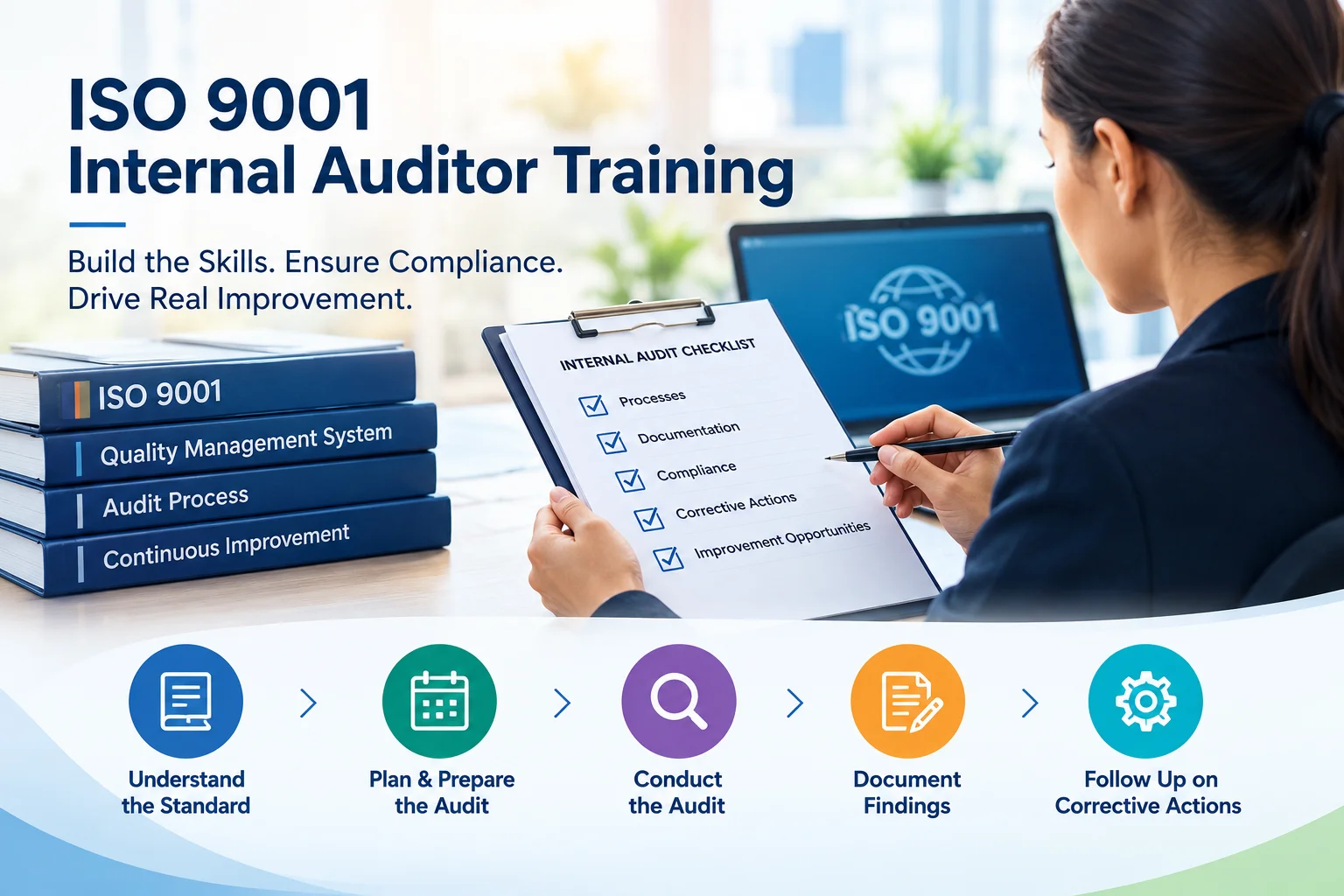
Before anyone can audit against ISO 9001, they need a solid working knowledge of what the standard actually requires. Training typically walks through the structure of the standard clause by clause, explaining not just what each requirement says, but what evidence would demonstrate that an organization is meeting it in practice.
Audit Planning and Preparation
Effective audits don't happen spontaneously. Training covers how to plan an audit: defining scope, reviewing relevant documentation beforehand, preparing a checklist or set of questions tailored to the process being audited, and scheduling in a way that minimizes disruption to daily operations.
Conducting the Audit
This is often the most practical part of the training, covering interview techniques, how to trace a process from start to finish, how to sample records effectively, and how to remain objective even when auditing a team or process the auditor is personally familiar with.
Documenting Findings
Auditors learn how to write findings that are specific, evidence-based, and actionable. A finding like "documentation was incomplete" is far less useful than one that identifies exactly which record was missing, why it matters, and what requirement it relates to.
Following Up on Corrective Actions
Training also typically covers what happens after the audit report is delivered: how findings translate into corrective actions, how those actions get tracked, and how auditors verify that a corrective action actually resolved the underlying issue rather than just addressing a symptom.
Who Typically Takes This Training
Internal auditor training is relevant to a broader group of people than many organizations initially expect. Quality managers are the obvious candidates, but department heads, operations staff, and even employees outside the quality function often benefit from learning to audit, since it deepens their understanding of how their own processes fit into the larger system.
Some organizations deliberately rotate internal audit responsibilities across different employees rather than concentrating the role in one person. This spreads audit knowledge more widely across the organization and reduces the risk of blind spots that can develop when the same person always reviews the same processes.
Building Objectivity into the Audit Process
One of the trickier aspects of internal auditing is maintaining objectivity when auditing your own organization. Trained auditors learn specific techniques to manage this, such as avoiding audits of their own direct work area, focusing questions on evidence rather than opinion, and separating the observation of a fact from any judgment about whether it's good or bad.
This distinction matters because the value of an audit comes from accurate observation, not from confirming what everyone already assumed. An auditor who walks in expecting to find a specific problem is far more likely to miss issues elsewhere, or to interpret ambiguous evidence in a way that fits a preconceived conclusion.
How Internal Audits Feed the Larger Quality System
Internal audit findings don't exist in isolation. They feed directly into management review, corrective action processes, and the continual improvement expected under ISO 9001. A pattern of similar findings across multiple audits, for example, often points to a systemic issue rather than an isolated mistake, and that pattern is only visible when audits are conducted consistently and documented clearly.
This is part of why organizations invest in iso 9001 internal auditor training rather than relying on informal reviews. A trained auditor produces findings that are consistent, comparable across audit cycles, and genuinely useful for identifying trends that a single audit wouldn't reveal on its own.
Common Misconceptions About Internal Auditing
A common misconception is that internal audits exist mainly to prepare for external assessments. While a well-maintained internal audit program certainly makes external assessments smoother, treating internal audits purely as rehearsal misses their actual value. Internal audits are a management tool first, meant to keep the quality system honest between external reviews, not just before them.
Another misconception is that auditing requires an adversarial mind-set. In practice, the most effective internal auditors approach the process collaboratively, working with process owners to understand why something happens the way it does before determining whether it aligns with documented requirements. Audits that feel like an interrogation tend to produce defensive answers rather than accurate ones.
Skills That Extend Beyond the Audit Itself
The skills developed through internal auditor training tend to carry over into other parts of an employee's role. Learning to ask precise, open-ended questions improves how someone gathers information generally. Learning to trace a process from input to output builds a sharper understanding of operational dependencies. Learning to document findings clearly improves reporting and communication skills more broadly.
Because of this, many organizations view internal auditor training as a professional development opportunity, not just a compliance requirement. Employees who go through it often come away with a more analytical, systems-level view of how the organization functions, which tends to be useful well beyond the audit program itself.
Keeping Internal Audit Skills Current
Like most skills, auditing ability tends to fade without practice. Organizations that treat internal auditor training as a one-time event often find that audit quality declines over time, as auditors fall back into more casual, less structured habits. Periodic refreshers, calibration exercises where multiple auditors review the same process and compare findings, and mentoring newer auditors all help keep audit quality consistent.
A strong internal audit program isn't built in a single training session. It's built through repetition, feedback, and a genuine organizational commitment to using audit findings as a tool for improvement rather than a formality to get through before the next external review.
How Internal Auditor Training Differs from Broader Auditor Certifications
It's worth distinguishing internal auditor training from other, more advanced audit-related roles within the ISO 9001 ecosystem. Internal auditor training is generally scoped to equip someone to audit within their own organization, using the organization's own documented processes as the reference point.
Other roles go further, covering how to lead audit teams, manage more complex audit programs, or evaluate organizations from an external, independent standpoint. Internal auditor training is intentionally more focused, which makes it accessible to a wider range of employees who need practical audit skills without requiring the depth of a more advanced program. Understanding this distinction helps organizations choose the right level of training for the right role, rather than over-investing in advanced content for staff who only need to audit internally.
What to Look for in a Training Program?
Not all internal auditor training is structured the same way, and the format that works best often depends on how the organization plans to use it. Some programs are delivered as instructor-led sessions, allowing participants to ask questions and work through practical exercises in real time. Others are self-paced, which can suit organizations training multiple people across different schedules or locations.
Regardless of format, effective training tends to include practical exercises, not just a review of the standard's clauses. Mock audits, sample documentation review, and exercises in writing findings give participants a chance to practice the skill before applying it in a live audit. Training that stays purely theoretical often leaves participants familiar with the concepts but underprepared for the actual mechanics of conducting an audit.
Frequently Asked Questions About Internal Auditor Training
Does Everyone in the Organization Need This Training?
No. Typically, a smaller group of employees, often spanning multiple departments, is trained to conduct audits, rather than the entire workforce. What matters is having enough trained auditors to cover the organization's audit schedule without overburdening any single person, while also maintaining enough independence so auditors aren't reviewing their own direct work.
Can Someone Audit Their Own Department?
Generally, this is avoided wherever possible, since it undermines the objectivity that makes an audit useful. Many organizations address this by cross-training auditors across departments, so a person from one team can objectively audit a different team's processes.
How Often Should Internal Audits Happen?
This depends on the size and complexity of the organization, as well as which processes are being reviewed. Higher-risk or more complex processes are often audited more frequently, while stable, lower-risk processes might be reviewed less often. The key principle is that the full quality management system gets audited across a defined cycle, rather than certain areas being consistently overlooked.
Making Internal Audits a Genuine Asset
Organizations that get the most value from their internal audit program tend to share a few habits. They train auditors properly rather than assuming process knowledge is enough. They rotate audit assignments to build broader organizational awareness. They treat findings as opportunities rather than criticisms, and they follow through on corrective actions instead of letting them sit unresolved.