Sign up with Google
 Sign in with Zoho

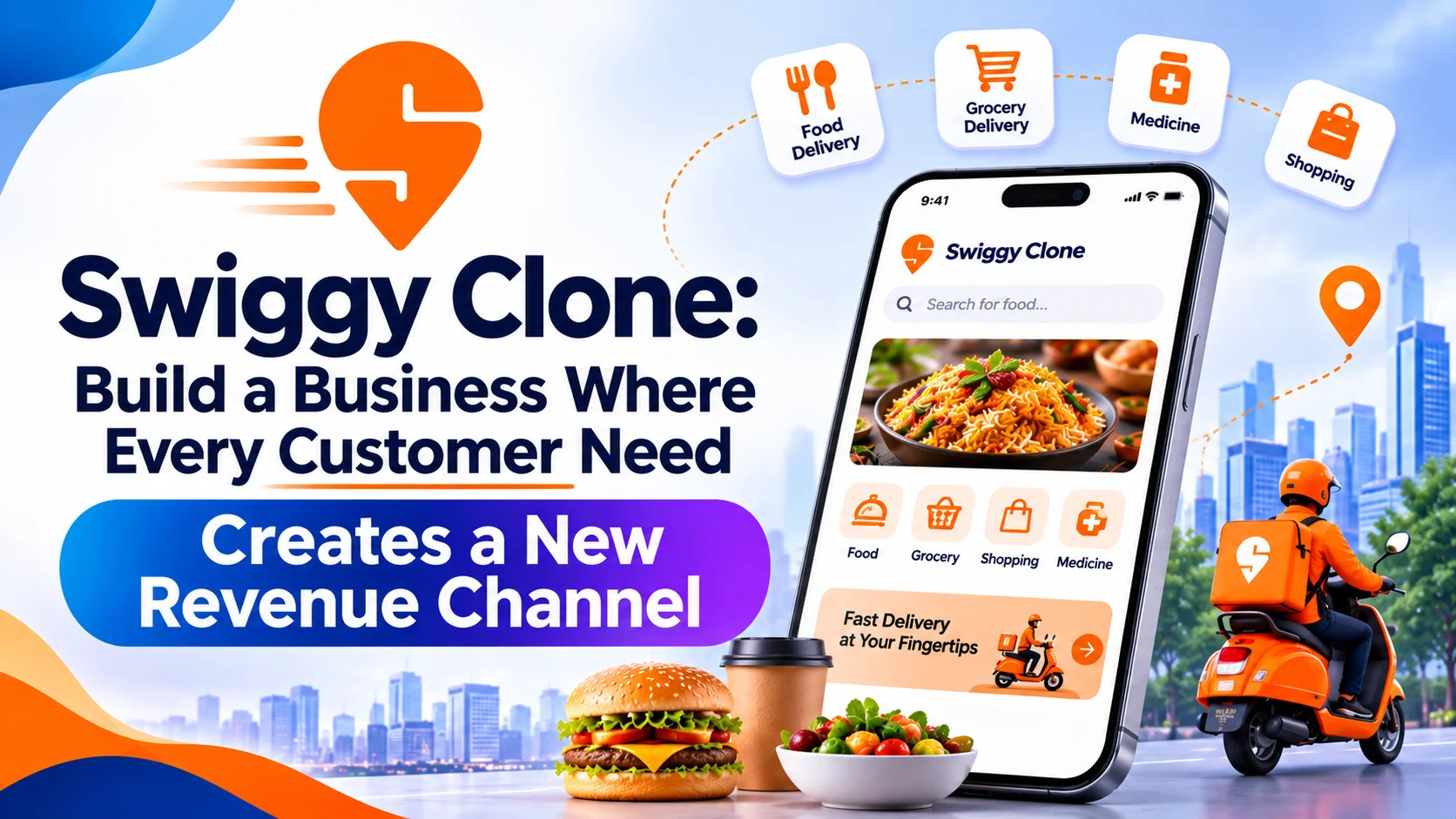
The next successful food delivery business may not be built around food alone. Consumers increasingly expect digital platforms to simplify several everyday activities through a single interface. Ordering lunch, purchasing groceries, discovering restaurants, and arranging quick deliveries represent different customer requirements, but they share one important characteristic: convenience drives the decision.
This creates an interesting business model for entrepreneurs exploring a Swiggy Clone. Instead of developing another restaurant-ordering application, founders can build a multi-service commerce platform that connects food businesses, retail merchants, delivery partners, and consumers within one digital ecosystem.
The real differentiator is not the number of services available. It is how effectively those services work together to increase customer engagement, transaction frequency, and revenue potential.
The Business Model: One Customer Base, Multiple Purchase Missions
Traditional food delivery platforms primarily depend on restaurant orders. Their revenue opportunities are closely connected to how frequently customers purchase meals through the application. However, a multi-service model approaches customer demand differently.
Consider a working professional who orders lunch through an application. The same customer may need groceries after work, household essentials during the weekend, or a restaurant reservation for a special occasion. Each requirement represents a separate transaction, but the platform can serve all of them through one customer relationship.
A Swiggy-inspired business model brings these purchase journeys together.
For entrepreneurs, this creates three strategic advantages:
- Higher customer engagement: Customers have more reasons to return beyond ordering meals.
- Multiple transaction opportunities: Revenue can come from different service categories.
- Shared customer acquisition: Businesses can introduce additional services to an existing user base rather than acquiring every customer from the beginning.
The objective is to make the platform useful across different moments of a customer's day.
Beyond Restaurant Delivery: Three Connected Business Engines
A differentiated Swiggy Clone can be structured around three complementary business engines.
1. Food Marketplace: The Customer Acquisition Engine
Restaurant delivery can serve as the foundation of the platform. It connects customers with restaurants, cloud kitchens, independent food businesses, and established restaurant chains.
However, the business should not focus exclusively on popular restaurants. Regional food specialists, healthy meal providers, office lunch services, late-night kitchens, and local favourites can help attract specific customer groups.
For platform owners, this creates room to develop a differentiated restaurant network instead of competing only through discounts and delivery speed.
Revenue opportunities can include restaurant commissions, promotional placements, advertising packages, and customer-side delivery or service fees.
2. Quick Commerce: Turning Occasional Visits into Frequent Transactions
Food orders are only one part of everyday consumer demand. Grocery shopping, personal care products, packaged foods, and household essentials create additional purchase occasions.
Integrating a quick-commerce marketplace allows the platform to connect customers with grocery stores, supermarkets, local retailers, and fulfilment partners.
The operational approach can vary depending on the business's resources. Entrepreneurs may begin with existing retail partners and expand towards dedicated fulfilment locations when order density supports the investment.
This distinction matters because quick commerce requires more than an additional product category. Inventory availability, picking operations, delivery distance, and order fulfilment costs must work together.
A Swiggy Clone that supports both restaurant ordering and grocery commerce can serve different customer requirements without treating them as completely separate businesses.
3. Out-of-Home Services: Extending the Customer Relationship
A customer does not always want a meal delivered. Sometimes the requirement is to discover a restaurant, reserve a table, explore dining deals, or book a local experience.
Adding restaurant discovery, table reservations, and dining-related services expands the platform beyond doorstep delivery.
This creates another customer interaction channel and gives restaurant partners more ways to reach potential customers.
For entrepreneurs, the strategic benefit is important: the platform can participate in both at-home consumption and out-of-home dining instead of depending entirely on delivery transactions.
The Hidden Advantage: Shared Infrastructure Across Services
The most interesting part of this business model is the infrastructure behind the customer experience.
A multi-service platform should not operate every category as an isolated application. It should use shared technology wherever practical while allowing individual services to maintain their own operational requirements.
For example, customer accounts, payment integrations, location services, notifications, analytics, promotional tools, and customer support can operate across multiple categories.
However, restaurant delivery and grocery fulfilment need different workflows. Restaurant orders depend on preparation time and kitchen coordination, whereas grocery orders require product availability, inventory updates, and picking operations.
The delivery network also needs intelligent allocation. Assigning orders based only on proximity may not be sufficient when delivery time, order type, partner availability, and route efficiency are involved.
This is where a well-designed Swiggy Clone can create business value through:
- Separate merchant and restaurant management panels.
- Real-time order assignment and delivery tracking.
- Inventory and catalogue management for retail partners.
- Route planning and delivery partner coordination.
- Centralised administration with category-level reporting.
- Customer analytics and personalised service recommendations.
The objective is to create a connected technology foundation without forcing every business category into the same operational process.
Where Entrepreneurs Can Find Their Market Position
Copying an established platform's entire service portfolio is not necessarily the right starting point. A more practical strategy is to identify a specific consumer behaviour or underserved market.
A business could begin with regional food delivery and later introduce grocery partnerships. Another could focus on office districts, combining scheduled meal orders with workplace essentials. A city-level operator might connect independent restaurants and neighbourhood retailers through one marketplace.
These approaches allow founders to test demand before committing to expensive infrastructure.
The most important decisions include selecting the initial service category, identifying reliable merchant partners, understanding delivery economics, and establishing sufficient order density in a defined geographical area.
Building the Platform Around a Bigger Business Vision
A Swiggy Clone app gives entrepreneurs a technology foundation for developing a connected food and convenience marketplace. With spotneats, businesses can explore a branded platform supported by customer-facing applications, merchant management, delivery operations, and administrative controls.
The long-term potential lies in building a business that understands multiple customer purchase missions rather than depending on a single transaction category.
For founders entering competitive delivery markets, the question is no longer simply how to attract more food orders. It is how to make one platform relevant to more everyday needs while maintaining sustainable operations.