Sign up with Google
 Sign in with Zoho
Industrial manufacturing depends heavily on reliable heating technologies to process metals efficiently. Traditional heating systems such as gas furnaces and flame heating have long been used in manufacturing operations, but they often lack precision, consume high energy, and require longer processing times.
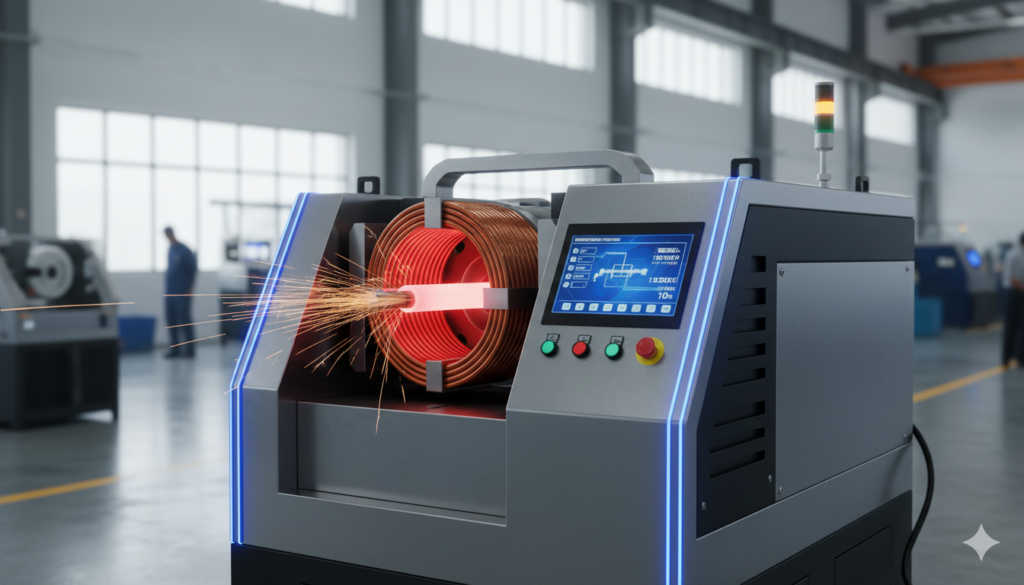
An induction heating machine has transformed industrial heating by providing a faster, cleaner, and more controlled method of heating metals. By using electromagnetic induction, these machines generate heat directly within the metal component, allowing industries to achieve accurate temperature control and high production efficiency.
Today, induction heating machines are widely used across multiple industries including automotive manufacturing, forging, aerospace engineering, heavy machinery, and power generation. Their versatility and efficiency make them one of the most important technologies in modern metal processing.
What is an Induction Heating Machine?
An induction heating machine is an advanced industrial system designed to heat electrically conductive metals using electromagnetic fields. When alternating current flows through an induction coil, it generates a magnetic field that induces electrical currents in the metal workpiece.
These currents produce heat due to the electrical resistance of the material. Since heat is generated inside the metal rather than transferred from an external source, the heating process becomes faster and more energy efficient.
This technology enables precise temperature control and uniform heating, making it suitable for a wide variety of industrial applications.
Automotive Industry Applications
The automotive industry is one of the largest users of induction heating technology. Many vehicle components require precise heating for processes such as hardening, brazing, and shrink fitting.
Induction heating machines are commonly used to process automotive components such as:
- Transmission gears
- Camshafts
- Crankshafts
- Axles
- Steering parts
These components require strong surface hardness and high durability to withstand mechanical stress and friction during operation. Induction heating ensures that the required hardness and metallurgical properties are achieved consistently.
Forging Industry Applications
Forging industries rely heavily on induction heating machines to heat metal billets before shaping them into components. Traditional furnace heating can take a long time and often results in uneven temperature distribution.
Induction heating systems provide rapid and uniform heating of billets, allowing forging operations to run more efficiently. The quick heating cycle reduces production time and improves throughput in manufacturing plants.
Additionally, precise temperature control ensures that the metal reaches the optimal forging temperature, improving the quality of forged products.
Aerospace Industry Applications
The aerospace industry requires extremely high standards of quality and reliability for its components. Many aircraft parts must withstand extreme temperatures, pressure, and mechanical loads.
Induction heating machines are used in aerospace manufacturing for processes such as:
- Brazing turbine components
- Heat treatment of high-strength alloys
- Hardening of precision mechanical parts
Because induction heating provides controlled and localized heating, it helps maintain the structural integrity and performance of aerospace components.
Heavy Engineering and Machinery
Heavy engineering industries manufacture large machines and equipment used in construction, mining, power generation, and industrial production. These machines include components that must operate under heavy loads and continuous stress.
Induction heating machines are widely used for heat treatment processes such as induction hardening of shafts, rollers, and gears. Hardened surfaces improve wear resistance and extend the lifespan of heavy machinery components.
This ensures reliable performance and reduces maintenance requirements for industrial equipment.
Brazing Applications in Manufacturing
Brazing is another important industrial process where induction heating machines play a significant role. Brazing involves joining two metal components using a filler metal that melts at a lower temperature than the base metals.
Induction heating provides accurate and localized heating for brazing operations, ensuring strong and clean joints without overheating surrounding areas.
This method is commonly used in the manufacturing of:
- Electrical components
- Copper tubes and fittings
- Cutting tools
- Industrial assemblies
The precise heating capability of induction systems improves joint strength and manufacturing quality.
Shrink Fitting Applications
Shrink fitting is a mechanical assembly process where a metal component is heated to expand its size before fitting it onto another component. When the heated part cools down, it contracts and creates a tight mechanical bond.
Induction heating machines are widely used for shrink fitting because they provide controlled heating without damaging surrounding components.
This method is commonly applied in assembling gears, bearings, and mechanical couplings used in industrial equipment.
Induction Heating in Pipe and Tube Manufacturing
The pipe and tube manufacturing industry also uses induction heating machines for several production processes.
Induction systems are used to heat metal pipes and tubes for operations such as bending, welding, and annealing. Uniform heating ensures smooth processing and prevents structural damage during manufacturing.
Because induction heating systems can be integrated into automated production lines, they significantly improve efficiency in pipe manufacturing plants.
Energy Efficiency Benefits
One of the most important advantages of induction heating machines is their energy efficiency. Traditional heating methods often waste energy by heating the surrounding environment along with the metal.
Induction heating generates heat directly inside the metal workpiece, which reduces energy loss and improves efficiency.
This targeted heating approach allows manufacturers to reduce electricity consumption while maintaining high production output. As industries focus on sustainability and cost reduction, induction heating technology continues to gain popularity.
Automation and Smart Manufacturing
Modern induction heating machines are designed to integrate with automated production systems. Many machines include programmable control systems that allow operators to set precise heating parameters.
Automated systems can monitor temperature, power input, and heating cycles to ensure consistent results. Integration with robotics and automated handling systems further improves production speed and reliability.
This makes induction heating technology an important component of smart manufacturing and Industry 4.0 initiatives.
Future of Induction Heating Machines
As manufacturing industries evolve, the demand for advanced heating technologies continues to grow. Induction heating machines are expected to become even more efficient with improvements in power electronics, digital controls, and automation.
New developments in induction coil design and high-frequency power systems are enabling faster heating and improved process control. These innovations will further enhance the performance and versatility of induction heating systems in industrial applications.
Conclusion
Induction heating machines have become an essential technology in modern industrial manufacturing. Their ability to provide rapid heating, precise temperature control, and energy-efficient operation makes them ideal for a wide range of metal processing applications.
From automotive and aerospace manufacturing to forging and heavy engineering, induction heating machines help industries improve productivity, reduce energy consumption, and achieve superior metallurgical quality.
As industries continue to adopt automation and sustainable manufacturing practices, induction heating technology will remain a key driver of efficiency and innovation in metal processing.