Sign up with Google
 Sign in with Zoho

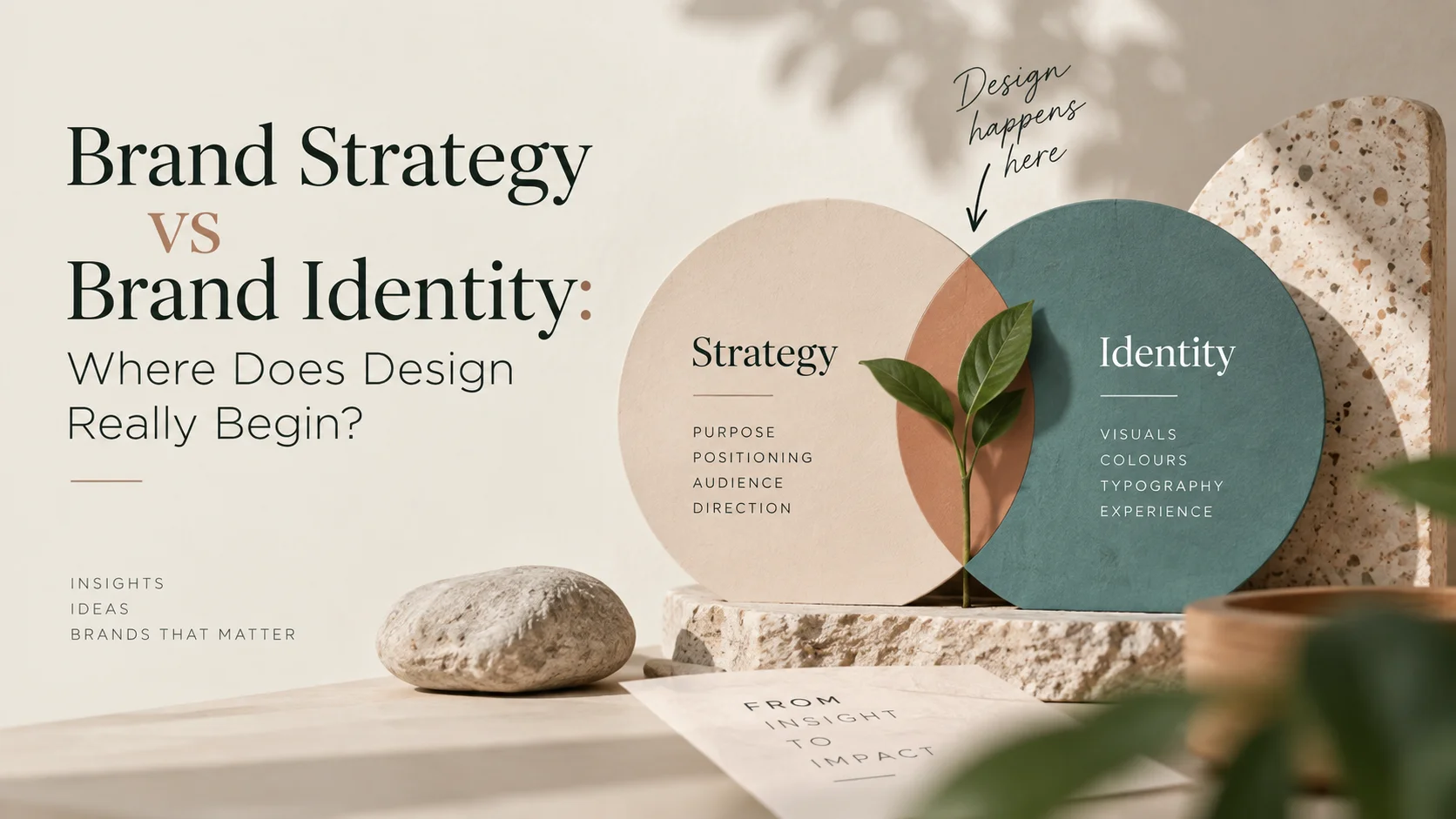
Ask ten founders where their brand "began," and most will point to a logo. A color palette. A font pairing that finally felt right. It's an understandable instinct — identity is the part of a brand you can see, share, and put on a business card. But it's also where a lot of brands quietly go wrong.
Because design doesn't actually begin with identity. It begins with strategy.
Two Different Questions
Brand strategy and brand identity answer two very different questions, and confusing them is one of the most common (and expensive) mistakes companies make.
Brand strategy asks: Who are we? Who are we for? What do we stand for, and why should anyone care? It's the thinking layer — positioning, values, voice, audience, differentiation. It's invisible in the final product, but it's the reason the final product makes sense.
Brand identity asks: How do we look, sound, and feel? It's the expression layer — the logo, the color system, typography, imagery, tone of voice in copy. It's what people actually see and remember.
Identity without strategy is decoration. Strategy without identity is invisible. You need both — but the order matters more than people think.
Why Design Can't Start With a Logo
Imagine hiring a graphic designer and the first question they ask is "what colors do you like?" It feels productive. It isn't.
Without strategy, that designer is guessing at:
- Who the brand needs to attract
- What impression it needs to leave
- What makes it different from the five competitors doing the exact same thing
- What tone builds trust with that specific audience
A logo built on preference instead of purpose might look good and still fail completely — because it's not actually saying anything. It's just aesthetics floating with no anchor.
This is why rebrands so often fall flat: a company swaps its visuals but keeps the same confused positioning underneath. New coat of paint, same identity crisis.
What Strategy Actually Gives Design to Work With
A solid brand strategy hands the design team a brief, not a blank page. It defines things like:
- Positioning — where you sit in the market and against whom
- Audience — who you're actually designing for, not everyone
- Personality — is the brand bold, calm, playful, authoritative?
- Values and mission — what the brand believes and won't compromise on
- Messaging pillars — the core ideas the brand keeps returning to
With that in hand, design stops being subjective. A designer isn't asking "do I like this blue?" They're asking "does this blue feel like the confident, no-nonsense brand we defined?" Suddenly there's a right answer, or at least a defensible one.
Identity Is Strategy, Translated
Once strategy is set, identity's job is translation — turning ideas into something sensory. A brand that's positioned as "the trustworthy expert" might land on a serif typeface, muted tones, and measured copy. A brand positioned as "the energetic disruptor" might reach for bold color, sharp angles, and punchy language.
Same process, wildly different output — because the strategy underneath was different. That's the whole point. Good identity isn't about what looks trendy; it's about what looks true to the thing you decided to be.
So Where Does Design Really Begin?
Not with a mood board. Not with a font. It begins with clarity — knowing who you are before you decide how to look like it.
If you're starting a brand (or fixing one that feels "off" despite a nice logo), start with the questions design can't answer on its own: Who are we? Who is this for? What do we want people to feel? Get that right, and the visuals almost design themselves.