Sign up with Google
 Sign in with Zoho


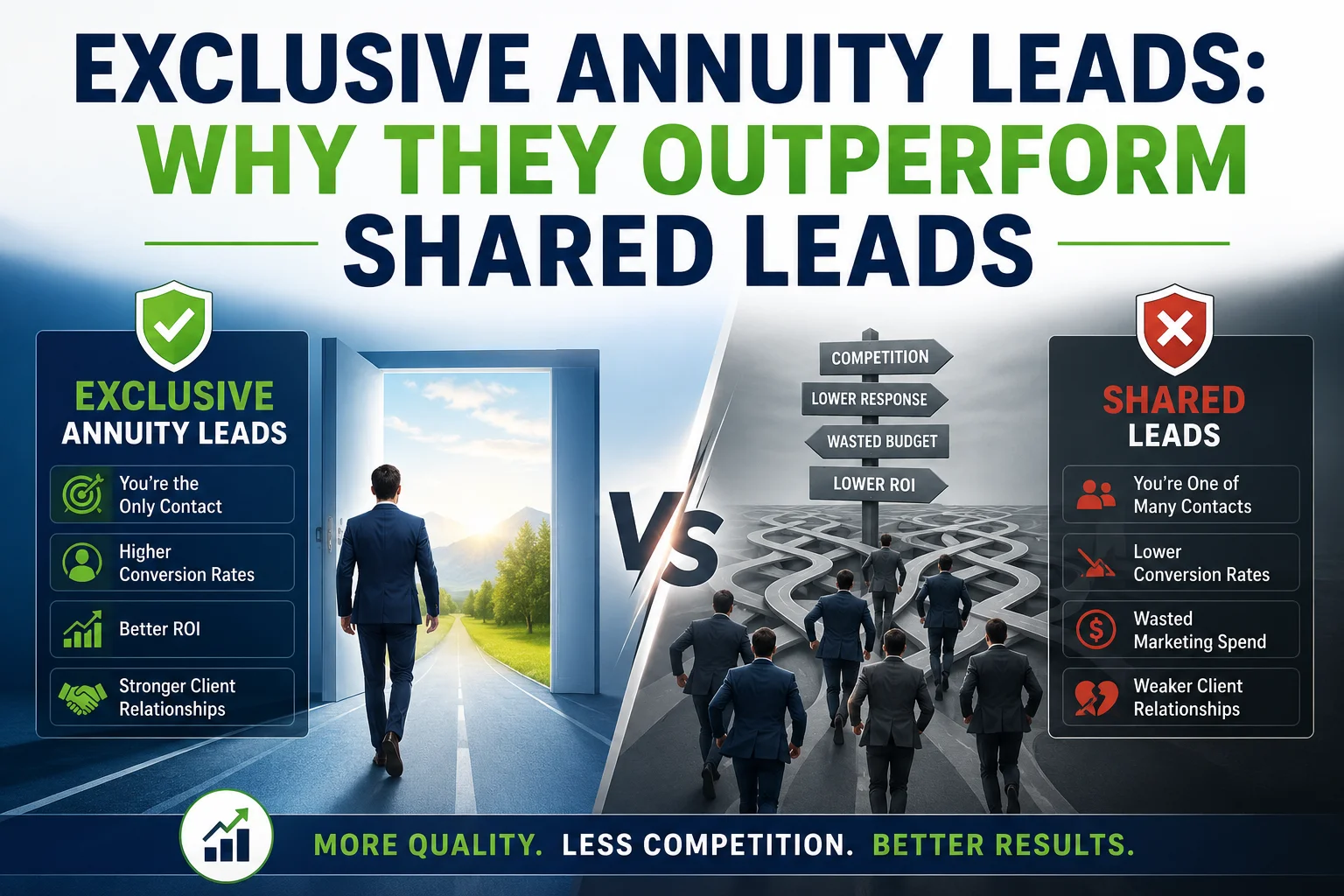
Exclusive annuity leads are prospects sold to only one agent, rather than distributed to three, four, or more competing agents at the same time. Because there's no race to be the first — or fifth — call the prospect receives, exclusive leads typically produce higher contact rates, better conversion, and a stronger overall return on investment, despite costing more upfront than shared leads.
This article covers what makes a lead "exclusive," how it compares to shared leads, realistic pricing, and how to tell if an exclusive lead source is legitimate before you commit ad spend.
What Does "Exclusive" Actually Mean?
In the lead generation industry, "exclusive" should mean the prospect's contact information is sold once — to you — and not resold to any other agent, agency, or call center. In practice, quality varies a lot between providers, so it's worth confirming:
- Is the lead sold exclusively at the point of capture, or only exclusively resold going forward (meaning it may have already gone to someone else first)?
- Does the provider guarantee exclusivity in writing, with a replacement policy if it turns out otherwise?
- Is the exclusivity tied to a time window (e.g., exclusive for 30 days, then resold)?
Genuine exclusivity means you are the only agent that prospect will hear from — full stop.
Exclusive vs. Shared Annuity Leads
With shared leads, five agents might call the same prospect within an hour, and the prospect quickly becomes annoyed, unresponsive, or simply picks whichever agent called first — regardless of who's the best fit. Exclusive leads remove that dynamic entirely.
Why Exclusive Leads Often Have a Better ROI
Even though the sticker price per lead is higher, the calculation that matters is cost per sale, not cost per lead:
- Fewer wasted dials on prospects who already committed to a competing agent
- Longer, higher-quality conversations since the prospect isn't fielding five sales pitches back to back
- Stronger trust — prospects don't feel "sold to" by a crowd of unfamiliar callers
- Better data hygiene, since exclusive providers tend to invest more in verifying contact info upfront
Agents who track their numbers carefully often find that exclusive leads, despite a 2–3x higher upfront cost, produce a lower overall cost per closed policy.
How to Vet an Exclusive Annuity Lead Provider
- Ask for a written exclusivity guarantee — not just a sales claim
- Check the lead source — direct mail, paid search, or co-registration form? More transparency generally means more trustworthy exclusivity
- Confirm compliance — TCPA consent, opt-in timestamps, and DNC scrubbing
- Request a small test batch before committing to a large volume order
- Look for replacement or refund policies on bad numbers, disconnected lines, or duplicate submissions
Who Should Buy Exclusive Annuity Leads?
- Established agents with a proven close ratio who want to maximize return on a limited monthly ad budget
- Agents in competitive markets where shared leads get called by 4+ competitors within the hour
- Teams focused on higher-ticket annuity products (like indexed annuities with larger premium sizes), where a single closed sale justifies a higher lead cost
Newer agents on a tight budget sometimes start with shared leads to build volume and script confidence, then transition to exclusive leads once their close ratio is strong enough to justify the higher spend.
FAQs
What makes an annuity lead "exclusive"? An exclusive lead is sold to only one agent rather than distributed to multiple competing agents. The prospect should only be contacted by you, not by several agents at once.
Are exclusive annuity leads worth the extra cost? For most established agents, yes. While the per-lead price is higher, exclusive leads typically produce better contact and close rates, often resulting in a lower overall cost per sale.
How can I confirm a lead is truly exclusive? Ask the provider for a written exclusivity guarantee, request details about the lead source, and consider a small test batch before scaling up your order.
Do exclusive leads still require compliance checks? Yes. Regardless of exclusivity, agents should confirm the provider follows TCPA consent rules, documents opt-ins, and scrubs contacts against Do Not Call lists.
Should new agents start with exclusive or shared leads? It depends on budget. Many new agents start with lower-cost shared leads to build volume and refine their pitch, then shift to exclusive leads once their close ratio justifies the higher cost per lead.
Conclusion
Exclusive annuity leads cost more upfront, but for agents with a solid sales process, they typically deliver a stronger return by eliminating competition for the same prospect. The key is working with a provider that offers a genuine, verifiable exclusivity guarantee and clean compliance practices — not just a marketing label. When evaluated by cost-per-sale rather than cost-per-lead, exclusive leads are often the smarter long-term investment for agents serious about scaling their annuity business.