 Sign up with Google
 Sign in with Zoho

If you’ve been keeping an eye on raw material invoices lately, you’ve probably noticed that the global plastics market is pulling in two completely different directions. Over in Asia, skyrocketing monomer costs sparked an immediate wave of post-holiday price hikes, leaving buyers scrambling. Meanwhile, across North America and Western Europe, factory managers effectively hit the brakes, forcing monthly contract negotiations into a near-total standstill despite rising energy and feedstock costs.
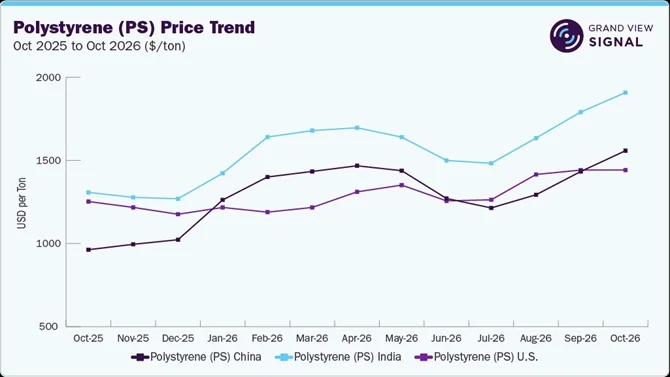
It’s an unpredictable environment to navigate, especially when trying to budget for packaging, automotive, or construction materials. Fortunately, data from the Grand View Signal’s Plastics Pricing Intelligence report gives us a clear look behind the curtain. Polystyrene (PS) led the charge as October's top-performing polymer segment, surging nearly 8% month-on-month across key regions, while major thermoplastics like polyethylene and PVC saw vastly different outcomes depending on where they were traded.
Whether you’re procuring bulk resin pellets, managing supply chains, or just trying to make sense of your quarterly procurement budgets, let’s unpack the five core market drivers steering the global plastics landscape right now.
1. Monomer Costs Push Asian Resin Prices Up in Asia (China)
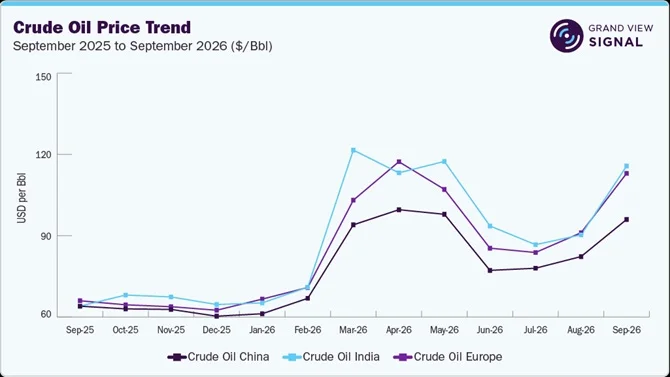
In the Asian plastics market, raw feedstock costs dictated terms throughout October. Driven by elevated crude oil prices and higher naphtha costs in China, basic monomer prices skyrocketed. Propylene surged by 10.1%, styrene jumped 9.9%, and paraxylene spiked 10.5%.
Because monomer costs make up the vast majority of the production budget for derivative resins, polymer producers had no choice but to pass these cost hikes downstream. As a direct result:
- Polystyrene (PS) jumped 8.7% in China.
- Polypropylene (PP) climbed 7.6%.
- Acrylonitrile Butadiene Styrene (ABS) increased by 7.2%.
Interestingly, polymers with a smaller monomer cost share or slower-moving feedstocks saw far milder adjustments. High-Density Polyethylene (HDPE) rose just 1.7% in China because ethylene price growth lagged behind propylene, while carbide-based PVC, which doesn't rely on crude oil feedstocks, rose only 2.5%.
2. Post-Holiday Restocking Gives Way to Caution in China
The timing of China's Golden Week holiday played a massive role in creating an initial October price surge. Leading up to the holiday break, Chinese converters allowed their raw material inventories to drop significantly. When factories reopened on October 8, converters rushed to restock right as upstream monomer costs were hitting new peaks.
This sudden post-holiday buying wave fueled a rapid price rally through mid-October. However, the buying spree quickly ran out of steam:
- Linear Low-Density Polyethylene (LLDPE) spot prices flattened completely after October 16.
- Polyethylene Terephthalate (PET) bottle chip dropped 2.9% from its October 9 peak as Mono Ethylene Glycol (MEG) prices softened.
- Dalian Commodity Exchange (DCE) futures contracts traded at a steep discount to spot prices, with January PP futures sitting roughly 13% below spot levels.
This quick shift from aggressive restocking to extreme buyer caution confirms that end-user industrial demand remains fragile. Once immediate operational needs were filled, buyers opted to sit on the sidelines rather than chase spot prices higher.
3. Western Contract Markets Stall on Weak Demand in the U.S. and Europe
While Asian sellers were successfully raising spot offers, Western contract negotiations ended in a complete standstill. Converters across both the United States and Europe firmly resisted price increases, pointing to soft consumer demand and comfortable supply availability.
In the U.S., monthly contracts for major commodity resins remained flat:
- Polyethylene (PE) contracts held steady after a minor September increase.
- Polyvinyl Chloride (PVC) stayed flat to lower under pressure from competitive Chinese export offers and domestic plant operating rates staying below 80%.
- Spot polyolefins actually slipped, with PP down 1.6% and Low-Density Polyethylene (LDPE) down 1.3%.
Over in Europe, ethylene contract prices rose 5.4%, but resin producers couldn't pass that increase on to buyers. HDPE film contracts rolled over, while European PP moved a mere 0.3%. Converter resistance in Western markets demonstrates that when end-use packaging, automotive, and construction demand is quiet, cost-push inflation alone isn't enough to sustain price hikes.
4. Supply Disruptions in Europe Versus New Supply in Asia (Germany and India)
Regional supply developments provided plenty of mixed signals for global purchasing managers. In Germany, low water levels on the Rhine River disrupted essential chemical feedstock barge deliveries to major production hubs. This forced Braskem to declare force majeure on PP supplies out of its Cologne and Schkopau facilities. Normally, a major force majeure would trigger a price spike, but weak European demand and prior imports completely muted the impact, leaving German PP prices up by just 0.1%.
Meanwhile, in Asia, production capacity expanded. LG Chem successfully restarted its massive Yeosu cracker in South Korea following a six-month maintenance shutdown, instantly boosting regional monomer and polymer availability.
This new supply availability quickly trickled down to import markets:
- In India, import offers at CFR Mundra eased despite domestic list price hikes by local producers like IOCL and Reliance.
- Indian import quotes for HDPE blow molding fell 2.3% and LDPE film dropped 1.6% by mid-month.
This clash between European operational hiccups and Asian supply expansion proves why tracking regional supply dynamics is critical for international trade.
5. Gulf Exporters Follow Asia Under War-Risk Costs (Saudi Arabia and UAE)
Middle Eastern resin producers in Saudi Arabia and the United Arab Emirates (UAE) navigate a unique market dynamic. Because Gulf petrochemical hubs export a huge percentage of their total polyolefin and styrenic output to Asia and India, their contract pricing closely mirrors Asian price movements.
During October, average export resin offers rose 4.3% in Saudi Arabia and 4.4% in the UAE, led by gains in PS, PP, and ABS. However, export offers were supported by more than just Asian demand:
- Geopolitical friction and shipping risks around the Strait of Hormuz kept war-risk freight insurance premiums elevated on ocean cargoes leaving Gulf ports.
- These elevated freight costs naturally increased landed prices for destination markets across Egypt (up 3.5% on average) and Morocco (up 3.2% on average).
For global polymer buyers sourcing from the Middle East, ocean logistics costs and geopolitical risk premiums remain just as influential as raw material economics.
Take Control of Polymer Volatility with Grand View Signal
In a market where monomer spikes, freight surcharges, and regional demand shifts can turn cost forecasts upside down overnight, having clear visibility into commodity pricing is essential. Grand View Signal provides real-time pricing intelligence, 10-year historical datasets, and predictive modeling tools to help procurement teams, chemical producers, and converters negotiate better contracts and manage margin risk.
What Grand View Signal Brings to the Table:
- 200+ Commodity Price Trackers: Access continuous price tracking across thermoplastics (PE, PP, PS, ABS, PVC, Nylon), polyesters (PET, EVA), bulk chemicals, and energy feedstocks.
- Deep Regional Price Coverage: Direct visibility into country-level price assessments across China, India, the U.S., Germany, France, the UK, Saudi Arabia, the UAE, Egypt, and Morocco.
- Geopolitical & Freight Risk Analytics: Advanced tools to model how trade policies, shipping routes, and energy market disruptions impact landed polymer costs.
- Forward-Looking Price Assessments: Data-driven forecasting models designed to help procurement managers move from reactive buying to proactive strategic sourcing.
Whether you're negotiating annual resin supply contracts, assessing import parity pricing, or tracking monomer spreads, Grand View Signal gives you the actionable data required to stay ahead of market turns.