Sign up with Google
 Sign in with Zoho

Radon is a naturally occurring radioactive gas that can enter buildings from the ground and accumulate indoors. Because it has no color, smell, or taste, testing is the only way to know the radon level inside a specific home.
But what about the area around your home? Are some parts of Canada more likely to have elevated radon? And if your region has a lower average, does that mean your home is low in radon?
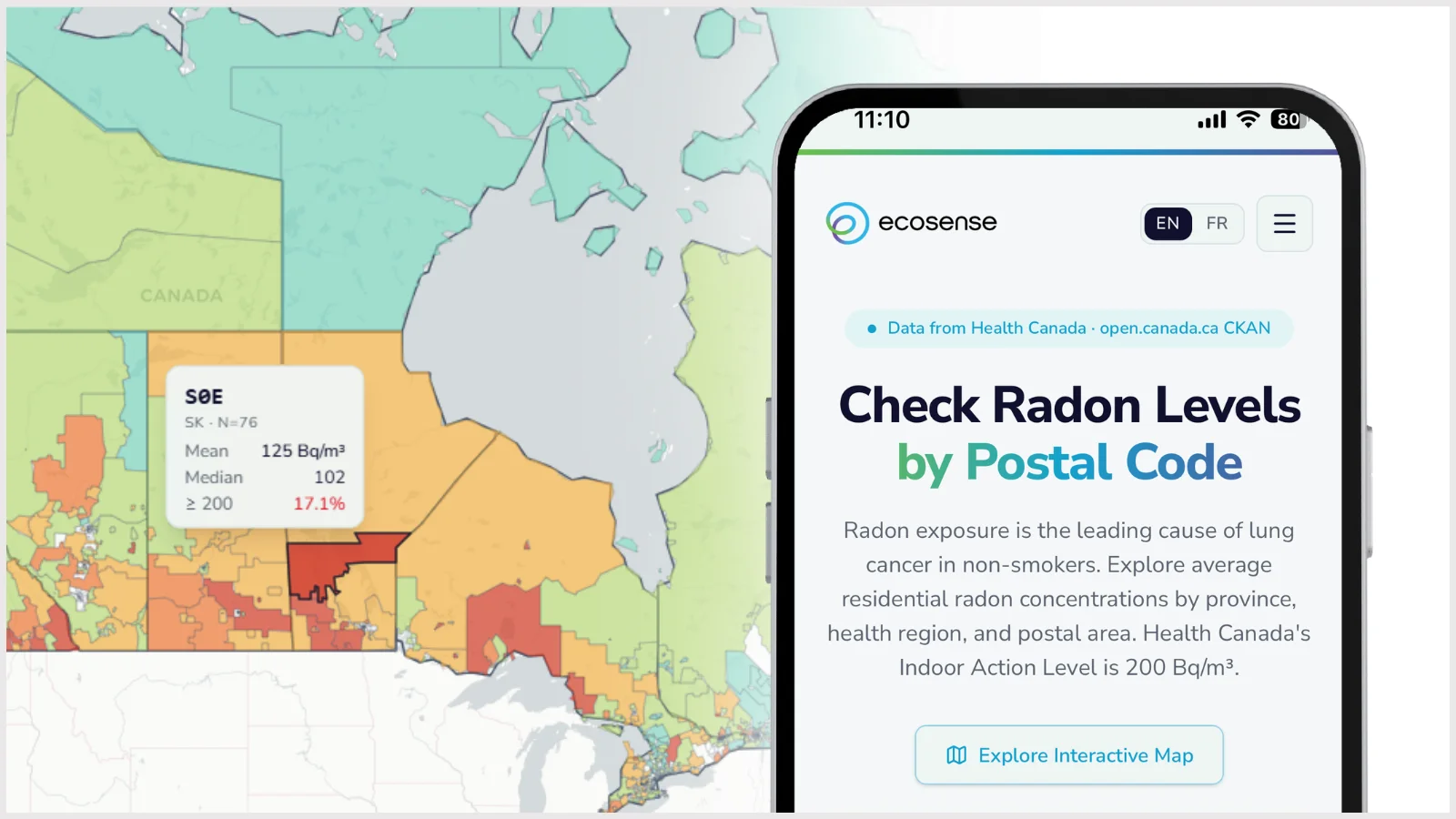
To make those questions easier to explore, Ecosense has launched a free interactive Canada Radon Map that uses publicly available Health Canada data to show local radon patterns. Canadians can search using the first three characters of their postal code, known as a Forward Sortation Area (FSA), and explore residential radon data across 963 areas.
The map is a useful starting point for understanding regional risk. , But it cannot predict the radon level in any individual home. Local data can show patterns, while only testing can tell you the radon level in your home.
What Is the Ecosense Canada Radon Map?
The Canadian Radon Map turns public radon data into an easier-to-explore visual resource. Instead of working through large datasets, users can enter the first three characters of a Canadian postal code to see information for their FSA.
The map allows users to:
- View average residential radon levels in their area
- See the percentage of homes above Canada's 200 Bq/m³ guideline
- Explore provincial and regional patterns
- Compare radon trends across different areas
- Learn how local measurements relate to Canadian guidance
The purpose is not to assess an individual home's exposure. It is to make local radon information easier to understand and use.
Check Radon Levels by Postal Code
If you are wondering about radon in your community, start by entering the first three characters of your Canadian postal code.
The resulting FSA information can help you explore questions such as:
- What are the average radon levels in my area?
- How common are elevated readings nearby?
- How does my area compare with other parts of Canada?
This can be particularly useful when buying a home, moving to a new community, or simply learning more about indoor air quality.
However, an area's average should be treated as context, not a prediction. A lower regional average does not rule out elevated radon in an individual home.
What Do Canada's Radon Levels Mean?
Health Canada's current guideline for radon is 200 Bq/m³. Corrective action is recommended when the average annual radon concentration exceeds this level in normally occupied areas of a building. Health Canada also recommends taking action sooner as radon concentrations increase.
The Ecosense map helps put local radon data into context by showing how measured concentrations relate to Canada's guideline.
In general:
- Below 100 Bq/m³: Lower radon concentration, although no level of radon exposure is considered completely risk-free.
- 100–200 Bq/m³: Elevated concentration; homeowners may consider taking steps to reduce radon levels, particularly as concentrations approach the Canadian guideline.
- Above 200 Bq/m³: Above Canada's guideline; corrective action is recommended.
The guideline is useful for understanding when action should be considered, but it should not be confused with a guarantee of safety. Health Canada notes that no level of radon exposure is entirely risk-free.
Is Radon Only a Problem in Certain Parts of Canada?
No. Radon can be found throughout Canada.
Radon levels can vary considerably across Canada, and while some areas have higher average risks, no region is completely exempt. A low average for your area doesn't automatically mean low radon in your home.
Health Canada reports that radon is found in buildings across Canada and that levels can vary significantly based on geography and building characteristics. Its 2024 cross-Canada survey found that approximately 17.8% of Canadian homes had radon concentrations at or above 200 Bq/m³.
That is why a national radon map is useful for awareness, but it cannot replace a test.
Why Can Two Nearby Homes Have Different Radon Levels?
Radon does not behave the same way from one building to another.
Radon concentrations can vary significantly even between neighboring properties, depending on:
- Foundation design
- Cracks in foundation walls or floors
- Soil and rock beneath the building
- Air pressure inside the home
- Ventilation patterns
- Heating and cooling systems
- Building materials and construction
- Weather and seasonal conditions
Radon levels change over time.
This means your neighbor's radon result or the average shown for your postal-code area cannot tell you what is happening inside your home.
The Most Important Step: Test Your Home
The Ecosense Canada Radon Map can help you understand radon risk in your area. The next step is finding out what is happening inside your own home.
Health Canada recommends a long-term radon test of at least three months, ideally during the fall or winter heating season. Testing can be done with a do-it-yourself test kit or through a certified radon measurement professional.
Why test for that long?
Radon levels fluctuate daily and seasonally. A long-term test captures these shifts, offering a far better estimate of your home's true annual average than a short-term snapshot.
For homeowners who want to understand these fluctuations in greater detail, continuous radon monitoring can provide ongoing measurements and reveal changes over time.
What If Your Home Has High Radon?
If your long-term test shows an average annual radon concentration above 200 Bq/m³, Health Canada recommends corrective action to reduce the level. The higher the concentration, the sooner action should be taken.
A certified radon mitigation professional can help determine the appropriate approach for your home. Effective mitigation methods can significantly reduce indoor radon concentrations.
Post-mitigation testing or ongoing monitoring helps confirm that radon levels remain reduced over time. Health Canada recommends retesting after installing a mitigation system to ensure it functions as intended.
From Radon Awareness to Action
The Ecosense Canada Radon Map makes it easier to explore radon levels by postal code and understand how radon trends vary across the country.
But the most important question is not, “What does my area look like?”
It is:
“What is the radon level inside my home?”
Your postal code can provide useful context, but only a radon test tells you what is actually happening in your home.
Whether you live in a major city, a rural community, or anywhere in between, radon testing is the only way to understand your home's exposure.
Explore the Ecosense Canada Radon Map, check the radon risk in your area, and take the next step by testing your home.
Frequently Asked Questions About Radon in Canada
1. Can radon levels change after a home renovation?
Yes. Changes to a home's foundation, ventilation, heating or cooling systems, or airflow can affect indoor radon conditions. After significant renovations, reassessing radon can be worthwhile.
2. Is radon testing necessary if my neighbour's home has a low reading?
Yes. Radon can vary significantly between homes, even when they are close together. A neighbour's result cannot determine the level inside your home.
3. Where should a radon monitor or test device be placed?
For a long-term measurement, Health Canada recommends testing the lowest level of the home that is occupied or could reasonably be occupied for at least four hours per day.
4. How common is high radon in Canada?
Health Canada's 2024 cross-Canada survey found that approximately 1 in 5 (17.8%) Canadian homes had radon concentrations at or above 200 Bq/m³.
5. Can renters test for radon?
Yes. Radon can affect individual units in multi-unit residential buildings as well as detached homes. Health Canada's measurement guidance covers individual units in multi-unit residential buildings.
6. Is continuous monitoring the same as a long-term radon test?
Not necessarily. Continuous monitors provide short-term readings and track fluctuations, but Health Canada's guidance focuses on long-term measurement to determine your home's average annual radon level. Choose the device and testing duration that best suit your goal.