Sign up with Google
 Sign in with Zoho
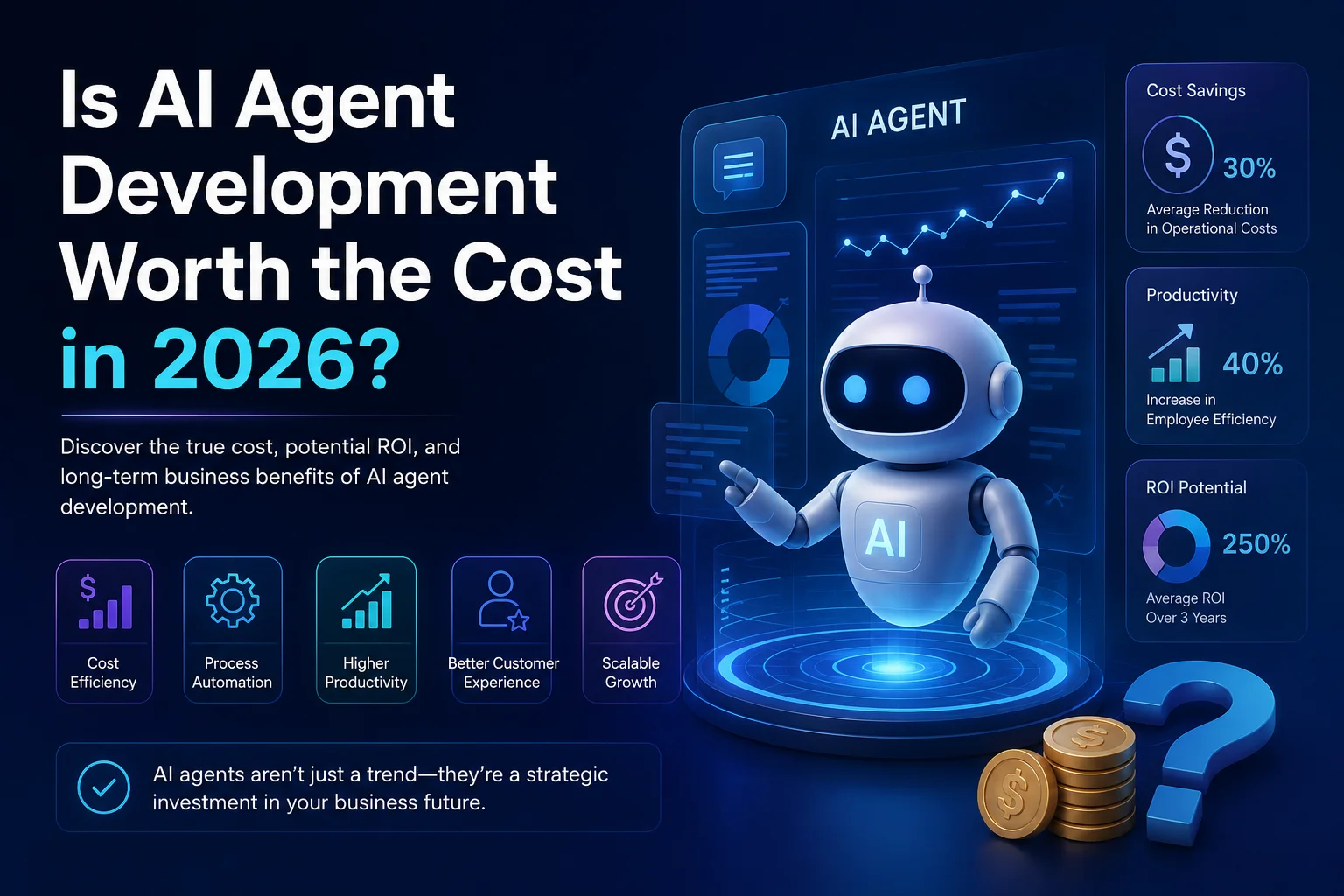
Artificial intelligence has become a cornerstone of digital transformation, and AI agents are emerging as one of its most impactful applications. Unlike traditional automation tools, AI agents can reason, make decisions, interact with multiple systems, and execute complex tasks with minimal human intervention. From customer support and sales automation to software development and business intelligence, AI agents are helping organizations streamline operations and improve productivity.
However, one question continues to dominate boardroom discussions: Is AI agent development worth the cost in 2026?
The answer depends on your business goals, use cases, implementation strategy, and expected return on investment (ROI). While AI agent development requires a significant investment, the long-term benefits often outweigh the upfront costs when implemented correctly.
This article explores the costs, benefits, challenges, and ROI of AI agent development to help businesses make informed decisions.
The Growing Demand for AI Agents
Businesses across industries are rapidly adopting AI agents to stay competitive in an increasingly digital marketplace. Unlike rule-based chatbots that rely on predefined workflows, modern AI agents can understand context, analyze information, retrieve data from multiple sources, and complete multi-step tasks autonomously.
Organizations are using AI agents for:
- Customer support automation
- Sales assistance and lead qualification
- IT helpdesk services
- HR recruitment and onboarding
- Financial reporting
- Healthcare administration
- Supply chain management
- Internal knowledge management
As AI technologies mature, businesses are moving beyond experimentation and investing in enterprise-grade AI solutions that deliver measurable business value.
Understanding the Cost of AI Agent Development
AI agent development costs vary widely based on the complexity of the project. A simple AI assistant designed to answer FAQs requires far fewer resources than an enterprise AI agent capable of integrating with multiple business systems and making autonomous decisions.
The overall cost typically includes:
- Solution architecture and planning
- UI/UX design
- AI model selection and integration
- Backend and frontend development
- API and third-party integrations
- Data preparation and knowledge base creation
- Security implementation
- Testing and quality assurance
- Deployment
- Ongoing maintenance and optimization
Businesses should also account for recurring expenses such as cloud infrastructure, AI model usage, monitoring, updates, and technical support.
Why AI Agent Development Can Be Worth the Investment
1. Significant Productivity Improvements
One of the biggest advantages of AI agents is their ability to automate repetitive and time-consuming tasks.
Instead of manually processing customer requests, generating reports, or managing workflows, employees can focus on strategic initiatives that require creativity and critical thinking.
This leads to higher productivity across departments and reduces operational bottlenecks.
2. Lower Operational Costs
Although AI agent development requires an initial investment, it often reduces long-term operating expenses.
AI agents can work around the clock without breaks, vacations, or overtime, allowing businesses to handle larger workloads without proportionally increasing staffing costs.
Over time, these efficiencies can generate substantial cost savings.
3. Faster Customer Support
Customers expect instant responses regardless of the time of day.
AI agents can provide immediate assistance, resolve common issues, retrieve account information, and escalate complex cases when necessary.
This improves customer satisfaction while reducing the workload on human support teams.
4. Better Decision-Making
Modern AI agents can analyze large volumes of business data within seconds.
They help organizations identify trends, generate insights, create reports, and recommend actions based on real-time information.
Business leaders benefit from faster and more informed decision-making.
5. Scalability
Unlike traditional software solutions, AI agents can scale alongside business growth.
Whether handling hundreds or thousands of customer interactions, AI agents can manage increased demand with minimal additional operational costs.
This scalability makes AI particularly attractive for rapidly growing businesses.
Situations Where AI Agent Development Delivers High ROI
AI agents generate the greatest value when deployed for high-volume, repetitive, and data-intensive processes.
Examples include:
Customer Service
AI agents answer customer inquiries, process support tickets, and provide personalized recommendations while reducing response times.
Sales
Sales teams use AI agents to qualify leads, schedule meetings, generate proposals, and manage customer interactions.
Human Resources
AI agents automate resume screening, interview scheduling, employee onboarding, and internal HR support.
IT Operations
Organizations deploy AI agents to resolve technical issues, monitor systems, and automate routine maintenance tasks.
Healthcare
Healthcare providers use AI agents for appointment scheduling, patient communication, documentation, and administrative support.
These applications often produce measurable improvements in efficiency and service quality.
Challenges Businesses Should Consider
Despite their benefits, AI agent development is not without challenges.
Initial Investment
Enterprise AI solutions require investment in development, infrastructure, integrations, and security.
Businesses should evaluate both short-term costs and long-term value.
Data Quality
AI agents rely on accurate, organized, and up-to-date information.
Poor-quality data can reduce the effectiveness of AI-driven decisions and responses.
Integration Complexity
Many organizations operate multiple software platforms that must work together.
Connecting AI agents with CRMs, ERPs, databases, and cloud services increases implementation complexity.
Security and Compliance
Organizations handling sensitive information must ensure compliance with industry regulations and implement strong security measures to protect business and customer data.
How to Maximize ROI
Businesses can significantly improve the return on investment by following a structured implementation strategy.
Start with a High-Impact Use Case
Rather than automating every business process, begin with a department where AI can deliver immediate value.
Customer support, internal knowledge management, and sales automation are common starting points.
Build an MVP
Develop a Minimum Viable Product (MVP) to validate performance before investing in advanced capabilities.
This reduces risk while allowing businesses to gather user feedback.
Measure Performance
Track metrics such as:
- Customer satisfaction
- Response times
- Employee productivity
- Cost savings
- Process completion time
- Revenue impact
These KPIs help determine whether the AI investment is achieving its objectives.
Continuously Improve
AI agents become more effective through continuous optimization.
Regular updates, prompt engineering, model improvements, and user feedback help maintain high performance over time.
Is AI Agent Development Right for Every Business?
Not every organization requires a fully autonomous AI agent.
Small businesses with limited automation needs may benefit from simpler AI tools or prebuilt platforms before investing in custom development.
However, businesses experiencing rapid growth, managing complex workflows, or processing large amounts of data often gain significant advantages from custom AI agent development.
The key is aligning AI capabilities with business objectives rather than adopting AI simply because it is a growing trend.
Future Outlook
AI technology is advancing rapidly, making development frameworks more accessible and deployment more efficient.
In 2026, businesses can expect:
- More capable AI reasoning models
- Lower infrastructure costs through model optimization
- Better AI orchestration platforms
- Increased enterprise adoption
- Improved security and governance tools
- Industry-specific AI agents tailored to specialized workflows
These advancements will continue to improve the value proposition of AI agent development while making implementation more practical for businesses of all sizes.
Conclusion
So, is AI agent development worth the cost in 2026? For many organizations, the answer is yes—provided the investment is guided by clear business objectives and a well-defined implementation strategy.
While development costs can be substantial, AI agents offer long-term benefits through automation, improved productivity, faster decision-making, enhanced customer experiences, and scalable operations. Businesses that focus on solving real operational challenges rather than chasing trends are more likely to achieve a strong return on investment.
As AI continues to reshape industries, investing in a thoughtfully designed AI agent is no longer just a technology decision. It is a strategic investment that can help businesses improve efficiency, remain competitive, and build a foundation for sustainable growth in the years ahead.