Sign up with Google
 Sign in with Zoho

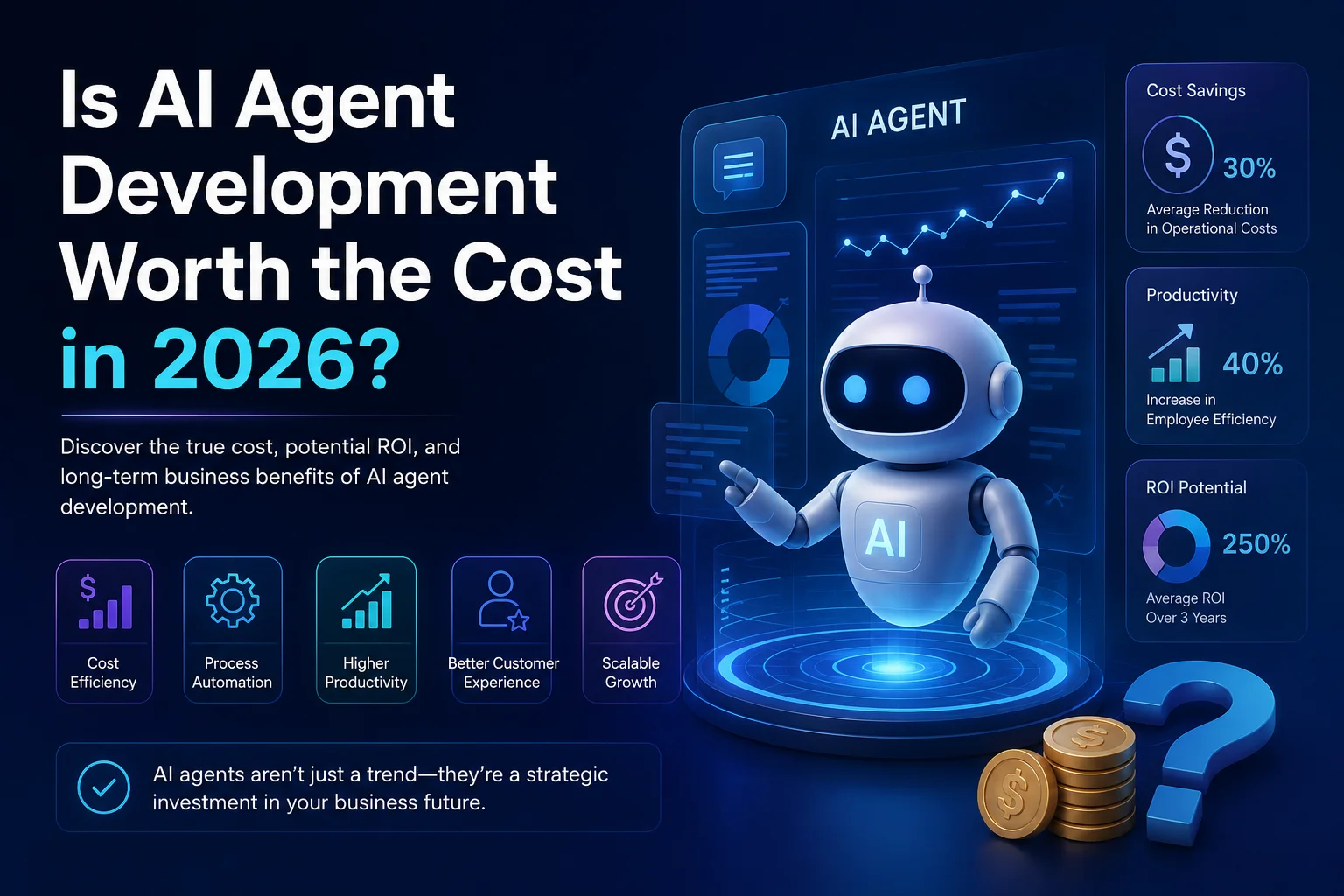
Artificial Intelligence is no longer an experimental technology reserved for innovation labs. It has become a strategic investment that is reshaping how enterprises operate, compete, and grow. Among the most significant advancements in this space are AI agents—intelligent systems capable of understanding context, making decisions, interacting with enterprise applications, and completing complex tasks with minimal human intervention.
From automating customer support and streamlining internal operations to assisting employees and accelerating decision-making, AI agents are helping organizations unlock new levels of productivity. However, building a successful AI agent requires much more than selecting a powerful language model or deploying a chatbot.
Enterprises need a structured development process that aligns AI initiatives with business objectives while ensuring security, scalability, and long-term performance.
This article explores the AI agent development process every enterprise should follow to build intelligent solutions that create lasting business value.

Why Enterprises Are Investing in AI Agents
Modern enterprises generate vast amounts of data, manage complex workflows, and rely on multiple software systems to run daily operations. As organizations grow, manual processes often become bottlenecks that slow productivity and increase operational costs.
AI agents help address these challenges by:
- Automating repetitive and time-consuming tasks
- Supporting employees with intelligent recommendations
- Improving customer service through faster responses
- Retrieving information from enterprise knowledge bases
- Coordinating workflows across multiple business systems
- Reducing operational costs while increasing efficiency
Rather than replacing employees, AI agents enhance their capabilities by allowing them to focus on higher-value work.
Phase 1: Define Clear Business Objectives
Every successful AI initiative begins with a well-defined business goal.
Many organizations fail because they adopt AI without identifying the specific problems they want to solve. Instead of asking, "How can we implement AI?", enterprises should ask:
"Which business process will benefit most from intelligent automation?"
Common enterprise use cases include:
- Customer support automation
- Employee knowledge assistants
- HR onboarding
- Financial reporting
- Sales enablement
- IT help desk automation
- Contract analysis
- Supply chain optimization
Clearly defined objectives help development teams prioritize features, measure success, and deliver solutions that address real business challenges.
Phase 2: Analyze Enterprise Requirements
Once the objective is established, the next step is understanding the operational environment.
Development teams should evaluate:
- Existing business workflows
- User roles and responsibilities
- Enterprise software ecosystem
- Data availability
- Security requirements
- Regulatory compliance
- Performance expectations
This discovery phase ensures that the AI agent integrates seamlessly into existing business operations rather than disrupting them.
Phase 3: Design a Scalable AI Agent Architecture
Enterprise AI agents require a robust architecture capable of handling large volumes of users, data, and business processes.
A modern architecture typically consists of several interconnected components.
Language Model
The language model serves as the reasoning engine, enabling the AI agent to understand requests, analyze context, generate responses, and plan actions.
Memory Layer
Memory allows the AI agent to maintain conversation history, user preferences, ongoing tasks, and long-term contextual information, resulting in more personalized and accurate interactions.
Knowledge Retrieval System
Instead of relying solely on pre-trained knowledge, enterprise AI agents retrieve information from internal documentation, policies, technical manuals, and business databases. This ensures responses remain accurate and current.
Decision Engine
The decision engine evaluates user requests, determines appropriate actions, selects relevant tools, and manages workflow execution.
Integration Layer
Enterprise AI agents gain significant value when connected to existing business applications, including:
- CRM platforms
- ERP systems
- Human Resource Management Systems
- Cloud storage
- Email services
- Customer support platforms
- Project management tools
- Business intelligence solutions
These integrations transform AI agents from conversational assistants into operational business tools.
Phase 4: Prepare Reliable Enterprise Data
High-quality data is the foundation of every successful AI agent.
Development teams typically gather information from:
- Internal knowledge bases
- Product documentation
- Business policies
- Standard operating procedures
- Customer service records
- Technical documentation
- Historical business data
- Enterprise databases
Before deployment, the data should be cleaned, categorized, validated, and continuously updated.
Reliable information improves response accuracy while reducing misinformation and inconsistent outputs.
Phase 5: Develop Intelligent Business Workflows
AI agents should follow structured workflows instead of generating responses randomly.
A typical enterprise workflow includes:
- Interpret the user's request.
- Understand business intent.
- Retrieve relevant enterprise knowledge.
- Determine whether external systems are required.
- Execute approved business actions.
- Validate the results.
- Generate a contextual response.
- Record important information for future interactions.
This structured reasoning process enables AI agents to complete sophisticated business tasks with greater reliability.
Phase 6: Prioritize Enterprise Security
Security is one of the most critical aspects of AI agent development.
Enterprise AI systems frequently interact with confidential customer information, financial records, proprietary business data, and internal communications.
A secure AI agent should include:
- Multi-factor authentication
- Role-based access control
- Data encryption
- Secure API communication
- Audit logs
- Activity monitoring
- Prompt injection protection
- Data privacy controls
- Human approval workflows for sensitive actions
Building security into the development lifecycle protects both enterprise data and customer trust.
Phase 7: Test Across Real Business Scenarios
Testing an enterprise AI agent extends far beyond checking response quality.
Development teams should evaluate:
- Accuracy of generated responses
- Business workflow execution
- Integration reliability
- Context retention
- Performance under heavy workloads
- Error recovery
- User experience
- Security vulnerabilities
Testing across real-world business scenarios ensures the AI agent performs consistently in production environments.
Phase 8: Deploy for Scalability
Enterprise AI agents must support thousands of users and business transactions simultaneously.
Deployment strategies should include:
- Cloud-native infrastructure
- High availability
- Load balancing
- Monitoring dashboards
- Automated scaling
- Backup and disaster recovery
- Continuous deployment pipelines
Scalable infrastructure enables organizations to expand AI capabilities without compromising performance.
Phase 9: Monitor and Continuously Improve
AI agent development does not end after deployment.
Successful enterprises continuously monitor:
- User satisfaction
- Task completion rates
- Response accuracy
- Workflow efficiency
- System performance
- Operational costs
- Security events
- Knowledge gaps
Continuous optimization allows AI agents to improve alongside evolving business requirements.
Common Challenges Enterprises Face
Developing enterprise AI agents comes with several challenges, including:
Integrating Legacy Systems
Many organizations rely on older software platforms that require custom integrations.
Maintaining Data Accuracy
Business knowledge changes frequently, making regular updates essential.
Ensuring Compliance
Enterprises must comply with industry regulations regarding privacy, security, and governance.
Managing AI Costs
Balancing model performance with infrastructure expenses is critical for long-term sustainability.
Building User Trust
Employees are more likely to adopt AI when the system consistently produces accurate, explainable, and secure results.
Addressing these challenges early increases the likelihood of successful implementation.
Best Practices for Enterprise AI Agent Development
Organizations can maximize success by following these principles:
- Begin with clearly defined business objectives.
- Build modular and scalable architectures.
- Use reliable, high-quality enterprise data.
- Integrate AI agents with existing business systems.
- Prioritize security, privacy, and compliance from the beginning.
- Test extensively before deployment.
- Continuously monitor and optimize performance.
- Measure business outcomes instead of focusing solely on technical metrics.
These practices help enterprises create AI agents that remain effective as business needs evolve.
The Future of Enterprise AI Agents
Enterprise AI agents are rapidly evolving beyond individual assistants into intelligent digital coworkers capable of managing complex business operations.
Future advancements are expected to include:
- Multi-agent collaboration across departments
- Advanced reasoning and planning capabilities
- Persistent organizational memory
- Greater personalization
- Multimodal understanding of text, images, audio, and video
- Autonomous workflow orchestration
- Deeper integration with enterprise ecosystems
- Stronger governance and responsible AI frameworks
Organizations that establish a structured AI development process today will be better prepared to capitalize on these innovations.
Final Thoughts
Building an enterprise AI agent is not simply a technology project—it is a strategic business initiative. Success depends on following a structured development process that begins with clear objectives, continues through thoughtful architecture and secure integration, and evolves through continuous monitoring and improvement.
Enterprises that approach AI agent development with a long-term vision can automate critical workflows, improve operational efficiency, empower employees, and deliver exceptional customer experiences. As AI continues to redefine the future of business, following a proven development process will be the key to building intelligent, scalable, and enterprise-ready AI agents that create sustainable competitive advantages.