Sign up with Google
 Sign in with Zoho

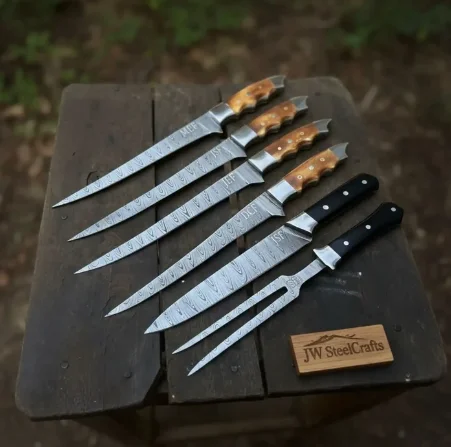
A specialized kitchen knife earns its place by solving a specific cutting problem. Boning knives are designed for controlled work around bones and joints, while fillet knives are intended to separate flesh from skin and bone with a blade suited to detailed cutting. When both tasks are part of the same kitchen workflow, a Damascus boning & fillet knife set can provide a practical collection of specialized blades in one configuration.
The challenge is knowing what actually matters before buying one. Damascus patterning can make a knife visually distinctive, but appearance is only one consideration. Blade geometry, flexibility, construction, handle design, maintenance, and the pieces included in the set all deserve attention.
What Is a Damascus Boning & Fillet Knife Set?
A Damascus boning & fillet knife set is a collection of narrow kitchen knives designed for detailed preparation of meat, poultry, and fish. Depending on the configuration, a set may combine blades for working around bones and joints with thinner or more flexible blades for filleting.
The main distinction is the cutting task. A boning knife generally prioritizes controlled movement around bone and connective tissue, while a fillet knife is commonly designed to flex and follow the contours of fish or other foods.
This makes a specialized set particularly relevant to cooks who regularly process whole fish, poultry, meat cuts, or other ingredients requiring precise trimming.
Why Does Blade Geometry Matter More Than Appearance?
Blade geometry determines how the knife interacts with food. For boning and filleting, a narrow profile can help the user make controlled cuts in confined areas, while an appropriately flexible blade can follow curved surfaces.
A useful way to think about the relationship is:
Blade shape → movement → control → cutting task
For example, a cook removing meat close to a bone may value a blade that feels stable and precise. Someone filleting fish may prefer a thinner blade with enough flex to follow the structure of the fish.
A Damascus pattern can add visual character, but it should not replace an evaluation of the actual blade profile.
What Does Full Tang Construction Mean?
Full tang construction means the blade steel extends through the handle. In a kitchen knife, this construction can provide a continuous structural connection between blade and handle and can contribute to a stable feeling during controlled cutting.
For a boning and filleting set, this is useful because the knives are often manipulated with deliberate, precise movements rather than used for simple chopping.
However, full tang construction should not be treated as a guarantee that one knife will outperform another. Steel composition, heat treatment, geometry, edge condition, handle ergonomics, and manufacturing quality also influence the overall result.
Buying principle: treat full tang construction as one important construction characteristic, not as a substitute for evaluating the entire knife.
Is Damascus Steel Suitable for Culinary Knives?
Damascus steel is valued by many knife buyers for its distinctive layered appearance and the craftsmanship associated with producing patterned blades. However, “Damascus” is not a complete performance specification.
will cut, how long its edge will last, or how resistant it will be to corrosion.
When evaluating a Damascus kitchen knife, consider the complete package:
- Blade geometry
- Steel characteristics
- Heat treatment
- Edge geometry
- Construction
- Handle design
- Intended use
- Maintenance requirements
This approach is more reliable than assuming that a particular visual pattern automatically means superior performance.
What Makes a Handcrafted Boning and Fillet Set Useful?
Handcrafted construction can appeal to cooks who want functional kitchen tools with individual visual character. But the practical value still depends on whether the design matches the user's preparation habits.
The current JW SteelCrafts product is described as a set of long, narrow Damascus blades with thin, curved profiles, full tang construction, black and orange resin handles, pinned construction, and a matching two-tine carving fork. Its stated uses include boning, trimming, filleting meat, poultry and fish, close work around bones and joints, and carving or serving.
Those details illustrate an important buying principle: a knife set should be evaluated according to what its individual components are designed to accomplish.
A cook who frequently prepares fish and trims meat may have a practical reason to own several specialized blades. Someone who rarely performs those tasks may get more value from a smaller collection.
How Do You Choose the Best Damascus Boning & Fillet Knife Set?
There is no single best set for every cook. The best option depends on the food being prepared, frequency of use, preferred blade feel, construction, and whether the complete configuration provides useful tools.
1. Identify Your Primary Preparation Task
Start with what you actually cut.
For fish, blade flexibility and a thin profile may receive greater priority.
For meat and poultry, controlled movement around bones and joints may be more important.
For mixed kitchen use, a set containing complementary blade types can make more sense than purchasing several knives with nearly identical profiles.
2. Examine the Blade Profile
Look for a blade shape that corresponds with the intended work.
A narrow, curved profile can be useful when the edge needs to follow contours. Flexibility should also be considered carefully: more flexibility is not automatically better because different cutting tasks require different levels of control.
3. Inspect the Handle
The handle should feel secure and manageable during wet food preparation.
Consider:
- Grip shape
- Handle material
- Pin or fastening construction
- Balance
- Comfort during repetitive preparation
- Ease of cleaning
A visually attractive handle is useful only if it also supports controlled handling.
4. Consider Full Tang Construction
Full tang construction can be a useful indicator when comparing similarly configured knives, particularly for buyers who prioritize a solid blade-to-handle connection.
But always consider it together with geometry, steel, edge design, and handle ergonomics.
5. Judge the Whole Set
Do not assume a larger knife collection is automatically better.
Ask:
Will I regularly use each specialized blade?
If the answer is yes, a set can consolidate several preparation tasks. If the answer is no, buying fewer, better-matched knives may be the more practical decision.
What Should a Damascus Boning & Fillet Knife Set Review Examine?
A meaningful Damascus boning & fillet knife set review should go beyond photographs and decorative details.
A useful review framework should examine:
This distinction is important because a manufacturer's specifications describe construction and intended use, while independent testing would be needed to establish long-term performance claims.
The current product page, for example, describes the set's construction and intended applications but also currently displays no customer reviews, so those specifications should not be presented as independent user-test results.
How Much Should You Pay for a Damascus Boning & Fillet Knife Set?
The Damascus boning & fillet knife set price should be evaluated against construction, materials, craftsmanship, number of useful pieces, and the intended frequency of use.
Instead of asking only whether a set is expensive or inexpensive, use this comparison:
Price → Materials → Construction → Blade design → Number of useful pieces → Maintenance → Expected frequency of use
The current JW SteelCrafts listing shows a displayed price of $328, reduced from a displayed $439 price. Because product prices can change, buyers should verify the current price before making a purchase.
For a frequent home cook or culinary enthusiast, a specialized set may justify a higher purchase price if its individual components replace several separate tools. For an occasional user, a single well-selected knife may be sufficient.
Is a Fillet Knife the Same as a Boning Knife?
No. Although the tasks overlap, the knives are designed around different cutting requirements.
A boning knife is primarily intended for controlled work around bones and joints. A fillet knife generally emphasizes the ability to separate flesh from skin and bone, especially when preparing fish.
The difference can be summarized simply:
Boning = controlled separation around bone and joints.
Filleting = following the structure of flesh, skin, and bone, often with greater blade flexibility.
Some knife sets combine both types because cooks may encounter both tasks during the same food-preparation session.
What Are the Advantages of a Specialized Knife Set?
A specialized set can provide several practical advantages.
Task-specific blades
Different blades can be selected according to the food and cutting motion rather than forcing one knife to perform every task.
Consistent collection
A matching set can provide a consistent handle design and visual appearance.
Greater workflow flexibility
A cook processing multiple ingredients can switch between appropriate knives instead of repeatedly adapting one general-purpose blade.
Culinary presentation
Some handcrafted sets combine functional kitchen tools with distinctive materials and visual design, making them appealing to cooks who also appreciate craftsmanship.
There are limitations, however. Specialized sets can cost more than a single knife and may require more storage and maintenance.
What Are the Common Buying Mistakes?
Mistake 1: Buying for the Damascus pattern alone
The pattern is visually distinctive, but it does not provide enough information about the knife's complete performance characteristics.
Mistake 2: Assuming more knives means better value
Unused knives add cost without necessarily improving the cooking workflow.
Mistake 3: Ignoring flexibility
A blade that is too flexible or too rigid for a particular task may feel less controlled.
Mistake 4: Neglecting maintenance
Specialized blades should be cleaned, dried, stored, and sharpened appropriately.
Mistake 5: Confusing product information with independent testing
A product page can accurately describe materials, configuration, and intended use. It should not automatically be interpreted as independent evidence of long-term durability or cutting performance.
How Should You Maintain a Damascus Kitchen Knife Set?
Proper maintenance is part of owning any specialized kitchen knife.
The product care guidance for the JW SteelCrafts set recommends hand washing and thorough drying, dry storage, avoiding impact against hard surfaces, maintaining the cutting edge appropriately, and applying a thin layer of oil for long-term protection of steel surfaces.
A simple maintenance routine is:
Clean → Dry → Inspect → Store → Maintain the edge
Avoid leaving a blade wet after food preparation. Storage should also prevent unnecessary contact with moisture or other materials.
For sharpening, use a method appropriate to the blade and edge geometry rather than treating every kitchen knife identically.
What Food-Safety Practices Should You Follow?
Knife maintenance and food safety are separate issues, and both matter.
The USDA Food Safety and Inspection Service explains that cross-contamination can occur when harmful bacteria transfer between food, cutting boards, and utensils. Raw meat, poultry, seafood, and their juices should be kept away from ready-to-eat foods.
After preparing raw proteins, wash the knife and other food-contact surfaces with hot, soapy water. USDA FSIS also recommends using separate cutting boards for fresh produce and raw meat, poultry, and seafood when possible.
For a kitchen using specialized boning and fillet knives, the practical workflow is straightforward:
- Start with a clean knife.
- Keep raw proteins separate from ready-to-eat foods.
- Avoid transferring raw-food juices to other ingredients.
- Wash the knife and preparation surfaces after use.
- Dry and store the knife appropriately.
A premium knife does not replace basic food-safety practices.
A Five-Point Buying Framework
Before purchasing a handcrafted Damascus boning and fillet collection, score the set against five questions:
Purpose
Does it match the foods you prepare most often?
Precision
Does the blade geometry support detailed cutting?
Construction
Is the blade and handle construction appropriate for repeated use?
Practicality
Will you use the included knives and accessories?
Maintenance
Are you prepared to clean, dry, sharpen, and store the blades correctly?
If a set performs well against all five criteria, its visual appeal becomes an added benefit rather than the primary reason for purchase.
When Is a Damascus Boning & Fillet Knife Set Worth Buying?
A Damascus boning and fillet set makes the most sense for cooks who regularly perform detailed meat, poultry, or fish preparation and want several specialized blades rather than one general-purpose kitchen knife.
It can also suit culinary enthusiasts who appreciate handcrafted construction and distinctive Damascus patterning.
For someone who rarely bones or fillets food, however, purchasing a complete set may be unnecessary. The better choice may be one specialized knife that matches the user's most common task.
Final Takeaway
A Damascus boning & fillet knife set should be evaluated as a working culinary collection first and a decorative object second. Blade geometry, flexibility, full tang construction, handle design, set configuration, maintenance, and intended use are more meaningful buying criteria than appearance alone.
The most useful question is not simply, “Which Damascus set looks best?” It is:
“Which configuration gives me the right blades for the food I actually prepare?”
For readers who want to examine a concrete example while applying these criteria, the JW SteelCrafts Damascus boning and fillet knife set offers a configuration featuring thin curved Damascus blades, full tang construction, black and orange resin handles, pinned construction, and a matching two-tine carving fork.
Whether the final choice is a complete collection or a single specialized knife, the same principle applies: choose the blade according to the task, evaluate construction objectively, understand the maintenance requirements, and judge value by actual kitchen use.