Sign up with Google
 Sign in with Zoho
Think about the last time you ordered food online. You probably did not spend much time thinking about what happens behind the scenes. You selected a restaurant, picked a few dishes, entered your address, paid, and waited for the delivery.
For a food delivery company, however, that simple order involves several moving parts. The restaurant has to receive the order, someone has to prepare it, a delivery partner has to collect it, and the customer needs updates along the way.
This is why building a food delivery platform is more than creating a mobile app.
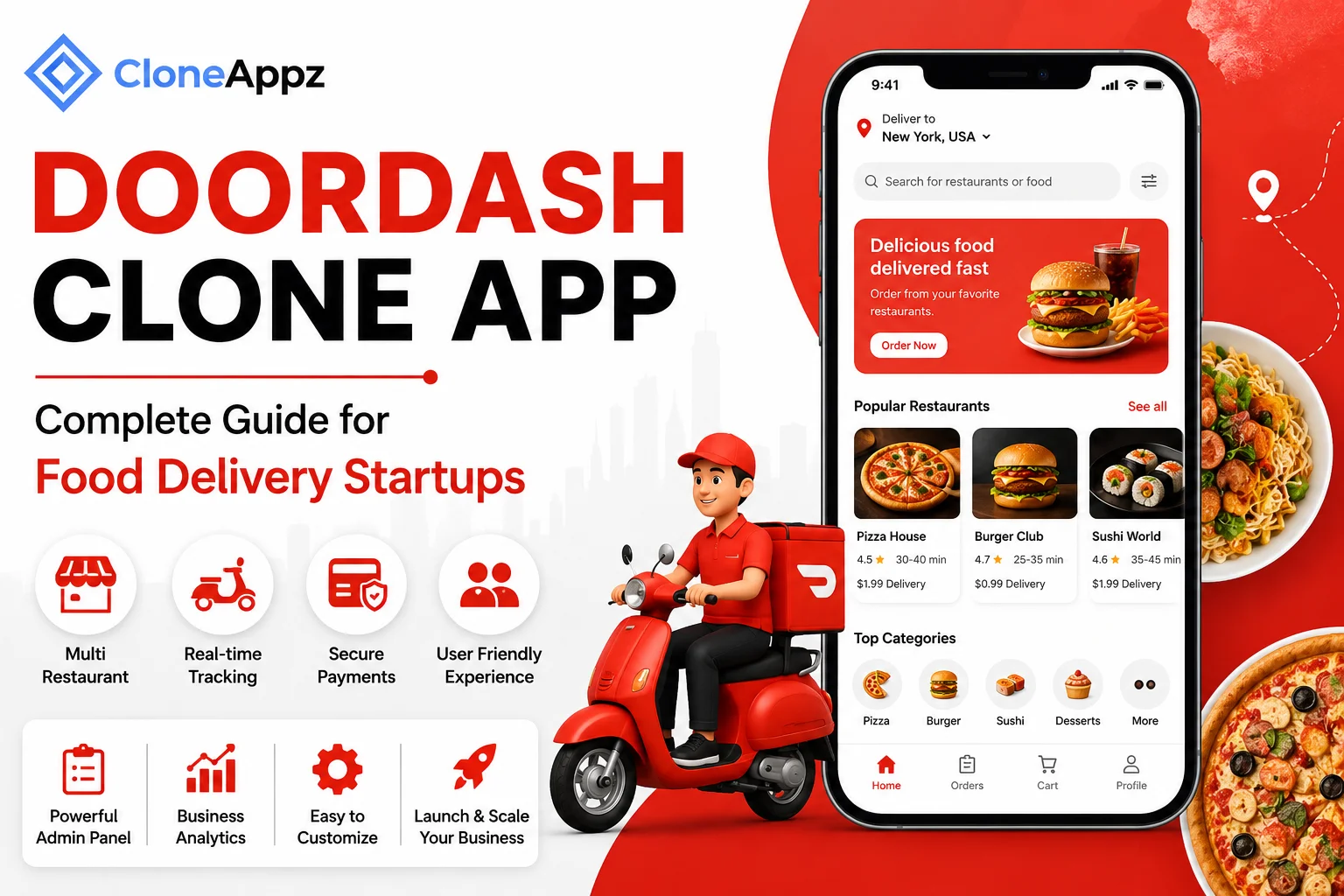
For startups entering this industry, a DoorDash Clone App can provide a practical starting point. Instead of spending the early stages of the project developing basic food-ordering functions, a business can start with an existing foundation and adapt it to its own idea.
What Makes a DoorDash Clone App Useful?
A clone app does not have to mean an identical copy of another company's application.
In practice, a startup can use the basic structure of a food delivery platform and then make its own decisions about design, pricing, delivery areas, restaurant commissions, promotions, and features.
For example, suppose you want to launch a food delivery service in a city where large platforms already exist. Competing with them on the number of restaurants may not be realistic at first.
Instead, you could focus on a smaller group of restaurants and offer something different—perhaps better delivery coverage in certain neighborhoods, lower restaurant commissions, or a service dedicated to local cuisine.
The application becomes the tool that supports that business idea.
How the Food Delivery Process Works
A typical DoorDash Clone App connects three operational sides with an administration system.
The customer places an order through the mobile app. The restaurant receives it and confirms whether it can prepare the food. Once the meal is ready, a delivery partner picks it up and takes it to the customer.
The administrator can monitor these activities and manage the users, restaurants, orders, payments, and other settings.
It sounds straightforward, but every step needs to work properly. If a restaurant does not receive an order notification, for instance, the customer may end up waiting without knowing what happened.
That is why reliability matters just as much as the visual design.
Customer Features That Matter
The customer side should feel simple. Most people opening a food delivery app are not looking for a complicated experience.
They want to answer three questions quickly:
What can I order? How much will it cost? When will it arrive?
A useful customer application can include:
- Restaurant search
- Location-based listings
- Cuisine and food filters
- Digital menus
- Food customization
- Cart and checkout
- Online payments
- Order status updates
- Delivery tracking
- Ratings and reviews
- Coupons
- Previous orders
One small detail can make a noticeable difference: showing realistic delivery times. If an app promises 25 minutes and regularly takes 50, customers will lose confidence even if everything else works well.
Restaurant Management
Restaurants need a different experience from customers.
Imagine a busy restaurant receiving dozens of orders during lunch. The restaurant staff should be able to see new orders immediately, confirm them, update preparation status, and mark unavailable dishes without digging through complicated menus.
A restaurant dashboard can provide tools for:
- Adding and editing menu items
- Updating prices
- Managing food availability
- Accepting incoming orders
- Updating preparation status
- Viewing order history
- Managing restaurant information
- Checking sales reports
A simple restaurant panel can actually be more valuable than a long list of advanced features.
Delivery Partner App
The delivery partner is responsible for the final step, so the app needs to give them the right information at the right time.
After accepting an order, the delivery partner can receive pickup details, restaurant information, customer location, and navigation assistance.
Other useful functions include earnings records, delivery history, availability settings, and status updates.
Real-time tracking can also improve the experience for customers. Instead of repeatedly calling the restaurant and asking where the food is, they can check the delivery status directly.
Ways to Earn From the Platform
Before developing an app, a startup should decide how it plans to make money.
A food delivery platform can generate revenue in several ways.
Restaurant Commission
The platform can receive a percentage from each restaurant order.
Delivery Charges
Customers can pay a delivery fee, which may vary according to distance or location.
Featured Restaurants
Restaurants can pay for additional visibility inside the application.
Promotional Campaigns
Brands and restaurants can purchase advertising or promotional placements.
Membership Plans
A subscription can provide customers with benefits such as reduced delivery fees or special offers.
The best model depends on the market. A new platform may initially choose lower commissions to attract restaurants and gradually introduce additional revenue sources as its user base grows.
Why Communication Should Not Be Ignored
Food delivery is not always as smooth as placing an order and waiting.
A customer may want to tell the delivery partner that they are at a different entrance. A restaurant may need to clarify an order. Customer support may have to contact someone about a delayed delivery.
Adding communication features can make these situations easier to handle.
A white label chat app can be customized for branded communication between users, support teams, restaurants, or delivery partners. Instead of sending users to another messaging service, businesses can provide communication features within their own digital environment.
For example, a startup could use chat for customer support while keeping order information visible alongside the conversation. Another business might use it mainly for delivery instructions.
The exact implementation depends on how the food delivery business operates.
Customization Is Where Your Brand Comes In
One reason businesses choose ready-made technology is speed, but speed should not come at the expense of identity.
The same basic food delivery framework could be used by two completely different companies. One might have a premium brand aimed at working professionals, while another could focus on affordable meals for students.
Their applications should not look or behave exactly the same.
Brand colors, interface design, delivery rules, promotions, payment options, commission structures, and even the onboarding process can be customized.
The goal is to make the technology fit the business—not force the business to fit the technology.
Security and Payment Considerations
A food delivery platform handles addresses, contact information, order details, and payments. These areas deserve careful attention during development.
Secure login systems, appropriate access controls, protected payment integrations, and responsible data handling should be part of the technical planning.
Payment requirements also differ from one market to another. A startup operating in India, for example, may need different payment options from a company targeting customers in the United States or Europe.
The development team should therefore discuss the target market and required integrations before development begins.
Start Small Instead of Trying to Do Everything
One mistake I often see in startup planning is trying to launch with every possible feature.
A new food delivery company may not need loyalty points, complex subscriptions, multiple delivery modes, dozens of filters, and advanced analytics on day one.
Start with the features customers actually need.
A first version might simply cover:
- Restaurant discovery
- Menu browsing
- Ordering
- Payments
- Delivery tracking
- Restaurant management
- Delivery partner management
- Admin controls
Once customers start using the platform, their feedback can tell you what deserves attention next.
This approach also makes testing easier because the team has fewer moving parts to manage during the initial launch.
Choosing the Right Development Company
The technology provider you choose can affect the project long after the application goes live.
Do not look only at the quoted development price. Ask what you actually receive.
For example:
- Is the source code included?
- Can the application be rebranded?
- Can new features be added later?
- Which payment gateways are supported?
- Is server deployment included?
- What type of technical support is available?
- Can the platform handle business expansion?
These questions can help avoid unpleasant surprises later.
A cheap solution that cannot be customized may become expensive when the business starts growing.
How to Launch Your Food Delivery Business
The app is only one part of the launch.
Start by researching the area you want to serve. Look at existing food delivery companies, restaurant choices, customer complaints, delivery times, and pricing.
Then build a restaurant network.
This step is particularly important. A beautifully designed app with ten restaurants may struggle to retain users, while a simple application with a strong selection of popular local restaurants can have a much better chance.
Once the restaurant network is ready, test the complete ordering process yourself. Place orders from different devices, check payment confirmations, follow delivery updates, and test what happens when something goes wrong.
Small problems discovered before launch are much easier to fix.
Final Thoughts
A DoorDash Clone App can be a useful starting point for entrepreneurs who want to enter the food delivery market without building every basic component from zero.
But the software itself is not the business.
Your restaurant partnerships, delivery operation, pricing, customer service, and understanding of the local market will ultimately shape the experience people receive.
Start with a clear idea instead of trying to serve everyone. Keep the ordering process simple, make restaurant management convenient, and give delivery partners the tools they actually need.
As the platform grows, additional technologies can be introduced where they solve real problems. A white label chat app, for instance, can strengthen communication and support without making customers leave the branded platform.
The strongest food delivery businesses are not necessarily the ones with the longest feature list. They are the ones that make ordering food feel easy, dependable, and worth coming back to.