Sign up with Google
 Sign in with Zoho
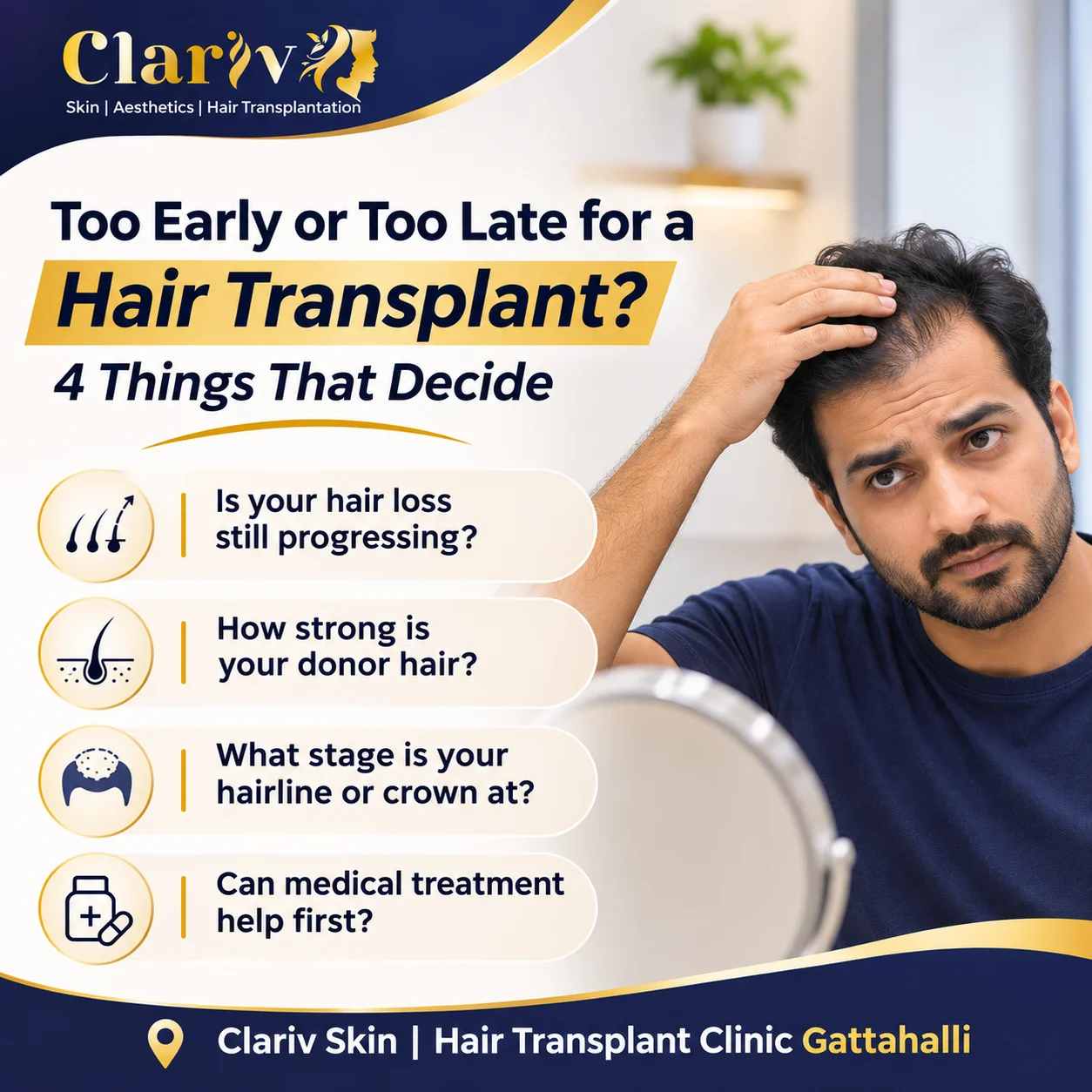
“Am I too young for a hair transplant?” and “Have I waited too long?” are two of the most common worries people carry into a hair clinic. Both come from the same place: nobody wants to rush into a procedure, and nobody wants to miss the right moment either.
The honest answer is that there is no single perfect age or stage. What matters is how stable your hair loss is, how much healthy donor hair you have, and what you want to achieve. If you are thinking about visiting a hair transplant clinic Gattahalli, this guide will help you understand where you stand before you book.
Why Timing Matters in Hair Restoration
A hair transplant moves hair from a permanent area, usually the back and sides of the scalp, to the thinning areas. The transplanted hair is meant to keep growing, but the natural hair around it can continue to thin if the underlying cause is still active. This is why timing is not a small detail. It decides how natural your result looks years later.
What Happens If You Go Too Early
When hair loss is still progressing, a transplant can fix today’s hairline but leave you with gaps later. Imagine a young person who restores the front hairline while the crown keeps thinning. Over time, the transplanted front can look like an isolated patch against the surrounding loss. A careful doctor plans for the future pattern of your hair loss, not only for what is visible today.
What Happens If You Wait Too Long
On the other side, waiting for years without any assessment can reduce your options. Advanced hair loss may mean a larger bald area to cover with the same limited donor supply. Early diagnosis, even if you do not plan a transplant, gives you time to slow the loss with medical treatment and keep more choices open.
Understanding the Stages of Hair Loss
Doctors often describe hair loss in stages. You do not need to memorise the scales, but a basic idea helps you follow what the doctor explains.
Early Stage: Thinning and a Slowly Moving Hairline
You may notice a wider forehead, thinner temples or a parting that looks broader than before. At this stage, medical treatment and scalp care often play the main role. A transplant is usually discussed only if the pattern is clear and the loss has slowed.
Middle Stage: Visible Gaps and Reduced Density
Here the hairline has moved back noticeably, or the crown shows clear thinning. This is the stage when many people start asking about a transplant. The doctor will check how stable the loss is and whether your donor area can support the coverage you want.
Advanced Stage: Large Areas of Loss
When a large part of the scalp has lost hair, the question becomes how much can realistically be covered. Some patients still benefit from a transplant, but expectations need to be set honestly. Density in every area may not be possible, and the doctor may suggest focusing on the areas that frame the face, such as the hairline.
Is Age the Deciding Factor?
People often ask for a minimum age, but age alone cannot answer the question.
Hair Loss in Your Early 20s
Hair loss can begin early, and it is natural to want a quick fix. At this age, however, the pattern is still unfolding. Doctors often prefer to observe, treat medically and plan carefully before recommending surgery.
Hair Loss in Your 30s and 40s
Many patients decide on a transplant in this range because their pattern has become clearer. The loss may have slowed, and the donor area is usually healthy. This is often a comfortable window for planning, though every case is different.
Hair Loss in Your 50s and Beyond
Age does not close the door on a transplant. What matters is overall health, the quality of the donor hair and whether any medical conditions or medicines affect the plan. The doctor will review these before suggesting anything.
Donor Hair: The Quiet Factor Behind Every Decision
Your donor area is the supply that makes a transplant possible. If it is strong, the doctor has more flexibility. If it is limited, planning becomes more careful.
Why Donor Quality Is Checked First
Thick, healthy donor hair in the back and sides of the scalp usually gives better coverage. Thin or weakened donor hair may limit how many grafts can be taken. This is one reason an examination in person matters more than any online opinion.
Why Natural Hair Still Needs Care
Transplanted hair is not the only hair on your head. The natural hair around it continues to age and may continue to thin. Many doctors suggest medical treatment alongside a transplant to protect what you already have.
When a Doctor May Say “Not Yet”
A good clinic will sometimes advise you to wait. This is not a rejection; it is part of responsible care. Common situations include:
- Hair loss that is still progressing quickly
- Shedding caused by stress, illness, nutrition gaps or hormonal changes that can still be corrected
- Scalp conditions that need treatment first
- Expectations that do not match what is achievable
- A donor area that is not yet strong enough for the plan you want
In these cases, treating the cause first often gives you a better foundation, and the transplant discussion can return later if it is still needed.
What You Can Do While You Decide
Waiting does not mean doing nothing. These habits support healthier hair whatever you decide.
Get Your Scalp and Hair Assessed
A proper examination tells you what is happening instead of leaving you to guess. Even if you are not ready for a procedure, the information is valuable.
Look at Everyday Factors
Poor sleep, long periods of stress, crash diets and low protein or iron intake can all affect hair. Small improvements in these areas will not fix pattern hair loss, but they support overall hair health.
Avoid Quick Fixes
Heavily advertised oils, supplements and gadgets often promise more than they deliver. Ask the doctor which products, if any, are worth using for your case.
Track Your Progress
Photos taken every few months in similar lighting help you and your doctor see whether your hair loss is slowing, steady or speeding up.
Questions to Bring to Your First Consultation
Coming prepared makes the visit more useful.
- What stage is my hair loss, and is it still active?
- Is a transplant suitable now, or should I try medical treatment first?
- How strong is my donor area?
- What are realistic results for my hair type?
- How will my natural hair be protected in the future?
- What does recovery look like, and how many follow-up visits are needed?
How Clariv Skin Approaches the Question
At Clariv Skin, a skin, hair and aesthetic clinic in Bangalore, we treat the consultation as the most important part of the journey. The doctor examines your scalp, discusses your hair loss pattern, and explains in simple language whether a transplant makes sense now, later or not at all. There is no pressure to decide on the first visit. If you are looking for a hair transplant clinic Gattahalli where you can ask your questions openly, our team is happy to help you understand your options.
Other Locations Across Bangalore
Skin and Aesthetic Care Beyond Hair
Hair and skin concerns often go together. Alongside hair restoration, Clariv Skin offers dermatology consultations, acne and pigmentation care, chemical peels, dermal fillers and facial aesthetic treatments. If scalp irritation or dandruff is part of your hair story, the doctor can look at that during the same visit.
Final Thoughts
So, is it too early or too late? For most people, it is neither. The better question is whether you understand your hair loss well enough to make a confident decision. An honest assessment from a doctor can tell you whether to treat, wait or plan a transplant. When you are ready, book a consultation at a hair transplant clinic Gattahalli and bring your questions. A clear conversation today can protect both your hair and your peace of mind.
Contact Details
Clariv Skin — Hair, Skin & Aesthetic Clinic
Phone: +91 77600 56665
Emil ID: [email protected]
Website: www.clarivskin.in
Address: G floor, Saptagiri, No.203, 15th Cross, 4th main, Ananth Nagar, Phase 1, Kammasandra, Electronic City, Hebbagodi, Karnataka 560100















.webp)