Sign up with Google
 Sign in with Zoho

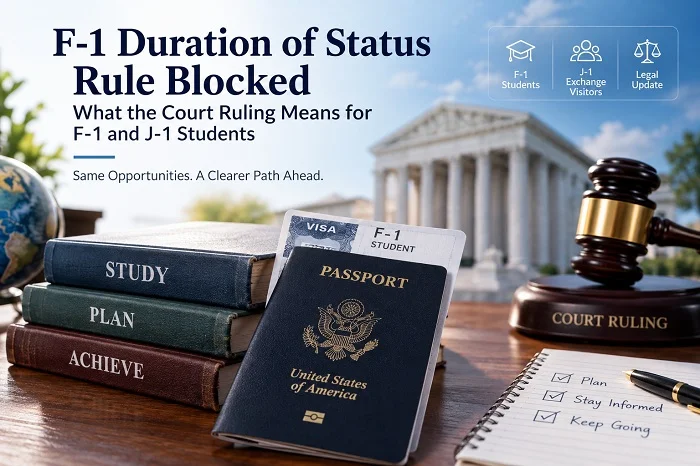
For years, international students in the United States have relied on a simple immigration concept: duration of status. Instead of receiving a fixed admission period, eligible F-1 students are generally admitted for D/S, allowing them to remain while they maintain their student status and meet the conditions of their program.
That system was scheduled for a major change in September 2026. The Department of Homeland Security planned to introduce fixed admission periods, generally capped at four years. But on September 14, a federal judge in Massachusetts issued a nationwide preliminary injunction blocking the rule before it could take effect.
For students, the immediate situation is relatively clear. The new four-year framework did not take effect. The uncertainty lies in what happens next.
The Four-Year Limit That Never Took Effect
The proposed rule would have replaced the familiar D/S system with a fixed period of admission. Students who needed additional time beyond that period would have faced a new extension-of-stay process through USCIS.
That change could have affected students very differently depending on their degree. A student completing a three-year master's program might rarely encounter the proposed four-year ceiling. A doctoral student, however, could face a very different situation.
Research programs often do not follow perfectly predictable schedules. Experiments fail. Data collection takes longer than expected. Dissertation revisions can add months. Under the proposed system, those delays could have created immigration consequences in addition to academic ones.
The rule also proposed shortening the F-1 post-completion grace period from 60 days to 30 days. Additional restrictions involving transfers, changes in educational objectives and pursuing additional degrees were included as well.
Because the injunction arrived before implementation, those changes remain on hold.
Why the Court Blocked the Policy
The court's decision did not simply declare the proposed immigration policy unacceptable. The judge's concerns focused on how DHS developed and justified the rule.
The court found that the plaintiffs were likely to succeed on claims under the Administrative Procedure Act. Among the concerns were DHS's treatment of the rule's costs and benefits, its consideration of less burdensome alternatives and its response to substantial public comments.
Nearly 22,000 public comments had reportedly been submitted during the rulemaking process. The court also questioned whether DHS had adequately demonstrated how the new system would advance the agency's stated objectives.
That distinction is important for international students. The injunction is preliminary and procedural. It does not necessarily settle whether a similar policy could appear again after further legal or administrative action.
In other words, students have more time, but the underlying debate has not disappeared.
What D/S Means for Students Today
For now, F-1 and J-1 students remain under the existing duration-of-status framework covered by the injunction.
Students do not need to file a new extension simply because the proposed four-year rule was announced. The new extension requirement never took effect. Likewise, the existing 60-day post-completion grace period remains in place under the current framework described in the source material.
This is particularly relevant for students approaching graduation or considering a longer academic pathway.
A student thinking about transferring universities, changing an educational objective or pursuing another degree also has more room to plan because the proposed restrictions are currently blocked.
That does not mean students should make decisions based on assumptions about what will happen months from now. Their designated school official remains the appropriate person to discuss individual immigration records and academic plans.
Academic Delays Can Become More Important
The proposed rule highlights a connection students sometimes overlook: academic progress and immigration planning can affect each other.
Imagine a PhD candidate entering the fourth year of a research program. Their dissertation is nearly finished, but an important experiment produces inconclusive results. The student needs another semester to repeat the work and complete the thesis.
Under the existing D/S system, the student's situation is handled within the current status framework as long as the student continues meeting the applicable requirements. Under the proposed fixed-period model, additional time could have required a USCIS extension.
That is why students should take academic planning seriously even while the rule remains blocked.
For major literature reviews, students can also seek subject-focused academic guidance when they need help understanding sources, organizing research or developing a clear academic structure. Expertsmind's Literature Review Homework Assignment Help is one resource students can explore for this type of coursework.
The same principle applies to larger research assignments. Students working through research questions, methodology, analysis and academic writing may find Expertsminds' Research Paper Help useful as an additional academic resource.
Academic support cannot predict immigration outcomes, but better planning can reduce avoidable delays in completing a program.
What Students Can Do During the Pause
The current pause creates an opportunity to prepare rather than react.
Students should first review their expected completion timeline with their DSO. Those enrolled in programs that could extend beyond four years have particular reason to understand how much time remains and what options exist if their circumstances change.
Keeping immigration documents organized is another practical step. Students should retain copies of their I-20 or DS-2019, I-94, enrollment records and relevant travel information.
It is also worth following the legal case through reliable sources. The attached resource notes a status conference scheduled for October 2, 2026, while organizations involved in international education and immigration continue to track developments.
Most importantly, students should separate what is happening now from what might happen later. The four-year rule is not currently being enforced simply because it was published. The injunction prevents its implementation while the litigation continues.
A Temporary Pause, Not a Final Answer
The duration of status dispute could develop in several ways. The government may appeal the injunction. The existing case could eventually produce a final ruling. DHS could also attempt another version of the policy after addressing the procedural concerns identified by the court.
None of those possibilities should be treated as a guaranteed outcome.
For international students, the practical response is preparation. Know your degree timeline. Keep your documents current. Maintain communication with your DSO and pay attention to official developments.
The proposed four-year system may have been stopped before it began, but the questions it raised about academic timelines, immigration administration and student planning are likely to remain relevant. For students, the smartest preparation is not predicting the next court decision. It is making sure their academic and immigration records are ready for whichever framework ultimately applies.








 🌎🔒#gdupco.webp)