Sign up with Google
 Sign in with Zoho

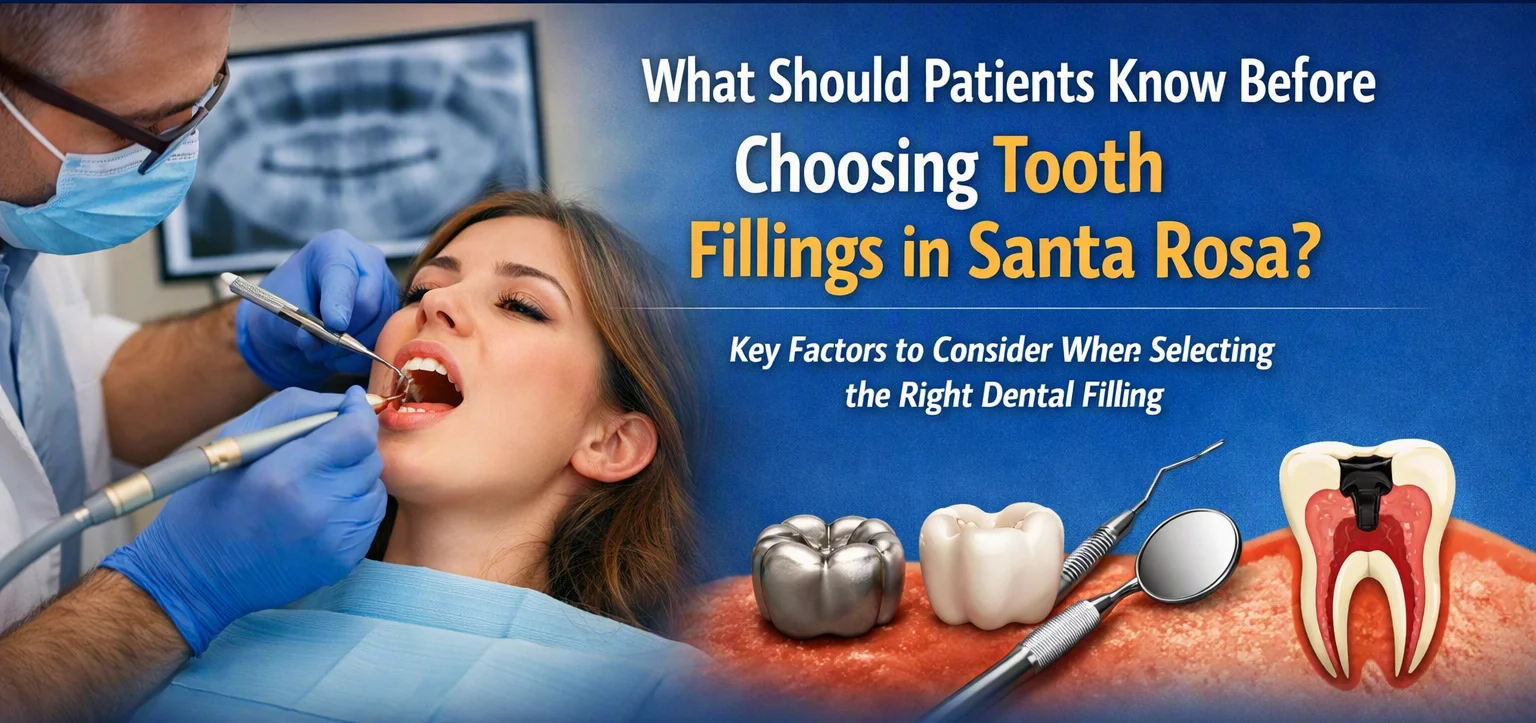
Choosing tooth fillings in Santa Rosa is usually less complicated than patients expect, but the right restoration depends on more than simply finding a cavity. The size and location of the decay, remaining tooth structure, material used, bite forces, and whether the decay has reached deeper parts of the tooth can all affect treatment decisions.
One important distinction is that very early tooth decay may sometimes be managed without a filling, while an established cavity that has created a hole in the tooth generally requires restorative treatment. The National Institute of Dental and Craniofacial Research (NIDCR) explains that early mineral loss can potentially be reversed, but once a cavity forms, the damaged tooth structure must be repaired.
Editorial note: Santa Rosa Beach, Florida, is a different community from Santa Rosa, California. This article follows the supplied target market and keyword, which are centered on Santa Rosa and surrounding Sonoma County communities in California.
Key Takeaways
- Not every early cavity requires a conventional filling; noncavitated decay may sometimes be managed with preventive or nonrestorative approaches.
- Once a true cavity has formed, a filling can restore the lost tooth structure and help prevent further breakdown.
- Composite resin, amalgam, glass ionomer, and resin-modified glass ionomer are among the direct restorative materials used in dentistry, with different indications and limitations.
- The best material depends on factors such as cavity location, size, moisture control, chewing load, aesthetics, and the condition of the tooth.
- Patients should ask not only “Which filling should I get?” but also “How extensive is the decay, and what treatment preserves the most healthy tooth structure?”
What exactly does a dental filling treat?
A dental filling is used to restore a tooth after decay has removed part of its structure. During treatment, the dentist removes diseased tooth tissue and fills the resulting space with a restorative material.
That sounds straightforward, but there is an important decision before the filling itself: does the tooth actually need a restoration yet?
Dental caries is a disease process rather than simply a hole in a tooth. Early lesions can involve mineral loss without a physical cavity. According to NIDCR, fluoride and saliva can help remineralize enamel during these early stages. Once mineral loss progresses to a true cavity, however, the damage is permanent and requires restorative treatment.
This distinction is useful for patients because it shifts the conversation from “fill every spot” to identify the stage of disease and choose the least invasive appropriate treatment.
What should patients ask before getting tooth fillings in Santa Rosa?
Before agreeing to treatment, patients can ask a general dentist several practical questions:
- Has the decay formed an actual cavity?
- How deep is the lesion?
- How much healthy tooth structure remains?
- Is the tooth experiencing sensitivity or pain?
- What material is being recommended, and why?
- Could a more conservative treatment be appropriate?
- Does the tooth have enough structural integrity for a filling, or might it require a larger restoration?
The ADA's evidence-based restorative caries guideline specifically addresses both caries-removal approaches and direct restorative materials. Its recommendations support treatment decisions based on the characteristics of the lesion and tooth rather than applying one restoration to every situation.
Does every cavity require the same type of filling?
No. The material selected can depend on the tooth and the clinical circumstances.
The ADA identifies several categories of direct restorative materials, including amalgam, resin-based composite, glass ionomer, and resin-modified glass ionomer. Each has different characteristics and clinical applications.
For example, tooth-colored composite resin can be attractive when appearance matters because it can be matched to the surrounding tooth. However, the suitability of composite is influenced by factors such as cavity size and the ability to maintain appropriate moisture control during placement.
The important point is that “tooth-colored” does not automatically mean “appropriate for every cavity.” Material selection should follow the clinical requirements of the restoration.
Are old silver fillings automatically a reason for replacement?
Not necessarily.
Dental amalgam has been used for decades, and patients sometimes consider replacing intact amalgam simply because they prefer tooth-colored restorations. However, removal is not automatically indicated merely because an existing filling contains amalgam.
NIDCR notes that the FDA does not recommend removing intact amalgam fillings solely because they contain mercury; removal itself can increase exposure to mercury vapor. Patients with concerns about an existing restoration should discuss its condition and available alternatives with their dentist rather than assuming replacement is necessary.
This is an important consideration for anyone researching tooth fillings in Santa Rosa, particularly patients who have older restorations and are considering elective replacement.
When might a filling not be enough?
A filling is designed to restore a tooth with localized loss of structure. If decay or damage has substantially weakened the tooth, a larger restoration may be more appropriate.
NIDCR distinguishes direct restorations, such as fillings, from indirect restorations such as crowns, which can be used for more substantial damage.
Likewise, significant pain or symptoms suggesting deeper pulpal involvement may require additional evaluation rather than simply placing a filling. Untreated advanced decay can lead to infection, abscess formation, and tooth loss.
Therefore, patients searching for a general dentist Santa Rosa CA should look for an evaluation that considers the whole tooth—not simply whether a filling can technically be placed.
What makes a good filling decision different from a purely cosmetic decision?
Appearance matters, particularly for visible teeth, but restoration planning should also consider function, durability, tooth preservation, and recurrence of decay.
The performance of a restoration can be affected by the material, the size and location of the restoration, how it is placed, and the chewing forces applied to the tooth.
A useful way to evaluate the decision is:
Disease stage → remaining tooth structure → restoration requirements → material selection → maintenance and prevention
This framework helps explain why the same material may be appropriate for one patient but not another.
How can patients reduce the chance of needing another filling?
A filling repairs the consequence of tooth decay; it does not eliminate the factors that caused the disease.
NIDCR recommends fluoride use, regular brushing with fluoride toothpaste, cleaning between teeth, and limiting frequent exposure to sugary foods and drinks as part of cavity prevention.
Patients at elevated caries risk may also benefit from individualized preventive strategies. The ADA notes that fluoride therapies and other interventions can be incorporated according to a patient's risk level and clinical circumstances.
For Sonoma County residents considering treatment, Buzza Dental Group provides information about its approach to tooth fillings in Santa Rosa, including symptoms that can warrant an evaluation and the restorative options available at its Santa Rosa practice.
Conclusion
The right approach to tooth fillings in Santa Rosa starts with understanding the condition of the tooth rather than choosing a material based solely on appearance or habit. Early noncavitated decay may sometimes be managed without conventional restoration, while an established cavity generally requires repair.
Patients should discuss the depth and location of decay, remaining tooth structure, restorative alternatives, material characteristics, and long-term prevention with their dentist. For residents of Santa Rosa, Rohnert Park, Windsor, Sebastopol, Cotati, Healdsburg, Petaluma, Sonoma, and nearby Sonoma County communities, a comprehensive examination can help determine whether a filling is appropriate and which restorative approach best fits the individual tooth.
FAQs
How do I know if I have a cavity?
Cavities may cause tooth sensitivity, pain, visible discoloration, or a hole in the tooth, but early decay often produces no symptoms. Dental examinations and, when appropriate, X-rays can help identify decay that is not obvious to the patient.
Can an early cavity heal without a filling?
Early tooth decay before a physical cavity forms can sometimes be stopped or reversed through remineralization, particularly with fluoride. Once a cavity has formed, the lost tooth structure cannot simply grow back and generally requires restoration.
Are composite fillings better than amalgam fillings?
Neither material is universally appropriate for every situation. Composite and amalgam have different characteristics, indications, and limitations. The appropriate choice depends on factors such as cavity size, location, aesthetics, and clinical conditions.
Should an old amalgam filling be replaced?
Not automatically. An intact amalgam filling does not necessarily need removal simply because it contains mercury. A dentist can evaluate whether it is damaged, leaking, recurrently decayed, or otherwise appropriate for replacement.
Can a large cavity still be treated with a filling?
Sometimes, but not always. When substantial tooth structure has been lost, a crown or another indirect restoration may provide a more appropriate treatment. The decision depends on the remaining tooth structure and overall condition.