Sign up with Google
 Sign in with Zoho

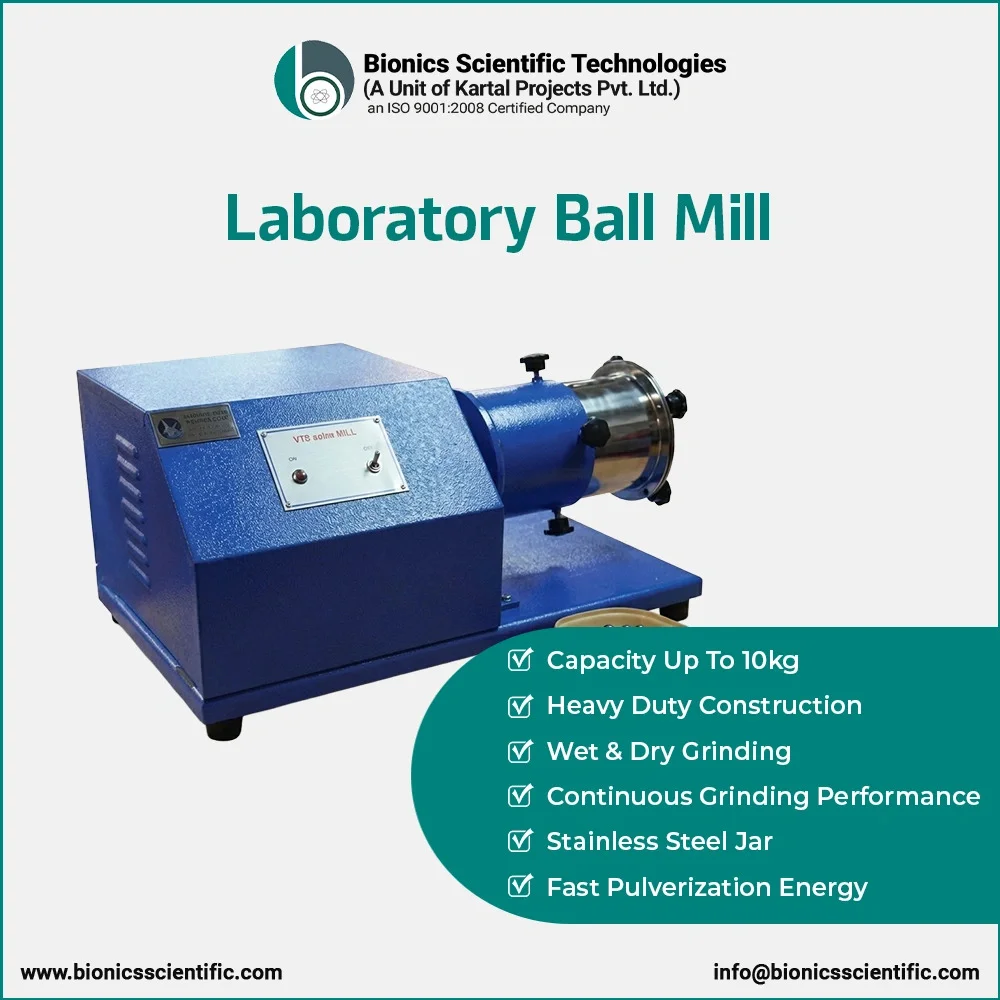
Your medication, the ceramics you use in your kitchen, or the concrete foundation of your house – there is a big possibility that some of these have been ground using the ball mill. It is just one of those machines that have been used across many different industries throughout the years without receiving proper recognition – it is a rotating cylindrical device which uses grinding media for grinding hard and brittle materials for more than a hundred years but somehow never gets replaced.
Working Principle of a Ball Mill
It all revolves around two forms of mechanical force. As the hollow cylindrical shell rotates either horizontally or vertically, grinding media in the form of balls made of ceramic, steel, zirconia, or tungsten carbide are cascaded into the shell to collide with the material being ground. One of them is the impact force which occurs when balls fall and strike the material. The other is the attrition force which occurs when the balls grind not only the material but also with each other. These two combine to reduce the particle size until they reach a particular size.
All Ball Mills Are Not Built the Same Way
Planetary ball mills use the principles of the ball mill but with centrifugal force applied to it to throw the grinding media against the jar walls rather than rely solely on tumbling action. This makes them very effective for making nanoparticles since planetary and high energy ball mills are capable of grinding particles with size less than 1 micron though this results in excessive heat generated during the process. Vibratory ball mills use rapid oscillations instead of rotation. Research proved that the size of grinding media can affect the processing time as changing from 12mm to 15mm grinding media reduces processing time by 22%.
Wet vs. Dry Milling
Ball mill can be operated both wet and dry, and the difference is more important than one could expect. In wet ball milling, materials get suspended in a liquid medium, which helps to lubricate the grinding surface, lower the friction between particles, and dissipate heat more efficiently compared to dry milling alone. Wet ball milling is considered the most effective way to create really fine powder since it is used for particle size reduction of poorly water-soluble pharmaceutical compounds for enhanced bioavailability. Although dry milling is simpler and does not require an additional step of solvent removal afterwards, it cannot produce such small particles.
Real Applications of the Equipment
Its range is much wider than many people would think. In pharmaceutical field, ball mills reduce particle sizes of medications and prepare them for making nanosuspensions. In mining industry and cement making, ball mills grind ores and raw mineral products to fine powder. In materials science, ball mills are used for mechanical alloying when new composite materials are formed by cold welding and breaking the powder particles. Even in biotechnological laboratories, there are smaller ball mills used for disruption of cell walls for extraction of proteins and DNA – another application of ball mills that has nothing to do with mining, yet uses the same principles and grinding media.
Conclusion
It is hard to imagine another piece of equipment that combines as wide range of applications as ball mill. From preparation of nanosuspensions to grinding of cement clinker or disrupting cell walls in biotechnical laboratories, the principles remain the same: grinding media, impact, attrition, and rotation control. That's precisely what makes ball mill so valuable across many fields of modern industry.