Sign up with Google
 Sign in with Zoho

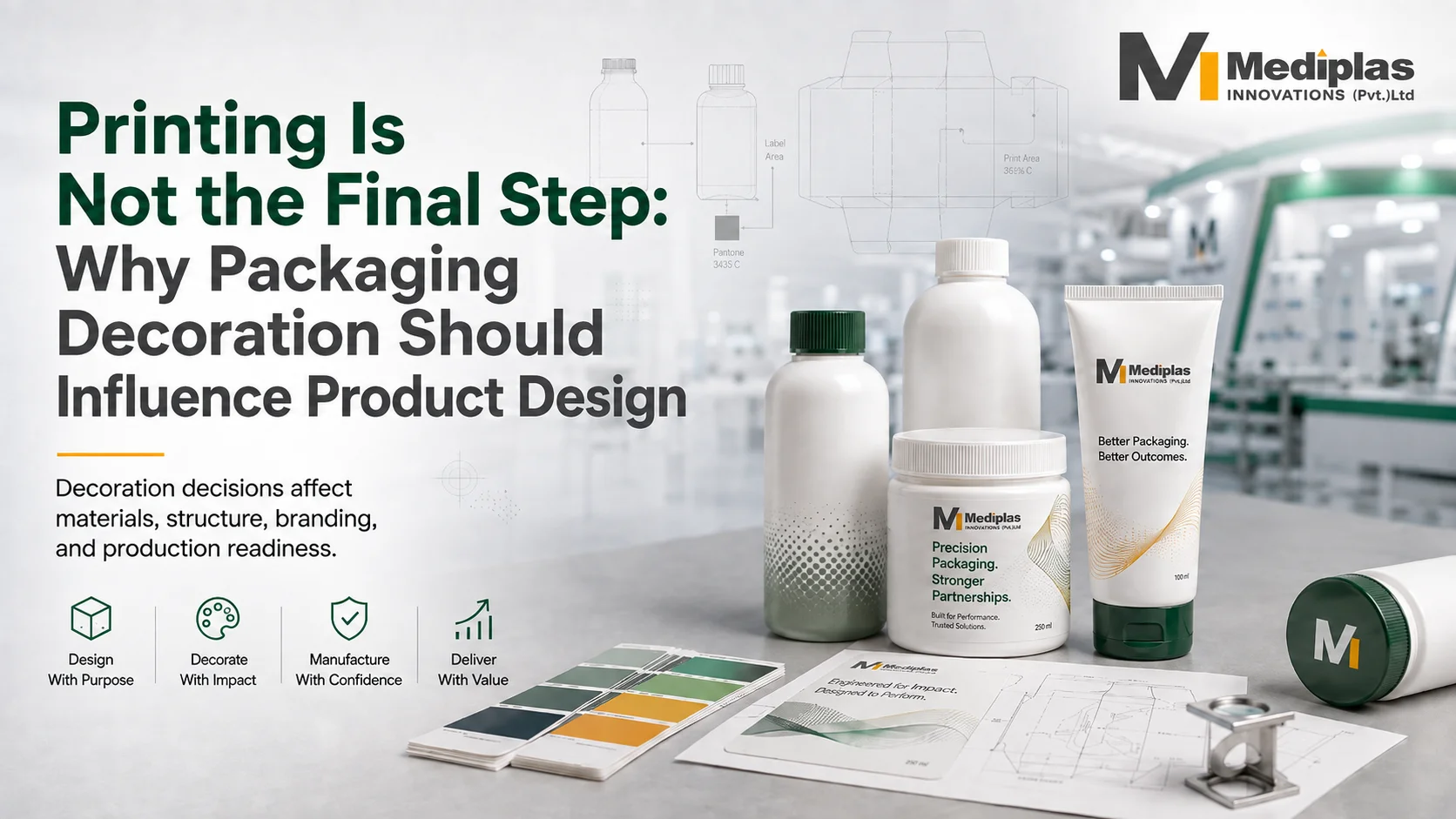
A common packaging-development sequence goes something like this:
Design the bottle.Approve the mould.Manufacture the samples.Then ask where the logo should go.
That order can work when the package already offers a generous, simple printable area.
For more distinctive bottles, jars and moulded plastic components, it can create unnecessary limitations.
Packaging decoration is often more successful when it is considered while the product is being designed.
The Artwork Lives on a Physical Object
A designer working on a computer sees a flat canvas.
The packaging manufacturer sees:
- curves
- ribs
- shoulders
- tapers
- handles
- moulding marks
- limited printable areas
Those physical details can determine how artwork can actually be applied.
The Best Branding Panel May Need to Be Designed In
If a bottle needs a prominent logo or regulatory text, the design can provide a suitable area intentionally.
This can be more effective than trying to squeeze branding between decorative features after the mould is complete.
Different Decoration Processes Have Different Strengths
No single process solves every branding challenge.
Packaging may use techniques such as:
- silk-screen printing
- pad printing
- UV-related printing
- laser marking or engraving
- labels or other approaches
The appropriate choice depends on the component and visual objective.
Colour Changes the Decision
If a brand identity relies on multiple colours, gradients or detailed graphics, its requirements differ from a minimal logo that can be permanently marked into a component.
Define the artwork before the final decoration process is selected.
Small Text Creates Practical Limits
Packaging often carries more information than a logo.
Depending on the product, brands may need:
- product name
- usage information
- measurement marks
- identification
- other required text
Very small artwork may look perfect on screen but prove difficult to reproduce clearly on a curved physical component.
Curvature Can Distort the Visual Result
A large print across a sharply curved bottle can behave differently from the same artwork on a flat panel.
The design team should understand:
- where the user views the artwork
- how much of it appears at once
- whether curvature changes proportions
- whether a different decoration process would be more suitable
Material Surface Matters
Plastic is not one universal printing surface.
Different resins, finishes and component designs can require different preparation and process choices.
The real component should therefore form part of decoration trials rather than assuming a process will behave identically on every plastic.
Durability Should Match the Product's Life
A cosmetic bottle handled with wet hands experiences different conditions from an industrial component used primarily for identification.
A pharmaceutical dosing component may prioritize legibility.
A premium jar may prioritize appearance.
Decoration should be chosen according to the package's actual environment.
Volume Changes the Economics
A method that works well for a small development batch may not be the best commercial option for a large repeat order.
Expected quantities should be part of the discussion from the beginning.
Printing and Moulding Teams Should Talk
When packaging production and decoration are treated as completely separate worlds, preventable problems can appear.
The product-development team should know:
- where artwork will go
- what process is proposed
- what surface is needed
- how the component will be held or oriented during decoration
That information can influence moulded geometry.
Branding Consistency Is a Manufacturing Issue
Marketing may define the acceptable appearance.
Manufacturing has to reproduce it.
Commercial production requires consistency in:
- position
- orientation
- colour
- clarity
- coverage
Physical Samples Beat Mock-Ups
A digital rendering is excellent for evaluating creative direction.
A physical decorated sample answers different questions:
Is the logo large enough?Is the colour correct against the bottle?Does the artwork remain readable around the curve?Does the finish suit the perceived price of the product?
Do Not Choose a Process Because It Sounds Premium
“Laser engraved” may sound premium.
“UV printed” may sound advanced.
“Screen printed” may sound established.
Those labels are irrelevant if the process does not suit the actual design.
The package, artwork and use case should determine the technique.
A Practical Decoration Brief
Before speaking with a manufacturer, prepare:
- The physical component or drawing
- Plastic/material information if known
- Artwork files
- Required colours
- Preferred print position
- Expected quantities
- Durability expectations
- Reference samples
Comparing Decoration Options
Businesses that need to decide between screen printing, pad printing, UV-related methods and laser marking can review a broader comparison of plastic packaging printing methods before locking artwork and tooling.
Final Thoughts
Decoration is not something that happens to packaging after the “real” development is finished.
It is part of the product consumers and operators actually see and handle.
When branding requirements influence the physical design early, both manufacturing and marketing gain more room to create a coherent final package.