Sign up with Google
 Sign in with Zoho
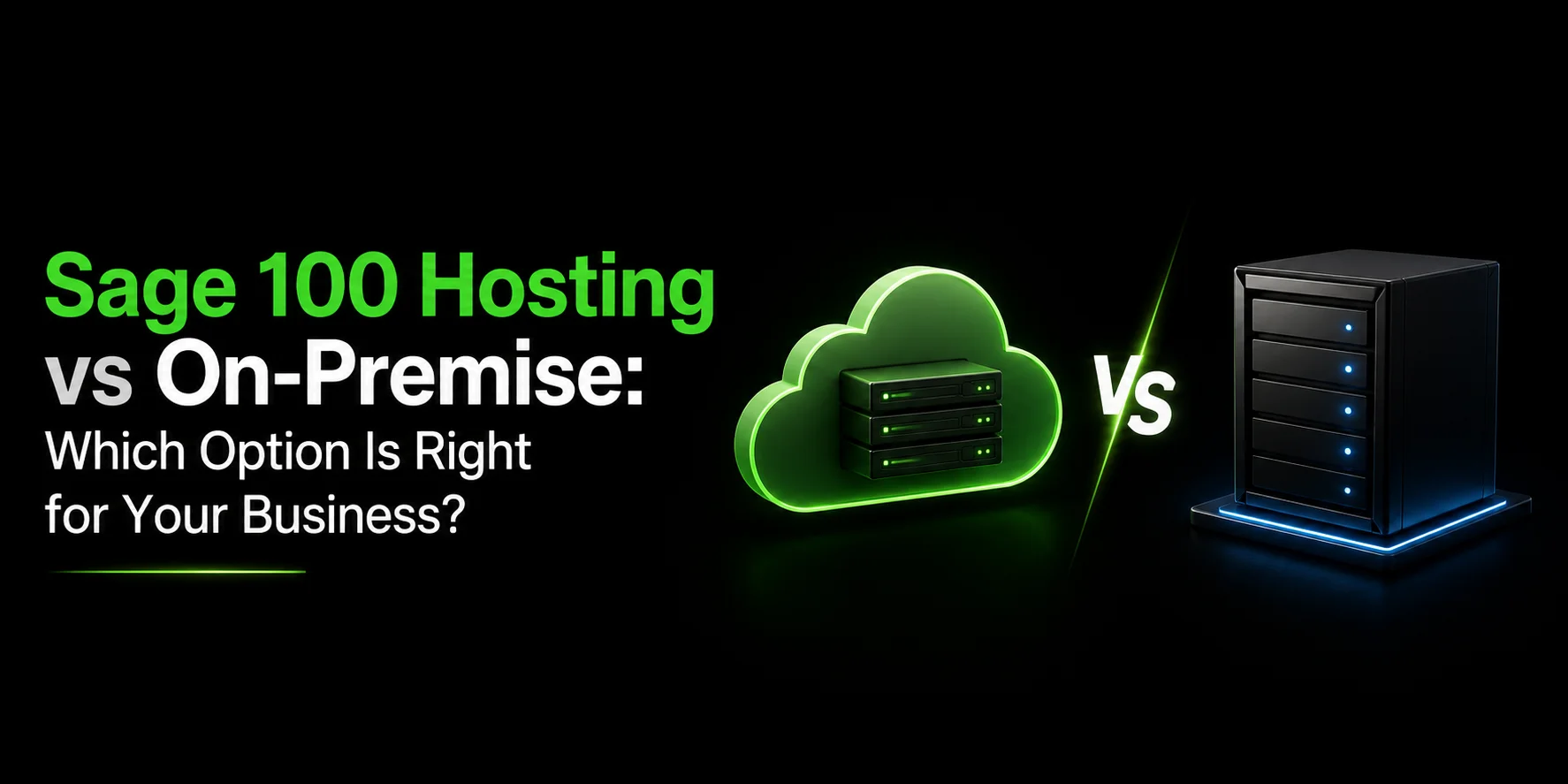
Choosing how to deploy your accounting and ERP software is one of the most consequential IT decisions a growing business will make. For companies running Sage 100, the debate often comes down to two paths: keep the software installed on local servers (on-premise), or move it to the cloud through Sage 100 hosting. Both approaches can get the job done, but they differ significantly in cost, flexibility, security, and long-term scalability.
This article breaks down the key differences between Sage 100 hosting and on-premise deployment to help you decide which model fits your business best.
What is Sage 100 On-Premise?
On-premise deployment means Sage 100 is installed directly on servers and workstations that your business owns and manages physically, typically within your own office or a company-owned data center. Your internal IT team (or a contracted provider) is responsible for hardware maintenance, software updates, backups, security patches, and troubleshooting.
This model has been the traditional standard for decades, and many established businesses still run it today, particularly those with strict data residency requirements or highly customized legacy configurations.
What Is Sage 100 Hosting?
Sage 100 hosting moves your ERP environment to a cloud-based infrastructure managed by a third-party hosting provider. Instead of maintaining physical servers, your business accesses Sage 100 remotely through a secure connection, from any device, anywhere with an internet connection.
The hosting provider takes care of server maintenance, data backups, security updates, disaster recovery, and uptime monitoring, freeing your internal team to focus on core business operations rather than IT upkeep.
Sage 100 Hosting vs On-Premise: Key Differences
Here’s a closer look at how both options differ:
1. Cost Structure
On-Premise: Requires a significant upfront capital investment in servers, networking equipment, and IT infrastructure. Businesses also bear ongoing costs for hardware replacement, electricity, cooling, and dedicated IT staff.
Hosted Sage 100 : Operates on a predictable, subscription-based (OPEX) model. There's little to no upfront hardware investment, and costs scale with usage, making budgeting easier for growing businesses.
2. Accessibility and Remote Work
On-Premise: Access is typically limited to the office network unless a VPN or remote desktop solution is separately configured, which can introduce additional complexity and security gaps.
Hosted Sage 100: Built for remote and hybrid work from day one. Employees, accountants, and stakeholders can securely log in from any location or device, supporting distributed teams and multi-location operations.
3. Security and Compliance
On-Premise: Security is entirely the responsibility of your internal team. This can be effective but requires continuous investment in firewalls, antivirus tools, patch management, and staff expertise.
Hosted Sage 100: Reputable hosting providers offer enterprise-grade security including multi-factor authentication, data encryption, 24/7 monitoring, and compliance support for standards relevant to finance and accounting operations.
4. Scalability
On-Premise: Scaling up means purchasing and installing additional hardware, a process that takes time, capital, and planning.
Hosted Sage 100: Resources can be scaled up or down quickly based on business needs, making it easier to accommodate seasonal demand, growth, or additional users without major infrastructure changes.
5. Maintenance and IT Overhead
On-Premise: Requires dedicated IT staff or contractors to manage updates, troubleshoot issues, and maintain hardware, an ongoing operational burden.
Hosted Sage 100: The hosting provider manages server maintenance, patching, and updates, significantly reducing the burden on internal IT resources.
6. Disaster Recovery and Uptime
On-Premise: Backup and disaster recovery must be independently designed and maintained, and recovery times can be lengthy if hardware fails.
Hosted Sage 100: Providers typically include automated backups, redundant infrastructure, and disaster recovery protocols, minimizing downtime risk and data loss.
Which Option Is Right for Your Business?
Consider On-Premise if:
- You have strict regulatory requirements mandating physical data control
- You already have significant investment in existing infrastructure
- You have a robust in-house IT team with capacity to manage servers
Consider Sage 100 cloud hosting if:
- You want predictable monthly costs without large upfront capital expenditure
- Your team works remotely, across multiple locations, or needs flexible access
- You want to minimize IT maintenance overhead and rely on expert-managed infrastructure
- You need scalability to support business growth without hardware constraints
- You want built-in disaster recovery and stronger uptime guarantees
For most small to mid-sized businesses today, the flexibility, cost predictability, and reduced IT burden of hosting make it the more practical long-term choice, especially as remote and hybrid work continue to shape how teams operate.
Conclusion
Both on-premise and hosted deployments can run Sage 100 effectively, but they come with very different cost structures, maintenance demands, and flexibility. If your business values predictable costs, secure remote access, and freedom from day-to-day server management, Sage 100 cloud hosting is generally the stronger long-term option.
If you're evaluating a move to the cloud, Apps4Rent offers managed Sage 100 cloud hosting solutions built around enterprise-grade security, 24/7 support, and reliable uptime, making the transition from on-premise infrastructure straightforward for growing businesses. Their team can help assess your current setup and recommend a hosting plan tailored to your workflow, user count, and compliance requirements.
Frequently Asked Questions (FAQs)
1. Is Sage 100 cloud Hosting secure enough for financial data?
Yes. Reputable Sage 100 cloud hosting providers implement enterprise-grade security measures including data encryption, multi-factor authentication, firewalls, and continuous monitoring, often exceeding the security level most small businesses can maintain in-house.
2. Can I migrate from on-premise Sage 100 to a hosted environment without losing data?
Yes. A properly managed migration process involves data backup, environment setup, testing, and validation to ensure a seamless transition without data loss or extended downtime.
3. How much does cloud-based Sage 100 cost compared to on-premise?
Hosting typically operates on a predictable monthly subscription model, which is often more cost-effective than on-premise in the long run once you factor in hardware, maintenance, IT staffing, and upgrade costs.
4. Can multiple users access cloud-based Sage 100 simultaneously?
Yes. Hosted environments are designed to support multiple concurrent users across different locations and devices, making it ideal for businesses with remote teams or multiple offices.
5. What happens if there's a server outage with hosted Sage 100?
Hosting providers typically maintain redundant infrastructure and disaster recovery protocols, ensuring minimal downtime and rapid restoration of services compared to recovering from a hardware failure on an on-premise server.