Sign up with Google
 Sign in with Zoho


Running a modern call center is no small feat. Customer expectations are at an all-time high, agents are handling increasingly complex issues, and managers are drowning in data. Traditionally, evaluating agent performance meant manually reviewing a tiny fraction of total calls—often less than 1%—using a static spreadsheet.
That approach is no longer cutting it. Enter AI QMS software and intelligent call center quality assurance scorecards.
By integrating artificial intelligence into Quality Management Systems (QMS), organizations are shifting from reactive spot-checking to proactive, 100% automated performance visibility. Let’s dive into how AI-driven tools are reshaping customer service quality assurance (QA) and why your call center needs to make the switch.
What is AI QMS Software?
A Quality Management System (QMS) traditionally helps contact centers monitor, evaluate, and improve agent performance and customer interactions. However, legacy QMS solutions rely heavily on human auditors who listen to recorded calls, fill out forms, and score agents manually.
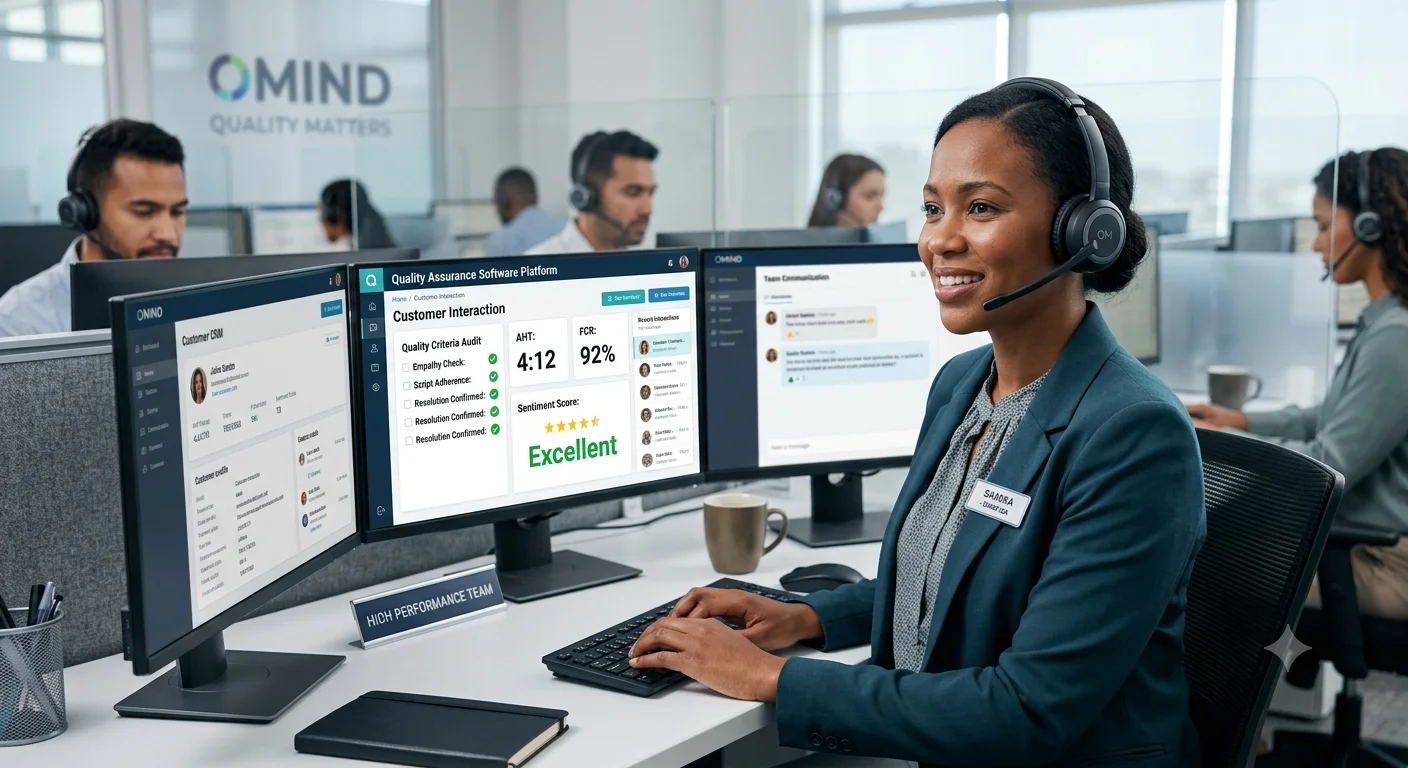
AI QMS software supercharges this process. By leveraging Natural Language Processing (NLP), speech-to-text transcription, and sentiment analysis, AI-powered systems can analyze every single customer interaction—voice calls, chats, and emails—at scale.
Instead of guessing whether your agents are adhering to compliance standards or showing empathy, AI QMS software analyzes the entire conversation instantly, flagging coaching opportunities and highlighting exceptional service.
The Evolution of the Call Center Quality Assurance Scorecard
For years, the call center quality assurance scorecard has been the backbone of agent evaluation. Typically, a scorecard includes criteria such as:
- Greeting and verification protocols
- Tone of voice and empathy
- Accuracy of information provided
- Adherence to compliance and legal scripts
- Proper closing and wrap-up
While these metrics remain essential, traditional scorecards have a major flaw: human bias and limited sample sizes. A QA analyst might grade five calls a month for an agent handling five hundred interactions. Those five calls might not accurately reflect the agent’s overall performance.
How AI Enhances the QA Scorecard
When you combine advanced ai call center software with your QA scorecard, everything changes:
- 100% Coverage: Instead of grading 1% of interactions, AI grades 100%. You get a holistic, unbiased view of every agent's performance.
- Automated Scoring: Routine criteria—like whether an agent stated the required compliance disclosure or used the customer's name—can be automatically verified and scored by the AI.
- Objective Sentiment Analysis: AI doesn’t have bad days. It accurately measures customer sentiment shifts throughout a call, tracking how effectively an agent de-escalates a frustrated caller.
- Real-Time Guidance: Advanced AI call center software doesn't just grade after the call; it can listen in real-time, prompting agents with suggested knowledge-base articles or compliance reminders while they are still on the line.
Key Benefits of Implementing AI-Driven QA
Investing in AI QMS software yields massive returns for both supervisors and frontline agents. Here is what you can expect:
1. Faster, More Effective Coaching
Managers spend less time listening to hours of calls trying to find "coachable moments." The AI QMS software automatically surfaces calls where customers expressed high frustration or where compliance was missed. This allows managers to walk into coaching sessions with hard data and precise audio clips, making feedback actionable and objective.
2. Improved Compliance and Reduced Risk
In regulated industries like finance, healthcare, and insurance, missing a single mandatory script phrase can result in hefty fines. AI call center software scans every single interaction for compliance keywords, instantly alerting management to potential risks before they escalate into compliance failures.
3. Boosting Agent Morale and Reducing Turnover
Call center burnout is notoriously high, often driven by unfair or opaque evaluations. With an AI-powered call center quality assurance scorecard, agents know they are being evaluated fairly across all their interactions, not just a random, unlucky sample. Furthermore, targeted coaching helps agents improve their skills faster, leading to higher confidence and job satisfaction.
4. Uncovering Deeper Customer Insights
Beyond agent performance, AI QMS tools analyze aggregate data to reveal why customers are calling. You can track trending product issues, recurring billing complaints, or feature requests simply by analyzing the semantic themes of thousands of conversations. This turns your call center from a cost center into a goldmine of business intelligence.
The Future of Call Center Quality Assurance
The days of reviewing a handful of calls per month on a static spreadsheet are officially numbered. Customer expectations demand fast, empathetic, and accurate service, which requires total visibility into your operations.
By implementing AI QMS software, modernizing your call center quality assurance scorecard, and adopting robust ai call center software, you empower your team to move from guesswork to continuous improvement.
If you want to elevate your customer experience, reduce compliance risks, and turn your QA team into strategic advisors, the time to embrace AI-driven quality management is now.