Sign up with Google
 Sign in with Zoho

Every enterprise AI conversation this year follows the same arc. A pilot shows promise. Leadership gives the green light for a full rollout. Then the rollout stalls. The AI model was never the culprit. The real issue surfaced when the agent tried to pull a customer record scattered across four systems, each with a different identifier. No one could say which one was correct.
Choosing a Salesforce integration partner has become the most critical decision in any AI initiative. But many companies still treat it like a routine procurement exercise, comparing connectors and daily rates.
The data now makes this mistake impossible to ignore. And it should reshape how you brief any integration partner. The numbers tell a clear story: integration is not the supporting infrastructure for AI. It is the core of the project.
What the Benchmark Data Says About the Real Bottleneck
MuleSoft’s 2026 Connectivity Benchmark Report, based on a survey of 1,050 IT leaders conducted with Vanson Bourne and Deloitte Digital, puts hard numbers on the problem. The average company runs 957 applications. It has fully integrated only 27% of them. Half of all enterprise AI agents operate in silos. And just 54% of organizations have any centralized governance over their agents.
The fallout is tangible. 86% of IT leaders agree that without proper integration, agents create more chaos than value. Teams spend 36% of their time, on average, just building and testing custom integrations. And 64% of leaders worry they will miss their near-term AI targets.
Gartner quantified the likely outcome. In June 2025, it forecast that over 40% of agentic AI projects will be scrapped by the end of 2027. The key reasons are ballooning costs, fuzzy business cases, and weak risk controls.
Read these findings together, and the briefing for any Salesforce integration partner shifts. You are not paying for cables and connectors. You are paying for the confidence that an agent can act on your data without veering off course.
Why “We Integrated the Systems” Is Not the Same as a Data Foundation
Two integration projects can look identical on paper but produce results that differ drastically. The label "Salesforce integration services" tells you almost nothing about a partner's true capability.
The first type of project moves records between systems based on a fixed schedule. It passes user acceptance testing. It works for now. But it leaves behind plenty of point‑to‑point connections. All new applications that need that data require a custom build.
The second type of project first establishes what a customer is. It resolves conflicting identifiers into a single record. It clarifies the meaning of each critical field, documents those definitions in plain language, and exposes the data through governed interfaces. It also tracks data freshness and quality continuously. Plus, it assigns clear ownership. When a number looks off, there is a person accountable for fixing it.
Only this second approach holds up when an AI agent starts making real decisions based on that data.
Most companies have documentation that describes the ideal data foundation, but very few actually build it. That gap separates ordinary integration shops from true Salesforce integration experts.
What to Look for When You Find a Salesforce Partner
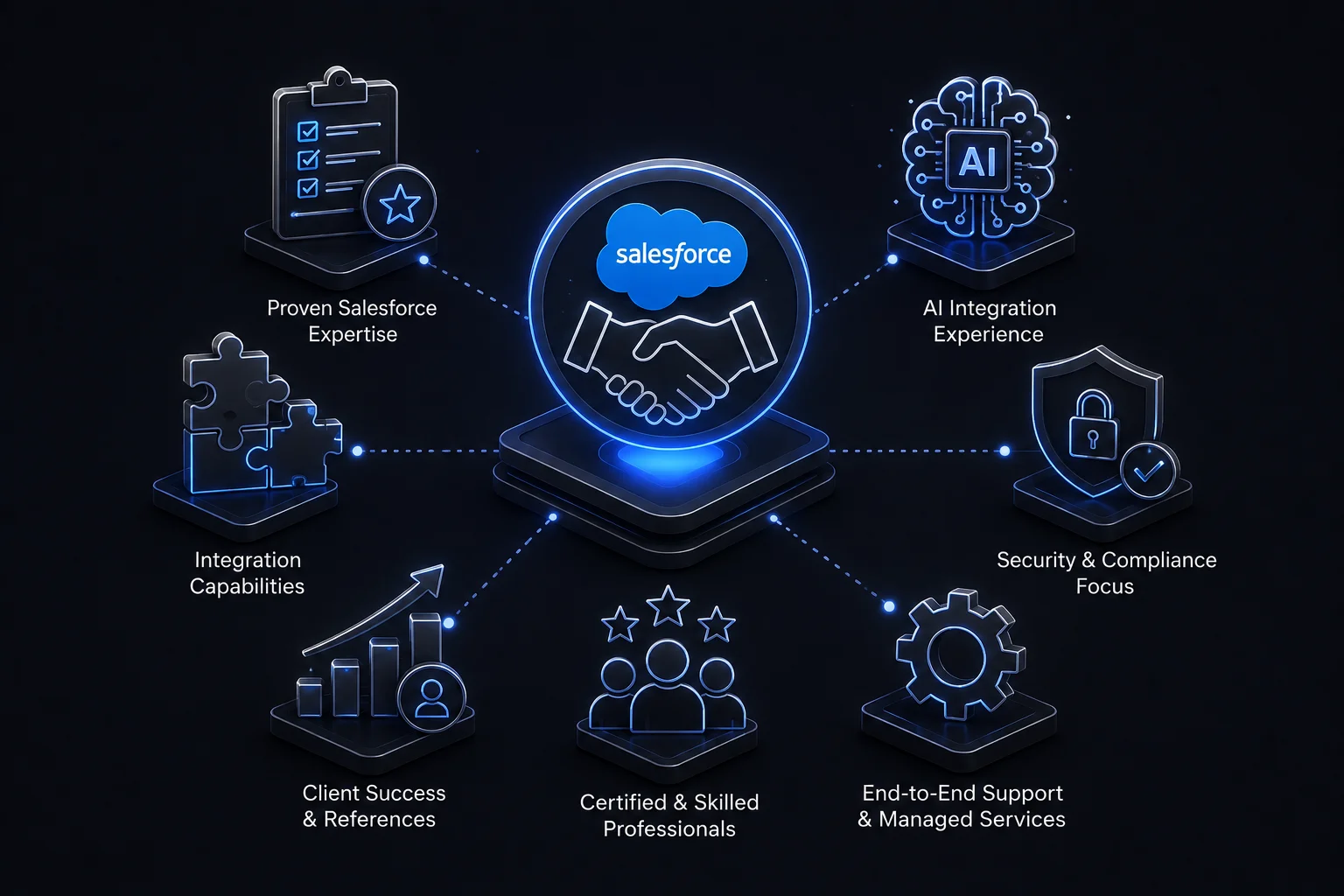
Look for a Salesforce partner with proven implementation experience, strong industry expertise, and a track record of delivering projects on time and within budget.
Prioritize partners who take time to understand your business processes, integration needs, data strategy, and long-term scalability. Certifications matter, but they are not a substitute for curiosity about your operations.
Judge a Salesforce Integration Partner on Data Work
Ask for a walkthrough of a real customer identity model the firm has built. Request the actual rules they used to resolve conflicts.
Experts who do this routinely will have strong opinions about survivorship rules and match confidence thresholds. A firm that lacks this experience will instead show you a glossy architecture diagram filled with arrows and boxes. That diagram does not determine whether your AI agent returns a correct answer. The data underneath does.
A Governance Answer, Not a Governance Slide
Few organizations have centralized agent governance, and this is where you find real differentiation.
Ask a procedural question: Next quarter, one of our business units wants to deploy an agent using our Salesforce data. How do we prevent that from happening behind our backs, and what is the approval workflow?
A partner that has dealt with agent sprawl will describe a clear process with roles, checkpoints, and escalation paths. A partner that has not will name a software product and move on.
Salesforce Registered Partner Status Is a Floor
Verifying that a firm appears on Salesforce's registered partner list is a sensible first check. But it tells you very little. That status confirms that they hold certifications and have a commercial relationship with Salesforce.
It does not tell you if their team has ever integrated a general ledger system, handled data residency laws, or untangled a messy middleware setup left by a previous vendor. Use the AppExchange listing to build a shortlist. Then evaluate each firm on the engineering your project requires.
Who Owns the Outcome After Go-Live
Integration debt is usually created during the handover. The system works at launch. The partner's team leaves. But a few months later, a nightly sync job starts failing.
Ask what the firm hands over in writing, and what support is offered in the first quarter after launch.
A partner that expects to remain accountable, even when a third-party API changes its data structure, will have designed their contract and scope differently from the beginning.
Ten Questions for Your Shortlist of Salesforce Integration Consultants
- How do you unify the same customer across our CRM, ERP, and service systems? And who decides when records conflict?
- Which of our data sources would you consider unfit for AI use today? What evidence would you use to make that call?
- How do you choose between native Salesforce tools, MuleSoft, or an integration platform we own?
- What metrics do you track after launch? What triggers an "integration incident" alert?
- What metrics do you track after launch? What triggers an "integration incident" alert?
- What do you do when a source system changes its data structure without warning?
- What is your approach to data residency rules and field-level permissions when agents are involved?
- What regression tests do you run whenever Salesforce releases a new version?
- What documentation will you leave behind so our team can maintain and modify the system without you?
- When have you told a client that their AI use case was premature, and what did you suggest instead?
- Which people will be doing the day-to-day work on our project?
The tenth question sorts a shortlist of Salesforce integration consultants faster than the other nine. It also sets the tone for a relationship in which the work is done by the people who scoped it.
Conclusion
The companies winning with Salesforce AI are not the ones deploying the most agents. They are the ones who prioritized trustworthy data first and chose partners who wanted to talk about data foundations. They did the messy work early, and it paid off.
If that is the kind of conversation you want to have, start your search for the best Salesforce integration services with the data layer and not the endpoints.