Sign up with Google
 Sign in with Zoho
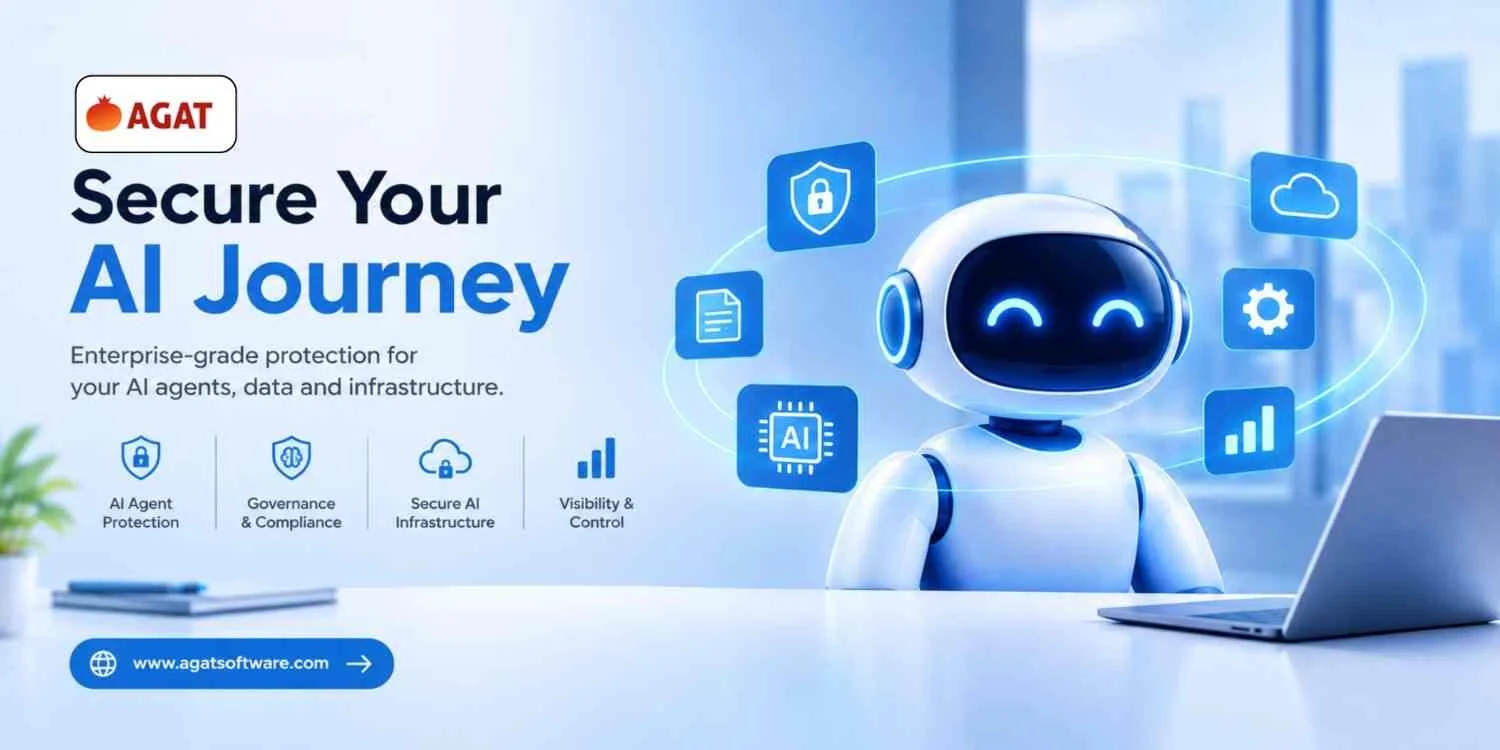
Artificial intelligence is becoming part of everyday business operations. Companies now use AI assistants to analyse information, automate workflows, support employees, interact with customers, and connect different business systems. As these systems become more capable, however, security teams need to think beyond protecting a single chatbot or AI application
An AI agent can interact with company data, call external services, use business tools, and take actions based on instructions. This makes security, access control, monitoring, and accountability important parts of any enterprise AI strategy.
For organisations adopting AI at scale, the goal is not simply to restrict its use. The focus should be on creating a controlled environment where employees and AI systems can work productively while sensitive information and business processes remain protected.
Why does AI security matter more as AI adoption grows?
Traditional security controls were designed around users, applications, networks, and known data flows. AI introduces another layer because users can communicate with models using natural language, while AI agents may independently interact with tools and systems.
A poorly controlled AI workflow could expose confidential information, use an unauthorised model, or perform an action beyond what was intended. Risks can also come from prompt injection, excessive permissions, unapproved AI services, or sensitive data being included in requests.
A practical security strategy therefore needs visibility across prompts, agents, models, users, applications, and the systems connected to them.
This is where artificial intelligence security becomes more than a technical requirement. It becomes part of responsible enterprise AI management.
What should organisations consider when governing AI agents?
AI agents need clearly defined responsibilities and boundaries. Before deploying an agent, organisations should understand what it can access, which tools it can use, what data it can process, and what actions it is allowed to perform.
Good ai agent governance should cover areas such as:
- Agent ownership and accountability
- Access to internal and external systems
- Approval requirements for sensitive actions
- Monitoring of agent activity
- Audit records for important decisions and actions
- Data access and privacy controls
- Policies for different departments and user groups
- Regular reviews of agent permissions
These controls become especially important when an organisation operates multiple agents across different teams. Without proper oversight, it can become difficult to determine which agents exist, who manages them, and what they are actually doing.
How can enterprises protect AI agents without slowing down productivity?
Security does not have to mean stopping every AI action. A better approach is to apply controls according to the level of risk.
For example, an AI assistant that summarises publicly available information may need relatively simple controls. An agent that can access financial records, customer information, internal documents, or business applications requires much stricter policies.
Enterprise ai agent protection can include real-time monitoring, permission controls, action approvals, audit trails, and the ability to block risky activity. Organisations can also establish policies around sensitive information and determine which AI tools and models are approved for specific business purposes.
AGAT Software, for example, provides security capabilities designed to give organisations visibility and control over AI agents, prompts, models, and data. Its platform includes agent discovery, ownership mapping, audit trails, runtime blocking and approvals, alongside controls for prompt inspection and sensitive data protection.
What role does an AI gateway play in enterprise security?
As companies adopt multiple AI models and services, managing access individually can quickly become difficult. An ai API gateway can provide a central point through which AI requests and services are managed.
A gateway can help organisations control which models and services users or applications can access. It can also support API key management, usage monitoring, access policies, and cost tracking.
This centralised approach can make AI environments easier to manage because security teams have a clearer view of how AI services are being consumed.
For example, an organisation may allow one department to use a particular model for research while restricting access for another department because of data sensitivity. Policies can be applied based on users, applications, models, or business requirements rather than relying entirely on individual teams to manage access themselves.
How can organisations protect sensitive data when using AI?
Data protection should be considered at every stage of an AI workflow.
Before information reaches a model, organisations should determine whether it contains confidential, personal, financial, customer, or proprietary information. Controls can then be used to identify or restrict sensitive content where appropriate.
It is also important to consider where AI services are hosted and how data is handled. Some businesses may prefer private cloud, on-premises, or air-gapped deployments because their requirements call for greater control over data and infrastructure.
Private AI environments can also help organisations keep AI operations closer to their existing security and compliance processes. AGAT Software supports deployment options including on-premises, air-gapped, private cloud, and SaaS environments.
What should a practical enterprise AI security strategy include?
There is no single control that can address every AI-related risk. A stronger strategy combines several layers.
Organisations should start by identifying the AI tools, agents, models, APIs, and data sources currently in use. From there, they can define acceptable use policies, assign ownership, review permissions, and establish monitoring requirements.
Regular testing is also important. Models and agents can change over time, and new tools may be introduced without going through traditional technology review processes.
The most effective approach is therefore continuous rather than one-time. Security teams should be able to see what AI is being used, understand how it is being used, and respond when activity falls outside established policies.
FAQs
What is AI agent governance?
AI agent governance refers to the policies, controls, ownership, monitoring, and approval processes used to manage AI agents throughout their lifecycle.
Why do enterprises need protection for AI agents?
AI agents can access data, interact with applications, and perform tasks. Strong controls help ensure that these capabilities are used only within approved boundaries.
What does an AI gateway do?
An AI gateway provides a central control point for managing access to AI models and services. It can support authentication, policy enforcement, usage monitoring, and API management.
Can AI security work with private AI environments?
Yes. Enterprise AI security can be designed for private cloud, on-premises, or air-gapped environments, depending on an organisation's security and data requirements.
Is AI security only the responsibility of the IT team?
No. AI security often involves IT, security, compliance, legal, data teams, business leaders, and employees. Clear responsibilities across these groups help organisations adopt AI safely while maintaining business productivity.