Sign up with Google
 Sign in with Zoho

Why Intelligent Automation Is Reshaping Modern Business?
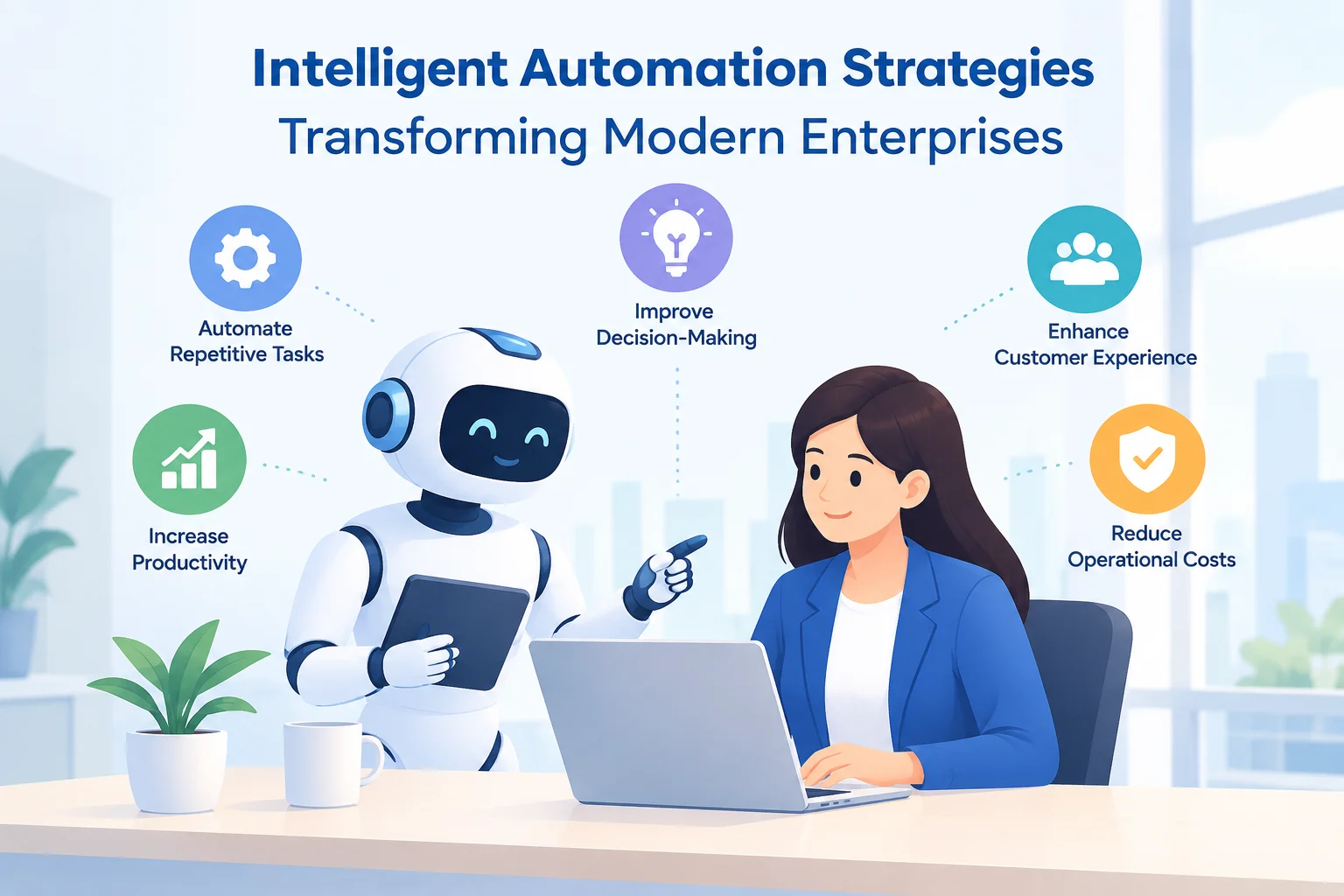
Innovation in intelligent automation is one of the greatest factors contributing to digital transformation that helps businesses optimize their performance by enhancing decision-making processes and productivity. In contrast to conventional automation that relies on certain predefined rules, intelligent automation is based on technologies of artificial intelligence, machine learning, RPA, NLP, and advanced analytics allowing the organization to perform not only routine operations but cognitive functions as well.
The modern enterprise faces the demand to lower the cost of performing various operations, to provide customers with personalized experience, and to adapt promptly to changing circumstances. Thus, intelligent automation helps businesses to eliminate the manual inefficiency, increase speed of execution and obtain real-time insight for better decision making. Be it invoice processing, supply chain management or helping customer service teams with chatbots powered by AI, automation is used today in all departments of the organization. According to Consegic Business Intelligence, the Robotic Process Automation (RPA) Market is expected to grow at a CAGR of 30.4% through 2030, reflecting the rising demand for intelligent automation across enterprises.
As new technological advancements take place, intelligent automation is no longer considered to be just a competitive edge but a necessity for sustainable development of the business.
Core Technologies Powering Intelligent Automation
The success of intelligent automation is contingent upon the combination of various technologies that will be used to automate different business processes. To start with, there is artificial intelligence (AI), which helps automation systems to interpret data, discover patterns, and make reasonable decisions. The machine learning (ML), being a part of the AI field, helps automation systems to become more accurate while learning from historic data.Robotic Process Automation (RPA) is used to automate the repetitive tasks that are based on rules like data entry, invoicing, and reports. However, the application of Artificial Intelligence makes RPA transform into intelligent automation where it is able to deal with exceptions and make decisions based on context. Natural Language Processing (NLP) gives the ability to systems to understand and produce human language, which is used for the creation of applications like virtual assistants, chatbots, and automated document analysis.Other technological capabilities include computer vision, intelligent document processing (IDP), predictive analytics, and cloud computing. Enterprises are able to use these tools in order to process images, extract information from documents, make predictions about business performance, and implement automation worldwide.
How Intelligent Automation Is Revolutionizing Enterprise Operations
Intelligent automation is transforming the way modern organizations operate by automating their workflows, reducing the need for human effort, and facilitating faster decision-making. Automation intelligence systems are being integrated into finance, procurement, customer service, human resources, and supply chain management to improve the efficiency of businesses’ operations. Such repetitive operations like invoice processing, payroll management, employee onboarding, and inventory management can now be done using intelligent automation and much faster and accurately than before using manual methods. People are able to devote more time to implementing innovation initiatives and engaging customers thanks to intelligent automation.Apart from automating the routine operations, intelligent automation improves the decision-making process by analysing the data in real time and generating recommendations for taking actions that increase productivity and mitigate risks of operational inefficiencies. Besides, workflows automated using intelligent automation make it possible to maintain consistency, avoid any errors due to people, and increase regulatory compliance thanks to the availability of detailed audit trails. Intelligent automation makes remote and hybrid work models effective as well by facilitating collaboration among the teams working remotely. With digital transformation gaining momentum, intelligent automation is becoming crucial for businesses' agility.
Industry Applications: Intelligent Automation Across Business Sectors
The concept of intelligent automation is bringing great changes in industries through automation of processes, enhanced customer experience, and data-driven decisions making. In manufacturing, intelligent automation helps in conducting predictive maintenance, quality checks, and optimization of production process without affecting downtime. The healthcare sector applies intelligent automation for the management of patient records, appointment scheduling, help in diagnostics, and administrative processes so that medical professionals can concentrate on patient care. Intelligent automation finds applications in financial institutions in detecting fraudulent activities, processing loans, customer identification, and compliance.Retailers make use of intelligent automation for providing personalized customer experience, demand forecasting, inventory management, and automated customer support via chatbots. In logistics and supply chain management, automation brings about efficiency in route optimization, warehousing, shipment tracking, and demand forecasting which results in quick deliveries and reduced operational costs. Human resource management makes use of intelligent automation for resume screening, interview scheduling, onboarding of employees, and analysis of workforce performance. Therefore, the concept of intelligent automation is applied by all industries to achieve efficiency in the process, response to changing customer needs and regulations, and market conditions among other factors.
Overcoming Implementation Challenges and Building a Successful Automation Strategy
Although intelligent automation provides many opportunities to boost business success, its implementation requires comprehensive planning and proper execution. One of the difficulties organizations often encounter is the integration of automation solutions into legacy systems that lack the capacity to accommodate current technological solutions. Another issue is poor quality of data that can affect the work of AI, which is why data governance and standardization are necessary before using intelligent automation at scale. The organization also faces the issue of cybersecurity and data privacy. These issues make it necessary for the business to develop and implement appropriate security frameworks.Another common challenge related to intelligent automation is employee resistance. Workers can resist such changes because of the fear of being displaced by machines or their inability to cope with advanced technology. Businesses can avoid this difficulty by developing employee training and upskilling programs that will help workers learn how to use automation technology and understand how it can improve their performance. An effective strategy for automation is to identify processes that are valuable to the organization, to define goals, conduct pilot tests, and automate. The automation process can be enhanced within organizations by constant monitoring and evaluation of the performance.
The Future of Intelligent Automation: Trends for the Next Generation of Enterprises
Great strides have been made in the intelligent automation field thanks to the developments in AI, machine learning and cloud computing. Some of the emerging trends include hyper automation, which involves integration of AI, robotic process automation, analytics, and process mining for the purpose of automating whole business ecosystems instead of specific tasks. Another trend that will continue shaping the future is that of generative AI, which is characterized by report generation, content creation, software development assistance, and customer engagement through natural conversations with customers. With autonomous decision-making capability, AI agents can help transform the enterprise processes through automation without much human effort.Another future trend includes predictive analytics, digital twins, and edge AI, which will facilitate the real-time monitoring of operations, prediction of equipment failures, resource optimization, and strategic planning in the organization. Collaborative work between humans and AI will increase and will be used in solving the business problems and delivering innovations to address them. Accessibility of the automation technology will become easier as it will be provided through cloud computing platforms. The enterprises that will be focusing on responsible AI, ethics, and innovations will be future-ready.