Sign up with Google
 Sign in with Zoho


When we think about sustainable fashion, the first things that usually come to mind are organic cotton shirts, recycled fabrics, or clothes made from old garments. Very few people think about the small label sewn inside a shirt. Yet that little piece of fabric is also part of the clothing supply chain. Eco Friendly Fashion Labels are becoming an interesting option for businesses that want to look at those smaller details instead of focusing only on the main fabric.
A clothing label has a simple job. It tells us the size, fabric composition, washing instructions, or sometimes the name of the brand. But making thousands of these labels still requires materials, printing, packaging, and transportation. That is where the sustainability conversation becomes interesting. A small change may not transform the fashion industry overnight, but many small changes made together can reduce unnecessary material use.
Why Fashion Labels Deserve More Attention
Imagine a clothing company producing 20,000 shirts for one collection. Each shirt might need a neck label, care label, size information, and a paper hangtag. Multiply that by several collections, and the number of individual labels becomes surprisingly large.
This is why label selection deserves some attention.
It does not mean every traditional label is bad or that every alternative is automatically sustainable. In fact, the situation is more complicated than that. A label that lasts for years may be a better choice for one garment, while a simple recycled-paper tag may make more sense for another.
The useful question is not, "Which label is the greenest?"
A better question is, "Which label does the job with the least unnecessary material and waste?"
That small change in thinking can lead to more practical decisions.
What Can Sustainable Fashion Labels Be Made From?
There are several materials available, and each one has its own advantages and limitations.
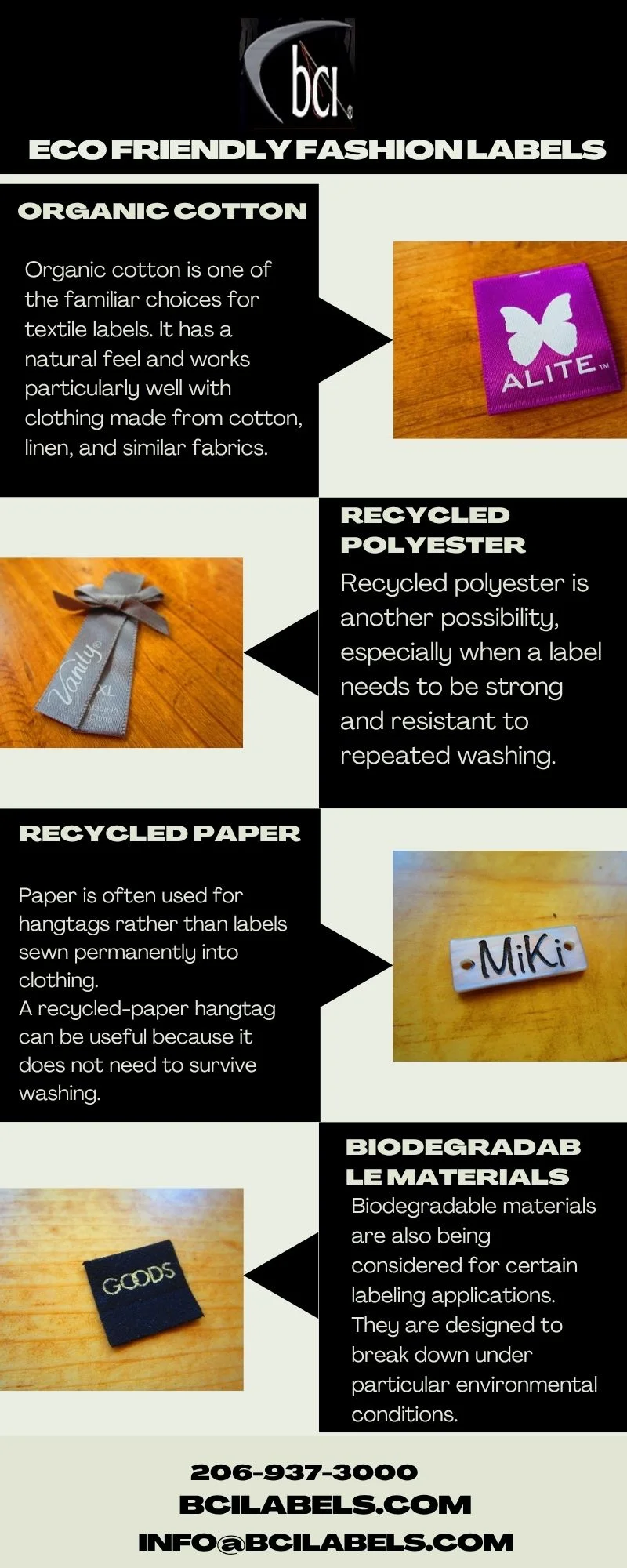
Organic Cotton
Organic cotton is one of the familiar choices for textile labels. It has a natural feel and works particularly well with clothing made from cotton, linen, and similar fabrics.
There is an important detail here, though. Organic cotton should not be treated as a magic word that automatically makes a product environmentally harmless. Cotton still requires land, water, processing, energy, and transportation.
For that reason, it is better to look at the complete journey of the material rather than judging it by one characteristic.
Recycled Polyester
Recycled polyester is another possibility, especially when a label needs to be strong and resistant to repeated washing.
The basic idea is straightforward: material that already exists is used again instead of relying completely on newly produced material.
This can be useful for permanent garment labels, but it is still a synthetic fiber. Anyone comparing different options should check the actual recycled content instead of assuming that every recycled polyester label has the same environmental profile.
Recycled Paper
Paper is often used for hangtags rather than labels sewn permanently into clothing.
A recycled-paper hangtag can be useful because it does not need to survive washing. Once the customer has purchased the garment and removed the tag, its job is finished.
This is a good example of why the purpose of a label matters. There is little reason to make a temporary tag as durable as a care label that may stay with a garment for several years.
Biodegradable Materials
Biodegradable materials are also being considered for certain labeling applications. They are designed to break down under particular environmental conditions.
The phrase "biodegradable" needs some attention, however. It does not necessarily mean that the material will disappear quickly anywhere it is thrown away. Some products need industrial composting or controlled conditions.
Reading the actual product information is much more useful than relying on the word alone.
Eco Friendly Address Labels Have a Place Too
The discussion does not have to stop with clothing labels. Fashion businesses also use packaging, shipping stickers, and mailing materials every day.
Eco Friendly Address Labels can be considered when a company is reviewing its packaging choices. These labels may seem unrelated to clothing, but they are still part of the journey between a business and its customer.
For example, a small online clothing store might use recycled packaging but continue using conventional labels and excessive inserts. Looking at the entire package rather than just one component can reveal opportunities to cut down on unnecessary material.
There is no need to change everything overnight. A business can start with one item, measure the result, and then decide what should come next.
How to Choose a Label Without Overthinking It
Sustainability can sometimes become confusing because there are so many materials and claims to compare. A simple checklist can make the decision easier.
Start With the Label's Purpose
First ask what the label actually needs to do.
Does it need to survive dozens of washes? Is it simply a hangtag? Does it need to be soft against the skin? Will it be removed after purchase?
The answers will immediately eliminate some unsuitable materials.
Think About Durability
A label that falls apart after a few washes is not necessarily a good choice simply because it was made from a natural or recycled material.
Care labels are a good example. Their information can remain useful throughout the life of a garment. If the printing fades or the label becomes detached quickly, the customer may no longer have access to washing instructions.
Durability is therefore part of the sustainability conversation.
Ask What Is Actually in the Label
When comparing suppliers, ask direct questions.
What is the label made from? Does it contain recycled material? What percentage is recycled? What type of ink is used? Is there an adhesive or coating? Are there certifications or documents supporting the environmental claim?
Clear answers are much more useful than a general statement saying that a product is "eco-friendly."
A Quick Look at Different Options
The table shows something important: there is no perfect material for every situation. A sensible decision depends on how the label will be used.
Small Changes Can Reduce Label Waste
One of the easiest things a clothing business can do is simply look at what it is already using.
Are there three tags where one would be enough?
Is the same information printed on both a hangtag and another insert?
Are large labels being used when a smaller version would still be readable?
These questions cost nothing to ask.
Another useful step is ordering carefully. Overstocking thousands of labels that later become outdated can create avoidable waste, particularly when a business changes its logo, sizing system, or product information.
A little planning can prevent that problem.
Do Not Assume "Eco Friendly" Means Everything Is Better
This is probably one of the most important points for anyone buying sustainable labeling materials.
Environmental claims should be specific.
For example, "made with 70% recycled polyester" tells the buyer something useful. "Good for the planet" does not explain much at all.
The same applies to terms such as "natural," "green," "biodegradable," and "sustainable." Each can describe a particular characteristic, but none of them tells the entire story.
Businesses should also be careful about making claims that they cannot support. Honest and specific information is more useful to customers than exaggerated environmental language.
What are Eco Friendly Fashion Labels?
They are clothing labels made with materials or production approaches intended to reduce unnecessary environmental impact. Options can include organic fibers, recycled materials, and selected biodegradable substrates.
Are cotton labels environmentally friendly?
Cotton can be a suitable natural-fiber option, but its environmental impact depends on farming, water use, processing, energy, and transportation.
Can sustainable labels survive washing?
Many can. The important thing is to select a material and printing method designed for the washing conditions the garment will experience.
Are recycled labels better than regular labels?
They can reduce the need for some virgin materials, but the overall impact depends on the source material, manufacturing process, durability, and eventual disposal.
How can a clothing company reduce label waste?
Businesses can remove unnecessary tags, choose suitable label sizes, avoid excessive stock, consider recycled materials, and review packaging at the same time.
Are paper labels suitable for clothes?
Paper works well for hangtags and temporary information. It generally is not the right choice for a permanent care label that must survive repeated washing.
Does a smaller label create less environmental impact?
Using less material can reduce material consumption, but the label still needs to be readable and functional. Making something unnecessarily small can create its own problems.
Can sustainable labels be recycled?
Some can, while others cannot because of mixed materials, adhesives, coatings, or local recycling limitations. The material composition should be checked before deciding how it should be disposed of.
Is there one best material for sustainable labels?
No. The best option depends on the garment, expected lifespan, washing requirements, information being provided, and the material's complete lifecycle.
Looking Beyond the Label
A label alone will not make a fashion collection sustainable. That would be an unrealistic expectation.
But sustainable fashion is often about looking at the details that are easy to ignore. Fabric choices matter. Manufacturing matters. Packaging matters. How long a garment lasts matters. The little label attached to it is simply one more part of that bigger picture.
Eco Friendly Fashion Labels can make sense when the material is chosen for a genuine reason rather than simply because it sounds environmentally friendly. A durable recycled material may be the right answer for one garment, while recycled paper could be perfectly adequate for a temporary hangtag.
The most sensible approach is to ask practical questions, compare the available options, and avoid using more material than necessary. That is a much more realistic way to approach sustainable labeling.
For businesses interested in making gradual improvements, starting with labels can be relatively straightforward. Review what is currently being used, remove anything unnecessary, ask suppliers for specific material information, and consider what happens to each component after the garment is sold.
These steps may seem small, but responsible fashion is rarely built from one huge decision. More often, it comes from many ordinary decisions made a little more thoughtfully.