Sign up with Google
 Sign in with Zoho

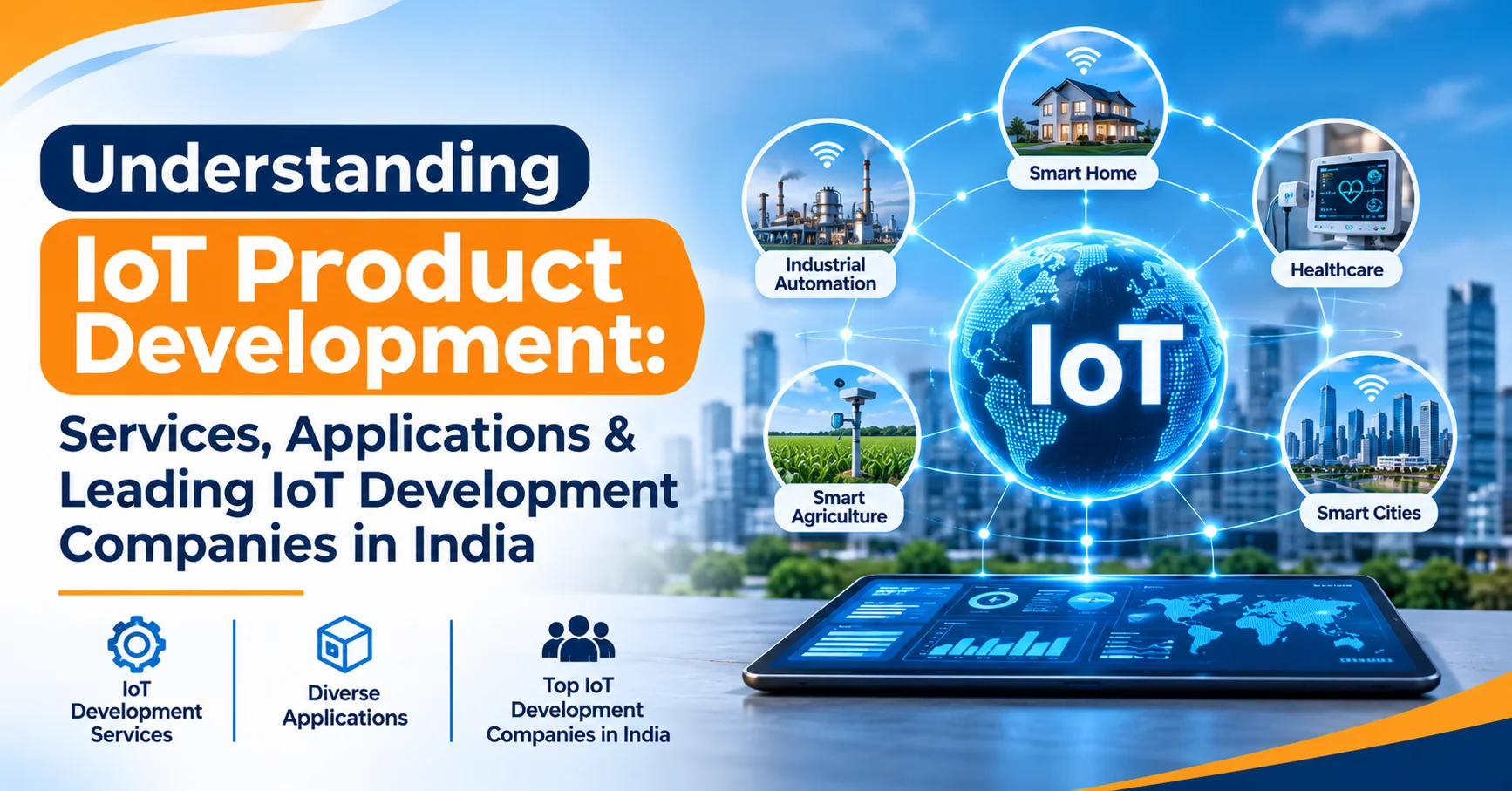
Think about a manufacturing unit where machines could report their own performance, a farmer who could check soil conditions without visiting every field, or a warehouse manager who could track the condition of goods while they are in transit. These are not isolated technology experiments anymore. They represent practical ways businesses are using the Internet of Things (IoT) to solve everyday operational problems.
But building an IoT product involves considerably more work than putting a sensor inside a device and connecting it to the internet. The hardware must collect accurate information, the firmware needs to process it, the network must transmit it reliably, and the software should present the results in a way people can actually use.
This is where IoT product development becomes important. A connected product is essentially a combination of several technologies working together. A problem in one area can affect the entire experience. For example, an efficient sensor becomes less useful if its battery drains too quickly or the application displays outdated readings.
Businesses entering this space often need engineering support across multiple stages, from the first prototype to deployment and ongoing maintenance. An experienced IoT Development Company can help bring these different elements together while considering product requirements, development costs, and future expansion.
In this guide, we look at how IoT products are developed, which services are involved, where businesses are using this technology, and what to consider before selecting an IoT development partner in India.
What Is IoT Product Development?
IoT product development refers to the process of designing, building, testing, and launching smart products that communicate with other devices and systems through the internet or other communication networks.
An IoT product generally consists of three major components:
- Hardware: Physical devices equipped with sensors, processors, controllers, and communication modules that collect information from their surroundings.
- Software: Embedded software, mobile applications, and web dashboards that allow users to interact with connected devices and control their functionality.
- Cloud Infrastructure: Cloud platforms and backend systems that store, process, analyze, and manage the data generated by connected devices.
For example, a smart home temperature monitoring system uses sensors to measure room temperature, transfers the collected data to a cloud platform, and displays the information through a mobile application. Users can monitor temperature levels remotely and automate their air conditioning systems based on predefined settings.
The same concept can be applied to manufacturing, healthcare, agriculture, logistics, retail, and many other industries.
Complete IoT Product Development Process
Building an IoT product requires a structured development approach. Each stage contributes to the product's performance, reliability, security, and long-term scalability.
1. Idea Validation and Requirement Analysis
The first step is identifying the problem that the IoT product will solve. Businesses must clearly understand their target audience, operational challenges, product objectives, and expected outcomes.
During this stage, development teams evaluate the feasibility of the proposed solution and define its technical requirements.
Important considerations include:
- Identifying the target users and their requirements.
- Defining the primary product features and functionalities.
- Selecting suitable sensors and hardware components.
- Determining connectivity requirements.
- Estimating development costs and timelines.
- Evaluating technical and commercial feasibility.
Proper planning at this stage helps reduce development risks and ensures that the final product meets business expectations.
2. Hardware Design and Prototyping
Hardware decisions made during the early stages can have a lasting impact on an IoT product. A sensor that works perfectly on a development board may behave differently once it is installed inside a compact enclosure or exposed to outdoor conditions.
Take a hypothetical agricultural monitoring device. It needs to measure soil moisture and send readings to a central system. If engineers select a component without considering outdoor exposure, battery requirements, and signal range, the device may become unreliable after deployment.
Hardware development involves much more than selecting electronic components. Engineers need to consider how the device will be used, where it will operate, and how easily it can be maintained.
The hardware design may include:
- Microcontrollers and processing units.
- Temperature, humidity, pressure, and motion sensors.
- Wireless communication modules.
- Battery systems and power management circuits.
- Printed circuit board (PCB) design.
- Protective enclosures and physical integration.
Platforms such as ESP32, Arduino, Raspberry Pi, and STM32 are commonly used during different stages of IoT development. The final selection depends on processing requirements, connectivity, power consumption, and product complexity.
Prototyping gives engineers an opportunity to test these decisions before committing to a production design. It also helps uncover practical issues that may not be obvious during the initial planning stage.
3. Embedded Software Development
Embedded software controls how an IoT device operates. It acts as the communication layer between the hardware components and the higher-level software systems.
During this stage, developers write firmware that manages sensors, processes input signals, controls device functions, and handles communication protocols.
Some commonly used IoT communication protocols and technologies include:
- MQTT for lightweight messaging between connected devices.
- HTTP and HTTPS for web-based communication.
- CoAP for resource-constrained IoT devices.
- Bluetooth Low Energy for short-range wireless communication.
- Wi-Fi and cellular networks for internet connectivity.
- Zigbee and LoRaWAN for specific low-power wireless applications.
The selection of technologies depends on the product's requirements, operating environment, data transmission needs, and power limitations.
4. Cloud and Backend Development
Once an IoT device starts collecting information, another question becomes important: where does all that data go, and how will people access it?
This is the responsibility of the backend and cloud infrastructure.
Imagine a company managing refrigeration units across several storage facilities. Each unit sends temperature readings at regular intervals. The backend receives these readings, associates them with the correct device, stores historical records, and makes relevant information available through a monitoring dashboard.
Without this layer, users would have little practical way to manage information coming from multiple connected devices.
Depending on the product, backend development may involve device registration, authentication, database management, API development, real-time data processing, and remote configuration.
Cloud platforms such as AWS IoT, Microsoft Azure, and Google Cloud offer technologies that developers can use when building these systems. The choice depends on the existing technology environment, security requirements, expected data volumes, and operational budget.
One important consideration is that cloud architecture should be planned around actual usage. A small prototype does not necessarily need the same infrastructure as a commercial platform supporting thousands of connected devices. Starting with an appropriate architecture and allowing room for expansion can help avoid unnecessary complexity and expense.
5. Mobile and Web Application Development
An IoT product needs an intuitive interface through which users can monitor and control connected devices.
Mobile applications and web dashboards make it possible to access device information, receive notifications, change settings, and monitor system performance remotely.
For example, an industrial IoT dashboard may display machine temperature, equipment status, production performance, and maintenance alerts. Similarly, a smart home application can allow users to control lighting, security cameras, and temperature settings.
Developers focus on creating user-friendly interfaces that present complex technical information in an understandable format.
6. Data Analytics and Automation
Data is one of the most valuable components of an IoT ecosystem. However, simply collecting information is not enough. Businesses need to convert raw data into actionable insights.
IoT analytics solutions help identify patterns, detect unusual activities, predict equipment failures, and improve operational decision-making.
Advanced IoT products may also use artificial intelligence (AI) and machine learning (ML) to support predictive maintenance, intelligent automation, and real-time optimization.
For instance, an industrial monitoring system can analyze machine performance data and identify signs of potential equipment failure before a breakdown occurs.
7. Testing, Security, and Quality Assurance
Before launching an IoT product, it must undergo extensive testing to ensure that all components work correctly.
Testing generally includes:
- Hardware functionality testing.
- Firmware testing.
- Connectivity and network testing.
- Mobile and web application testing.
- Performance and load testing.
- Battery and power consumption testing.
- Security and vulnerability assessment.
- Compatibility testing across devices and platforms.
Security is particularly important because connected devices can become potential entry points for cyberattacks.
Developers should implement encryption, secure authentication, access controls, secure boot mechanisms, and regular firmware updates to protect devices and user information.
8. Deployment, Monitoring, and Maintenance
Once testing is complete, the IoT product can be deployed in its intended environment. However, product development does not end with the initial launch.
Continuous monitoring and maintenance are necessary to ensure long-term performance. Development teams may provide firmware updates, security patches, cloud infrastructure management, troubleshooting, and feature enhancements.
This ongoing support helps businesses maintain product reliability and adapt to changing customer and technology requirements.
Major IoT Product Development Services
A professional IoT development partner offers a combination of services to support the complete product lifecycle.
The most common services include:
1. IoT Consulting and Strategy: Helps businesses identify suitable IoT opportunities, define technical requirements, select technologies, and create an effective development roadmap.
2. IoT Hardware Engineering: Covers circuit design, PCB development, sensor integration, component selection, and hardware prototyping.
3. Embedded Software Development: Focuses on firmware development, device programming, hardware integration, and communication protocols.
4. IoT Application Development: Includes developing Android, iOS, and web applications for remote device monitoring and control.
5. Cloud and IoT Platform Development: Provides scalable backend systems, device management solutions, cloud integration, and data storage infrastructure.
6. IoT Data Analytics: Uses data processing, visualization, AI, and machine learning to generate useful business insights.
7. IoT Security Solutions: Protects connected devices, communication networks, cloud infrastructure, and sensitive information.
8. Product Testing and Maintenance: Ensures product quality through functional testing, performance optimization, security assessments, and ongoing technical support.
By combining these services, businesses can develop complete IoT ecosystems rather than relying on disconnected hardware and software solutions.
Industry Applications of IoT Product Development
IoT technology has applications across almost every major industry. Some of its most important use cases include:
1. Healthcare
IoT is improving healthcare delivery through connected medical devices, remote patient monitoring systems, and smart wearable technologies.
Healthcare providers can monitor vital signs such as heart rate, blood oxygen levels, and body temperature using connected devices. This enables continuous patient monitoring and helps medical professionals access relevant health information remotely.
2. Manufacturing and Industrial Automation
Industrial IoT (IIoT) helps manufacturers improve productivity, equipment reliability, and operational efficiency.
Connected sensors monitor machinery performance, energy consumption, temperature, and vibration levels. Businesses can use this information for predictive maintenance, production monitoring, and automated quality control.
3. Smart Homes and Buildings
Smart home solutions allow users to remotely control lighting, security systems, thermostats, appliances, and other connected devices.
In commercial buildings, IoT systems can optimize electricity consumption, monitor indoor environmental conditions, and automate facility management.
4. Agriculture
IoT-based agriculture solutions help farmers make informed decisions using real-time environmental and soil data.
Smart irrigation systems, soil moisture sensors, weather monitoring devices, and connected agricultural equipment can improve water management, reduce resource wastage, and support better crop management.
5. Logistics and Transportation
IoT enables real-time vehicle tracking, fleet management, shipment monitoring, and route optimization.
Connected GPS devices and environmental sensors help logistics companies monitor vehicle locations, fuel consumption, cargo conditions, and delivery performance.
6. Retail and Supply Chain
Retail businesses use IoT for inventory tracking, smart shelves, automated checkout systems, and supply chain monitoring.
Connected devices provide better visibility into stock levels and product movement, helping businesses improve inventory management and customer experiences.
Leading IoT Development Companies in India: What to Look For
India has developed a strong technology ecosystem with companies offering IoT consulting, hardware engineering, embedded software, cloud development, and connected product engineering services.
However, selecting the right development partner requires careful evaluation. Rather than choosing a company based only on its pricing or marketing claims, businesses should consider the following factors:
- Technical Expertise: Check whether the company has experience in embedded systems, hardware engineering, cloud platforms, mobile applications, and IoT communication protocols.
- Industry Experience: Look for experience in developing IoT solutions relevant to your industry, such as healthcare, manufacturing, agriculture, or logistics.
- End-to-End Capabilities: Choose a partner capable of handling the complete product lifecycle, from initial consultation and prototyping to deployment and maintenance.
- Security Standards: Evaluate the company's approach to device authentication, encryption, data privacy, and cybersecurity.
- Portfolio and Case Studies: Review previous projects to understand the company's technical capabilities and problem-solving approach.
- Scalability: Ensure that the development partner can build solutions that support future product expansion and increasing device connectivity.
- Post-Launch Support: Check whether the company provides regular updates, technical maintenance, performance monitoring, and troubleshooting.
Some established technology service providers with IoT-related capabilities in India include Tata Consultancy Services (TCS), Infosys, Wipro, HCLTech, and Tech Mahindra. Businesses can also explore specialized IoT product engineering firms based on their specific hardware, software, and industry requirements.
The right choice ultimately depends on project complexity, technical requirements, budget, development timelines, and long-term business objectives.
Benefits of Partnering with an IoT Development Company
Working with an experienced development partner offers several advantages:
- Faster Time to Market: Experienced teams can streamline development activities and reduce product launch timelines.
- Access to Specialized Expertise: Businesses gain access to hardware engineers, embedded developers, cloud architects, and application developers.
- Cost Optimization: Outsourcing development can reduce the need to build and maintain a large in-house technical team.
- Improved Product Quality: Professional testing and engineering practices help improve reliability and performance.
- Better Scalability: Well-designed IoT architectures make it easier to add new devices, features, and integrations.
- Ongoing Technical Support: Continuous maintenance helps products remain secure, updated, and functional.
These advantages make professional IoT development services valuable for startups, established businesses, and enterprises planning to introduce connected products.
Future Trends in IoT Product Development
The future of IoT will be shaped by advancements in connectivity, artificial intelligence, automation, and edge computing.
Some important trends include:
- AI-Powered IoT: Combining AI and IoT will enable smarter automation, predictive analytics, and intelligent decision-making.
- Edge Computing: Processing data closer to connected devices will help reduce latency and minimize unnecessary cloud communication.
- 5G Connectivity: Faster network speeds and improved connectivity will support advanced applications such as autonomous systems and real-time industrial monitoring.
- Digital Twins: Virtual representations of physical assets will help businesses simulate operations, monitor performance, and identify potential issues.
- Enhanced IoT Security: Advanced authentication, encryption, and device management will become increasingly important as connected ecosystems expand.
These developments will create new opportunities for businesses to build innovative products and improve existing operations.
Conclusion
IoT product development is a comprehensive process that combines hardware engineering, embedded software, cloud infrastructure, application development, data analytics, and cybersecurity. From the initial idea and prototype to testing, deployment, and ongoing maintenance, every stage plays an important role in creating a successful connected product.
As IoT adoption continues to grow across healthcare, manufacturing, agriculture, transportation, retail, and smart infrastructure, businesses need reliable technical expertise to turn their ideas into practical solutions.
Partnering with the right IoT Development Company can help organizations simplify product development, reduce technical challenges, improve scalability, and accelerate innovation. By evaluating technical capabilities, industry experience, security practices, and long-term support, businesses can choose a development partner that aligns with their goals and build IoT products ready for the future.