Sign up with Google
 Sign in with Zoho
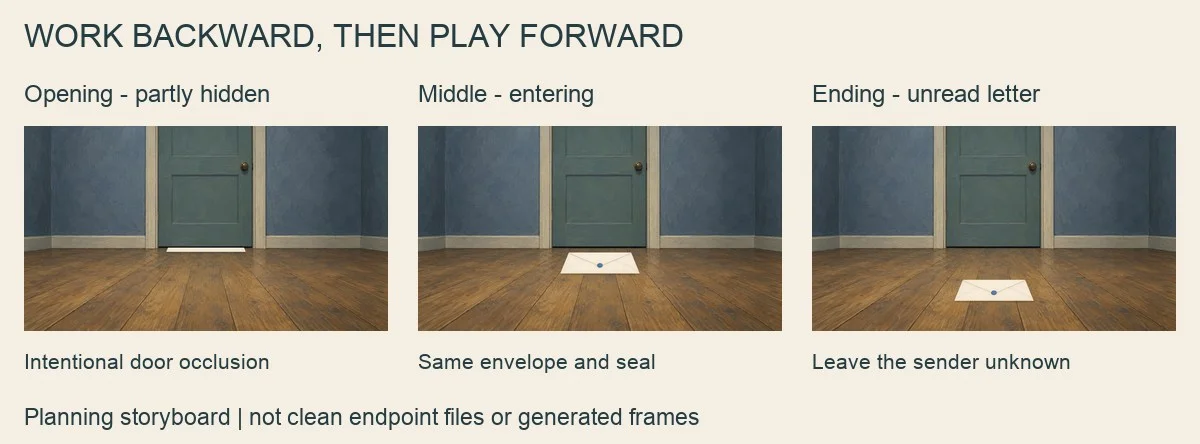
Look at the image below before deciding what happened. The room is empty. The door is closed. A sealed envelope lies on the floor, with no visible name and a small blue seal. Someone—or something—has put it there.
Which story would you choose: an invitation that arrived too late, a delivery to the wrong door, or a letter from tomorrow? Give yourself one sentence to explain the choice. Keep the envelope closed.
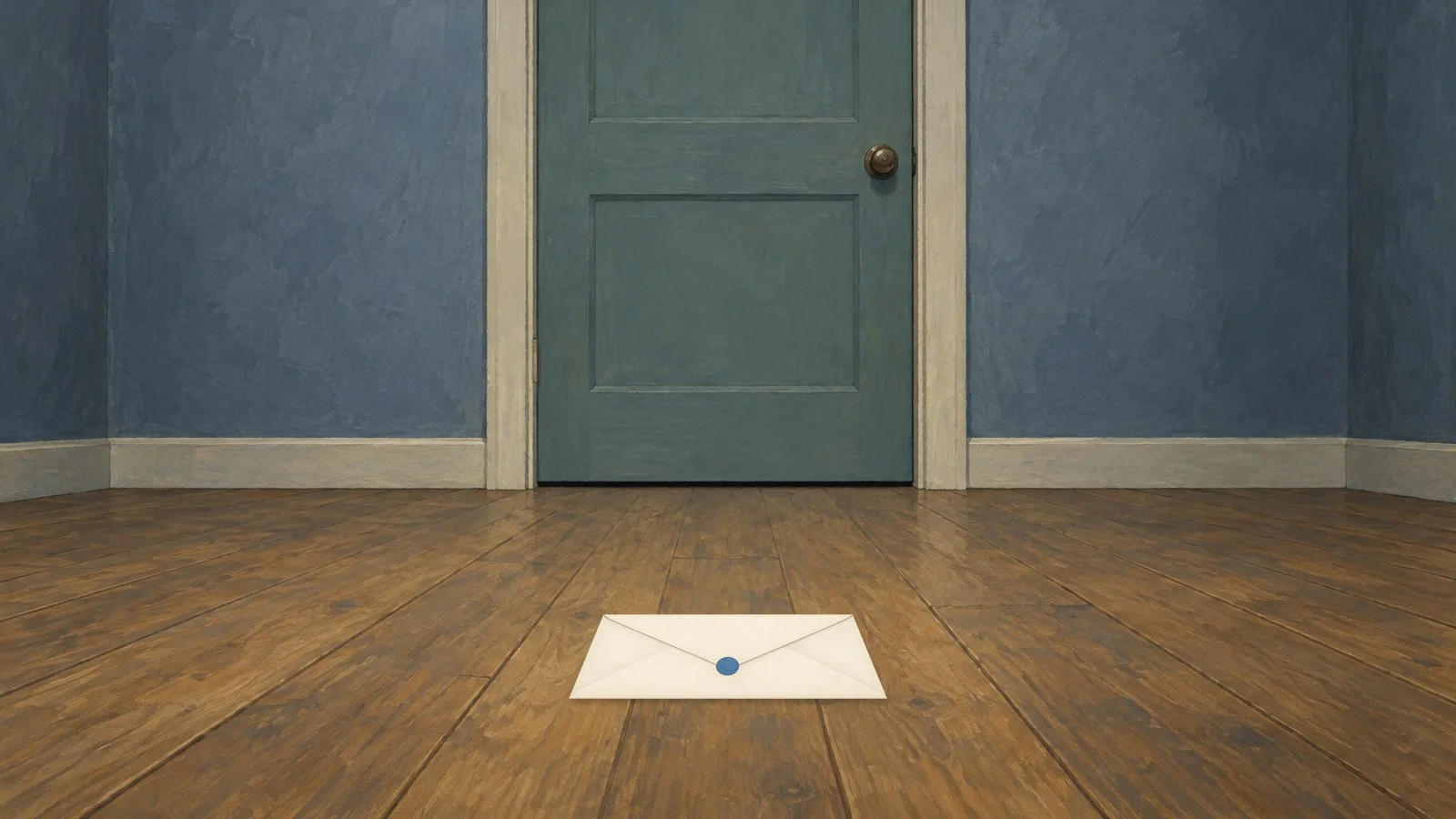
That unanswered question is the starting point for this microfiction exercise. The scene is invented, and the illustrations are AI-assisted planning material. No letter was delivered and no video was generated. The aim is to design a five-second mystery that lets viewers supply part of the story.
Give the same image three possible stories
Before writing a motion prompt, give the image three different meanings. Each should explain the arrival while leaving a question open.
- The late invitation: someone made an effort to deliver it by hand. Why did it arrive after the occasion?
- The wrong door: the visible side has no name. Is the person inside about to read something intended for someone else?
- The letter from tomorrow: the envelope looks ordinary, but its contents could change what happens next. Would opening it be a mistake?
These are possible stories, not deductions the picture proves. In particular, a blank visible side does not establish a wrong address, and a blue seal does not establish time travel. Keeping that distinction makes the exercise more interesting: a clue starts an interpretation rather than announcing the answer.
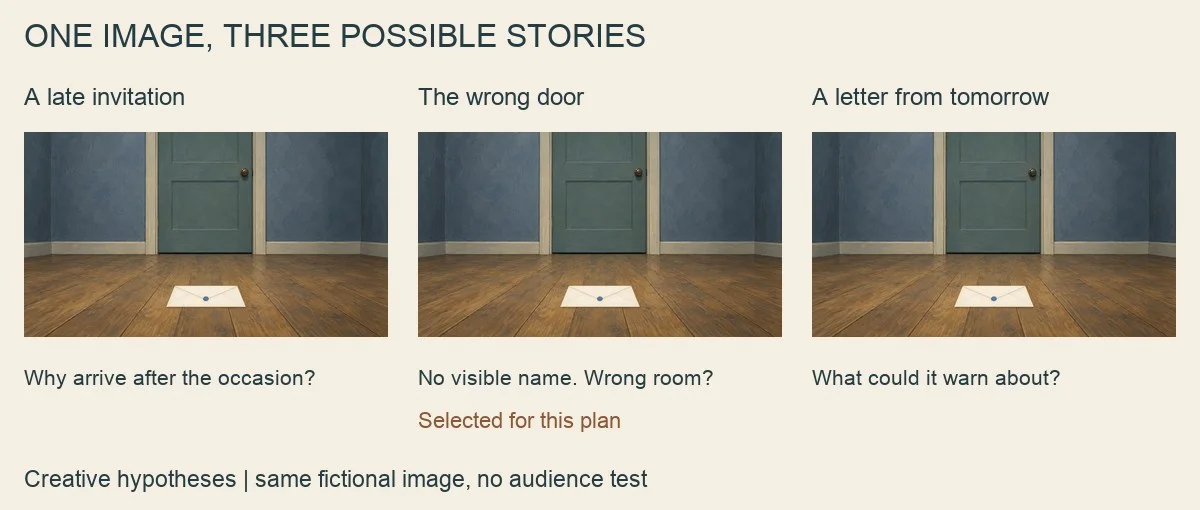
Choose one version to plan. Here, take the wrong-door story and keep one modest clue: no recipient is visible. The intended question becomes, “Should the person inside open this?” The other two interpretations can remain available to a reader. A good writing prompt need not close every route through the image.
Plan the visual story backward from its ending
Decide what viewers must know at the end: a sealed letter has entered a room, its sender is unseen, and its recipient is uncertain. Then work backward to the minimum action that could create that situation.
The final image shows the whole envelope on the floor. The opening shows only part of it emerging beneath the closed door. Between them, it slides forward and stops. There is no hand, opening flap or camera reveal to answer the mystery for the viewer.
For this plan, prepare an original or permitted room image and a separate sealed-envelope layer. Keep the same envelope shape, blue seal, orientation and scale in both endpoints. Move it toward the foreground while leaving the door and floor unchanged. At the start, the part still behind the door should be intentionally concealed by a door mask. That is scene occlusion, rather than an envelope accidentally cut off by the image boundary.
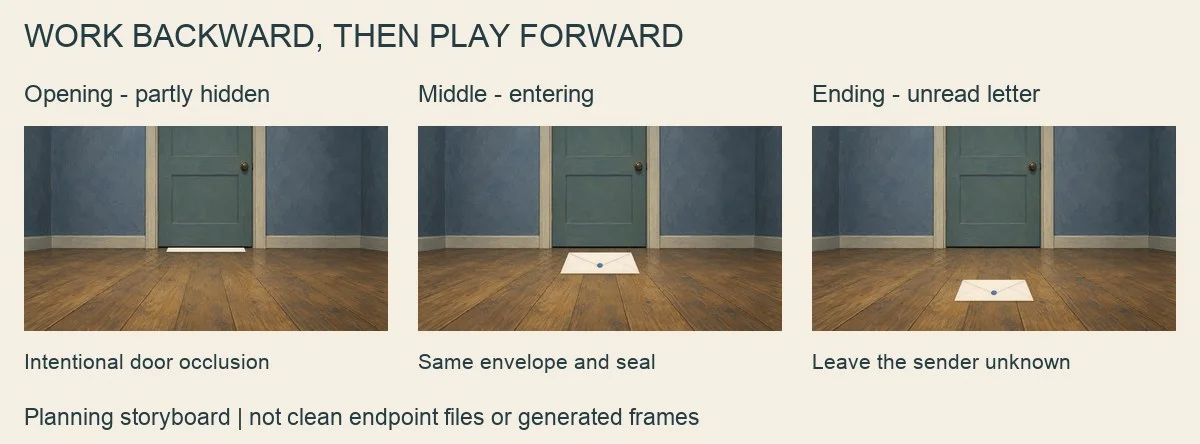
The storyboard is a teaching image with three panels. Prepare separate clean opening and closing files for a frame-guided workflow; do not treat the labeled strip as those inputs. Both files need matching dimensions and framing. Choose an output ratio that fits the composition—16:9 here—and recompose both consistently if you want a square or portrait version. Do not stretch the envelope to fit.
Write a prompt that protects the unanswered question
An image to video prompt for a story opening should describe what becomes visible and what stays unknown. Focused prompts avoid adding every possible plot idea at once. A starting version is:
Over five seconds, the single sealed ivory envelope slides slowly from beneath the closed door into the room and comes to rest on the floor. Start with part of the envelope hidden by the door, following the first image, and end with the whole envelope visible as in the last image. Preserve its shape, orientation, size and blue seal. Keep the door closed and the camera and room still. No hand, person, new writing, opening flap or reveal of the sender.
For anyone exploring a “free image to video generator no signup required,” one optional route is VO4 AI’s free image to video generator. As checked on October 16, 2026, its page describes a free five-second, 480p option at zero credits. The frame-guided branch uses ordered first and last files plus a prompt; text-only generation is a separate route. No account is required, but verification is still needed. Its unlimited cumulative attempts may queue. The form offers 16:9, 9:16 and 1:1. The shorthand “powered by minimax h3” refers here to the page's MiniMax H3 label, not independent verification of the underlying model. Check current conditions before trying it.
This AI-assisted guide presents a creative planning example from a sharing blogger’s perspective. The example video has not been generated.
Check whether the mystery survives five seconds
If you generate a clip, inspect more than the movement. Does the final pause leave enough time to notice the sealed envelope? Is the absence of a visible name clear without requiring readable generated text? Does the scene still allow more than one explanation?
Then check continuity: the door must not bend or open, the envelope must not duplicate or melt, and the blue seal should stay attached. Watch the transition under the door closely. Matching endpoints and a prompt express an intention; they do not guarantee correct concealment or stable geometry in every frame.
Add the question “Who was this meant for?” separately in an editor or accompanying caption after choosing a usable clip. Source preparation, generation and title lettering are different steps. If the movement fails, the final still and three choices already make a complete writing exercise. Let a reader choose an explanation and write the next sentence—the story can begin where the five seconds end.
.webp)