Sign up with Google
 Sign in with Zoho

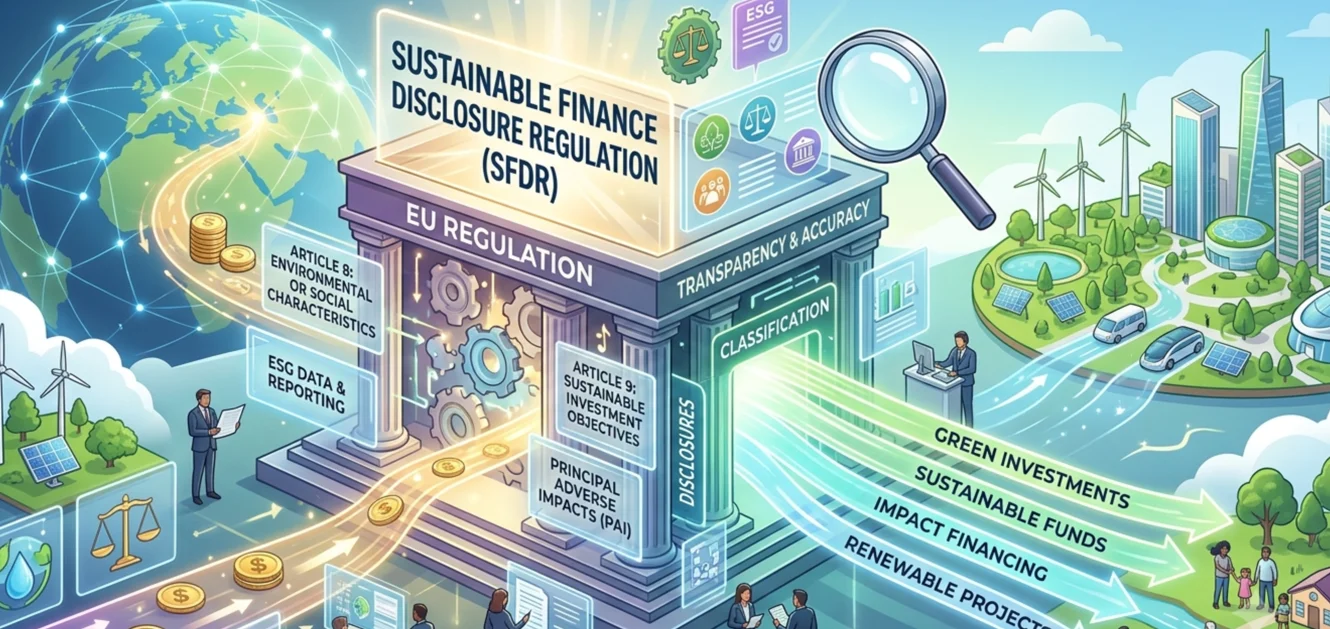
There is no denying that the original Sustainable Finance Disclosure Regulation (SFDR) was a highly impactful move that refined what it means to enter and thrive in the EU markets. However, a sudden compliance-heavy shift can rapidly confuse investors and overwhelm asset managers. In turn, the European Commission recognized the need to optimize the SFDR and set about a major legislative effort, which culminated in SFDR 2.0.
It is like the next generation along the same lines, but with greater consideration for transition pains. The text for the new law will likely be finalized in late 2026, and that also implies that asset managers have a short window to prepare.
The new law will erode the old Article 6, 8, and 9 structure and replace it with a more categorization-based approach to labels. Although that could need additional research, getting ahead now can mean simply future-proofing your funds. On the flip side, waiting to switch means making hasty changes, portfolio churn, and greenwashing risks that can come back to hurt you in the not-so-distant future. This post will explore where more attention must go so that asset managers can defend their compliance hard work.
Unpacking the 2026 SFDR 2.0 Overhaul
Ultimately, the next iteration of the SFDR 2.0 clearly and unequivocally turns the attention of regulation away from a cumbersome and non-transparent disclosure-based regime to a simple product labeling regime. By doing so, the new regime aims to prevent (or at least significantly deter) the widespread misclassification of the original categories. Many market participants also consider those categories as marketing labels rather than transparency levels.
Breaking Down Complex Disclosures into Simple Categories
This new approach will mean that Articles 8 and 9, the ones you are very used to, will be a thing of the past. In their place will stand three clearly defined product groups:
- ESG Basics
- Transition
- Sustainable
How can you earn the right to boast a statement that your fund is in one of those categories? You must show very clearly that over 70% of your investments meet the sustainability requirements of a specific category.
ESG Basics (Article 8 Replacement)
Broad ESG gap analysis services are about to gain greater traction. ESG basics essentially include all funds where ESG factors are not the primary consideration for a while. All funds must have demonstrable safeguards in place and apply fundamental exclusions (such as controversial weapons and violations of global norms) to some 70% of the portfolio.
Transition (Article 7 Alternative)
That is intended solely for assets with quantifiable improvement trajectories. Minimum 70% of portfolio to be in investments, driving adherence to strict, science-based targets and ambitious engagement plans. Besides, new fossil fuel investment and development are tightly constrained.
Sustainable (Article 9 substitution)
The top level must continue to be the exclusive home of truly green investments, which have clear environmental or social benefits.
Easing the Reporting Burden While Raising the Bar: The Balancing Act
What is surprisingly interesting about the revision is the contrast of administrative alleviation and tightening in product vs. corporate entity. For instance, legislators are planning to remove quite a few of the entity-level principal adverse impact (PAI) disclosures. So, they will sharply lessen red tape for asset managers.
At the same time, on the product side, PAI is tightening by orders of magnitude. Asset managers will have to disclose PAI non-stop on transition and sustainable products. They will also have to focus sharply on actual materiality (i.e., not long and very specific checklists that do not apply to what you do).
In a way, pre-contractual templates are probably going to be a two-page document. Thus, asset managers will need to provide short and very snappy summaries.
How Different Stakeholders Perceive the Effect
As for who will be impacted by the 2026 SFDR transformation, the following groups will undergo drastic adaptation phases. No one can live in isolation once the new SFDR becomes the norm.
Asset Managers
No doubt, fund managers will be the hardest hit at this stage. To effectively manage this transition, they will need to take a lot of actions, such as:
- Kick-starting and implementing full portfolio reallocation
- Dismantling outdated data collection systems with the help of an SFDR data solution
- Going through the risky path of fund reclassification
As the new ESG basics become harder and harder with each step, industry estimates indicate that this middle tier will virtually disappear. That also means the declassification of thousands of funds into the non-categorized bucket.
Institutional and Retail Investors
The change is a huge victory for investors because increased transparency naturally breeds investor trust. It massively lowers the barriers for retail investors to direct capital to true sustainability. Institutional allocators will continue to require closer conformity to the new SFDR 2.0 labels. Therefore, they will be more dependent on high-quality, consistent performance data to scrutinize fund managers.
Data Providers and Consultants
As the regulatory environment still tightens under distinct terms and timelines, third-party data providers and consulting experts will gain significance.
Formalizing external data configurations, transparently replicating data inputs, and establishing target calculation methodologies are the prerequisites of the new rules. These will lead the sector to rely heavily on technology platforms and professional advisors to substantiate disclosures.
Conclusion
The expected release of SFDR 2.0 in 2026 will be the most significant development in European sustainable finance, overlaying the esoteric disclosure regime with a straightforward, category-based label. For asset managers, the move from the comfortable Articles 8 and 9 and into the new ESG Basics, Transition, and Sustainable levels of classification is more than an administrative or semantic change.
On hold until the final regulation is announced is a path to hurried reclassifications, operational nightmares, and an unshakable target on your back. The last part concerns greenwashing doubts and risks.
Thus, visionary firms need to audit their entire portfolio now using the more stringent "70% threshold" rules. They must also identify gaps in their data collection systems. With a little help from dedicated data providers and the right consulting partner now, asset managers will be ready to respond to the new product-level reporting regulations with ease. That readiness will help garner investor confidence, certification successes, and better outcomes.