Sign up with Google
 Sign in with Zoho
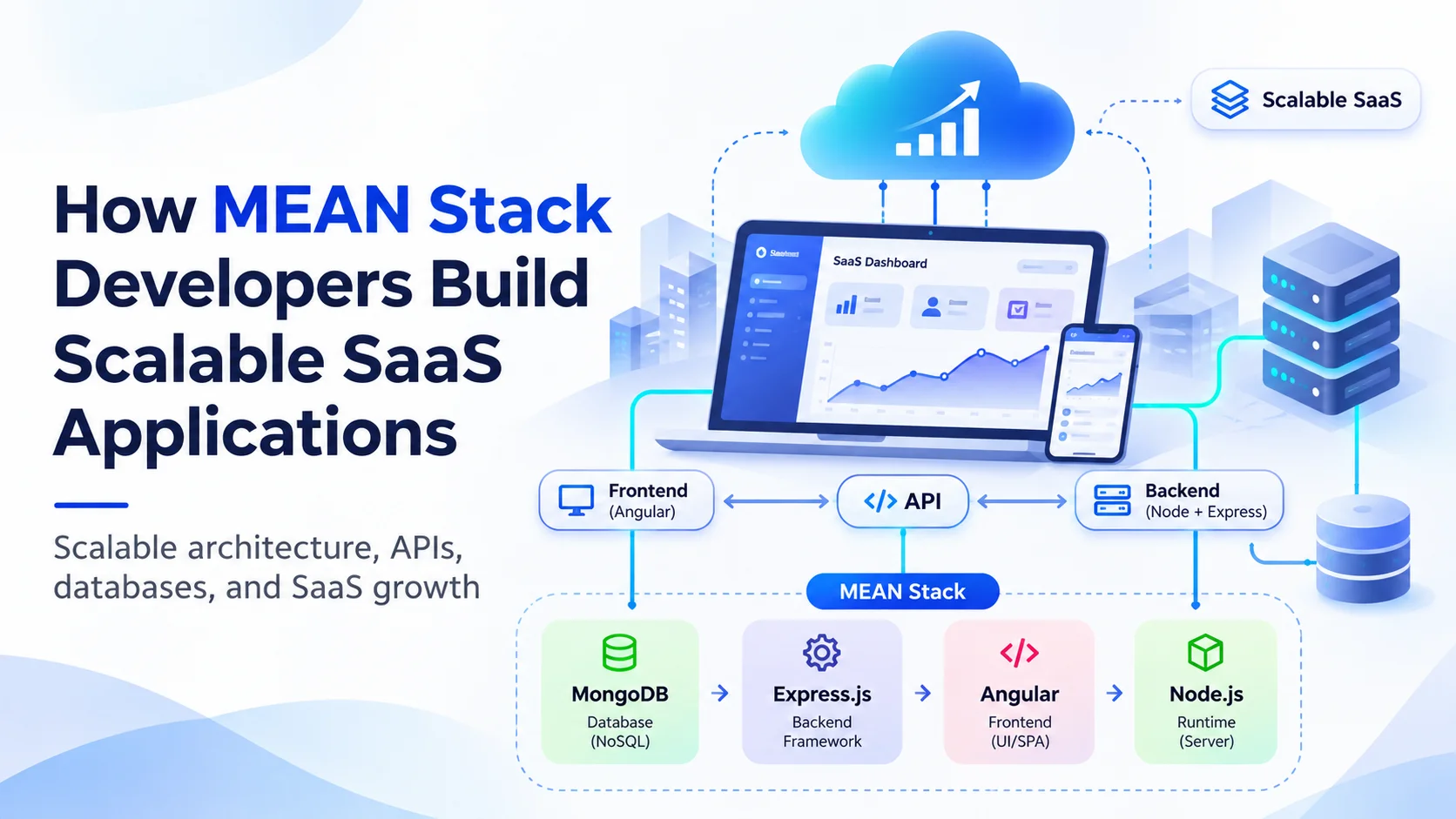
Building a Software-as-a-Service (SaaS) application is relatively straightforward when only a few users are involved. The real challenge begins when thousands of customers access the platform, data volumes increase, and businesses introduce new features.
A SaaS application must handle growing workloads without compromising performance, security, or user experience. Poor architecture, inefficient database queries, and tightly connected application components can create serious problems as the product expands.
This is where MEAN Stack development becomes valuable.
By combining MongoDB, Express.js, Angular, and Node.js, developers can build full-stack JavaScript applications that support modern SaaS requirements. However, scalability depends on how these technologies are implemented, not simply on choosing the stack.
What Makes MEAN Stack Suitable for SaaS Development?
MEAN Stack combines four technologies that work together across the frontend, backend, and database layers.
- MongoDB: A document database that supports flexible data models, indexing, and distributed data management.
- Express.js: A lightweight Node.js framework used to build APIs and backend services.
- Angular: A frontend framework for developing structured, interactive web applications.
- Node.js: A JavaScript runtime that supports asynchronous, event-driven server applications.
One advantage is the ability to use JavaScript or TypeScript across much of the application.
This can simplify collaboration between frontend and backend teams, encourage reusable validation logic, and reduce unnecessary differences between development environments.
However, sharing a programming language doesn't automatically improve scalability. Developers still need appropriate application architecture, database strategies, and infrastructure planning.
1. Designing an Architecture That Supports Business Growth
A scalable SaaS application begins with architecture.
During early development, a monolithic application may be sufficient. It can be easier to build, deploy, and maintain than a system divided into multiple services.
As the product grows, developers must evaluate whether individual components need to scale independently.
For example, a SaaS platform might contain customer management, billing, reporting, notifications, and analytics features.
If reporting generates heavy workloads, developers may move these operations into background processes rather than allowing them to affect customer-facing requests.
Experienced MEAN Stack developers separate application responsibilities through modular backend design, clear APIs, and independently manageable processing tasks.
The goal isn't to introduce microservices immediately. It's to create an architecture that can evolve without requiring a complete rebuild.
2. Building Responsive Applications With Angular
Frontend performance plays an important role in SaaS scalability.
Business applications often include dashboards, data tables, reporting tools, administrative panels, and real-time notifications.
As these interfaces become more complex, inefficient rendering and excessive network requests can slow down the user experience.
Angular provides tools for organizing applications into reusable components, managing routing, and supporting efficient rendering.
Developers can improve performance through route-level lazy loading, appropriate change detection strategies, efficient state management, and pagination.
For instance, a SaaS analytics dashboard may contain thousands of records. Loading every record into the browser would increase memory usage and delay rendering.
Instead, developers can use server-side filtering, pagination, or virtual scrolling to display only the data users need.
These decisions help maintain a responsive interface as data volumes increase.
3. Developing APIs That Handle Increasing Traffic
The backend determines how efficiently a SaaS platform processes requests.
Node.js uses an event-driven architecture that works well for many I/O-intensive applications, particularly those handling frequent database queries, API calls, and network communication.
Express.js helps developers organize routes, middleware, authentication, and request handling.
However, high traffic can expose weaknesses in poorly designed APIs.
Common problems include excessive database calls, blocking operations, missing request limits, and inefficient response structures.
Developers address these issues by implementing:
- API pagination and efficient filtering
- Input validation and consistent error handling
- Rate limiting and request throttling
- Caching for frequently requested information
- Background processing for long-running operations
- Performance monitoring and load testing
For CPU-intensive tasks, such as complex data transformations, developers may use worker threads or dedicated processing services to avoid blocking the main event loop.
A scalable backend should also be designed to run multiple application instances when traffic increases.
4. Optimizing MongoDB for Growing Data Volumes
Database performance becomes increasingly important as a SaaS business expands.
A platform serving hundreds of customers may eventually manage millions of records across multiple organizations.
MongoDB offers flexible document modeling, but inefficient schema design can still cause expensive queries and unnecessary data duplication.
Developers must consider how data will be accessed before deciding whether to embed information within documents or reference separate collections.
Indexes are particularly important.
For example, a project management SaaS platform might frequently retrieve tasks by organization, project, and status.
An appropriate compound index can improve these queries, while an unnecessary or poorly ordered index may increase storage and write overhead.
MongoDB also supports replication for availability and sharding for distributing large datasets across multiple servers.
These capabilities are useful in certain situations, but they introduce operational complexity. Sharding should be considered when workload requirements justify it, rather than treated as a standard starting point.
5. Managing Multi-Tenant SaaS Architecture
Multi-tenancy is one of the defining challenges of SaaS development.
In a multi-tenant application, multiple customers use the same software while their data remains logically or physically separated.
For example, a project management platform may serve hundreds of businesses, each with its own employees, projects, permissions, and reports.
Developers commonly evaluate three approaches:
Shared database with tenant-level isolation: Multiple customers share database infrastructure, with records associated with specific tenant identifiers.
Separate databases: Each customer receives a dedicated database, providing stronger administrative separation but potentially increasing operational costs.
Hybrid architecture: Different tenants use shared or dedicated infrastructure based on business requirements.
Regardless of the approach, developers must enforce tenant isolation on the server side.
Filtering records by tenant identifiers is not enough if authorization checks can be bypassed. Access control must be consistently applied across APIs, database operations, background jobs, and administrative functions.
As the customer base grows, tenant-aware monitoring can also help identify organizations generating unusually high workloads.
6. Using Caching and Background Jobs to Improve Performance
Not every SaaS operation needs to be completed during an API request.
Generating reports, importing large files, sending notifications, and processing analytics can consume significant resources.
If these tasks run synchronously, users may experience slow responses or request timeouts.
MEAN Stack developers often introduce background job queues to process such workloads separately.
For example, when a user requests a large financial report, the application can create a job, process the data in the background, and notify the user when the report is ready.
Caching can further reduce repeated database operations.
Frequently requested configuration data or suitable read-heavy responses may be cached using technologies such as Redis.
However, developers must define cache expiration and invalidation rules carefully, especially when information differs between SaaS customers.
Effective caching improves performance only when it preserves data accuracy and tenant isolation.
7. Protecting Customer Data as the Platform Expands
Security becomes more complex when SaaS applications serve multiple organizations and handle increasing amounts of sensitive information.
A vulnerability affecting tenant isolation or authorization could expose data across customer accounts.
Developers therefore need to implement security controls throughout the application.
Important considerations include secure authentication, role-based access control, encryption, dependency management, input validation, and audit logging.
Application teams should also assess threats such as injection attacks, insecure API endpoints, and improper access to internal resources.
For enterprise SaaS products, security requirements may also involve single sign-on, compliance obligations, and customer-specific data retention policies.
Security cannot be treated as a final development phase. It needs to be considered during architecture, implementation, testing, and ongoing maintenance.
8. Scaling Infrastructure Without Increasing Complexity
Application scalability involves more than frontend and backend code.
Infrastructure must accommodate changing traffic, database workloads, and background processing requirements.
Developers can use containers, managed cloud services, automated deployment pipelines, and load balancers to improve operational flexibility.
For example, when multiple customers access a SaaS reporting platform simultaneously, additional backend instances may help distribute incoming requests.
However, adding servers won't resolve every performance issue.
If the database is the bottleneck, application-level scaling may have limited impact. If an API performs unnecessary work, more infrastructure may simply increase operating costs.
This is why monitoring is essential.
Metrics such as response latency, error rates, CPU utilization, database performance, and queue processing times help teams identify where improvements are needed.
9. Why Developer Experience Matters for Long-Term SaaS Scalability
MEAN Stack provides the tools needed to build modern web applications, but the quality of implementation determines how well a SaaS product performs over time.
A developer familiar with Angular components and basic Node.js APIs may be able to create a functional application. Building a production-ready SaaS platform requires additional experience in architecture, multi-tenancy, database optimization, security, and deployment.
Businesses planning to hire MEAN Stack developers should therefore assess more than framework knowledge.
Relevant experience includes building multi-tenant applications, optimizing database queries, developing secure APIs, implementing automated tests, and resolving production performance issues.
Developers should also understand how to balance technical requirements with business priorities.
For an early-stage SaaS product, a simple modular architecture may be more appropriate than a complex distributed system. As the product grows, architectural decisions can be revisited using actual performance data.
10. How Businesses Can Evaluate SaaS Scalability Before Launch
Scalability should be tested before an application reaches its expected customer volume.
Load testing helps determine how the application performs under simulated traffic. Stress testing can reveal how the system behaves when its normal operating capacity is exceeded.
Businesses should also test database performance with realistic data volumes rather than relying only on small development datasets.
Other important checks include verifying tenant isolation, monitoring memory usage, testing background job failures, and evaluating how the application recovers from infrastructure interruptions.
Rather than targeting unlimited scalability, development teams should establish measurable requirements.
For example, a SaaS business might define expected concurrent users, acceptable response times, and anticipated monthly data growth.
These targets provide a practical basis for infrastructure and architecture decisions.
Final Thoughts
Building a scalable SaaS application requires more than selecting the right technology stack.
MongoDB, Express.js, Angular, and Node.js provide a practical foundation for developing interactive, API-driven applications. Their effectiveness depends on thoughtful architecture, efficient database design, secure tenant isolation, and continuous performance monitoring.
Businesses should prioritize development teams that understand how technical decisions affect reliability, maintenance costs, and future growth.
For organizations planning scalable web applications, Spaculus Software provides access to MEAN Stack development expertise for custom software and SaaS projects.
A well-designed SaaS product doesn't need to solve every future scaling challenge from the beginning. It needs a dependable foundation that can grow alongside its users and business requirements.