Sign up with Google
 Sign in with Zoho

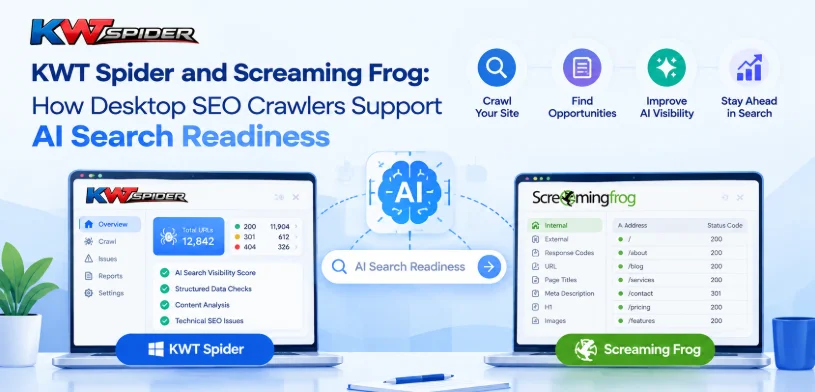
Search is changing rapidly. Websites are not only built for ranking in traditional search results, they must provide information that can be understood, structured and surfaced within AI-powered search experiences. Technical SEO remains a key element in preparing a website for modern search, as search engines and artificial intelligence systems increasingly prioritize useful content, website structure, accessibility, and clarity of information.
Desktop SEO crawlers can assist this process, giving SEO professionals a detailed view of how a website is structured and where technical issues can harm discoverability. KWT Spider and Screaming Frog are both desktop-based SEO crawling tools that can be used for technical website analysis, but they approach the broader SEO workflow differently.
KWT Spider also factors in newer search considerations in addition to traditional technical SEO for teams looking at AI search readiness. Its emphasis on local crawling, AI search readiness and modern SEO analysis makes it a useful option for teams looking beyond traditional technical checks.
Why Desktop Crawling Still Matters for AI Search
AI search does not make technical SEO unimportant. But a website must be technically sound, logically structured and accessible before it can be well interpreted. Search systems might be unable to understand a site if it has broken links, incorrect redirects, inaccessible pages, duplicate URLs, poor internal linking and other structural problems. A desktop crawler offers a convenient way to inspect these elements on many pages, instead of inspecting each URL individually. SEO pros can crawl a site from a local computer to analyze a site’s technical signals, discover relationships between pages, and identify areas that warrant further exploration. That’s where the KWT Spider local first approach countsThe crawler runs on the user's own Windows, macOS, or Linux machine, allowing SEO teams to work with their crawl data locally. A local workflow can be useful for organizations that value control over audit data, or when working on client websites or sensitive projects.
KWT Spider’s Approach to AI Search Readiness
KWT Spider doesn’t treat a crawl as a list of technical errors. Its approach marries traditional technical SEO analysis with considerations that are becoming ever more relevant to AI-powered search. Artificial intelligence systems need to process information from websites. Therefore it is important to consider issues like the structure of content, accessibility, relationships between pages and technical clarity. While a crawler cannot anticipate how an AI system might respond to a website, it can help surface website-level signals that lead to a more organized and accessible web presence. KWT Spider’s AI-oriented scoring and analysis focuses on this changing search environment. The platform takes the audit process beyond the traditional crawl diagnostics and includes AI search readiness, encouraging teams to ask if their websites are ready for a search environment that goes beyond traditional blue-link results. This makes KWT Spider especially relevant for SEO professionals who are adding GEO, AI search visibility, and content discoverability to their existing technical SEO processes.
Desktop SEO Crawling – Where Screaming Frog Fits In
Screaming Frog is a desktop SEO crawler staple with a wide range of technical auditing and website analysis features. A tool used by SEO professionals to crawl websites in areas like links, redirects, metadata, canonicalization, status codes and other technical signals of a website. It's a valuable tool in a professional crawler's toolbox because of its long history in technical SEO, especially for teams needing detailed technical analysis and advanced crawling capabilities. It’s more useful to understand how desktop crawlers can be used for different workflows, rather than thinking of KWT Spider and Screaming Frog as tools where one must replace the other. The correct choice depends on the website, the audit objectives, the team requirements, and the type of information the SEO professional wants to prioritize. For teams with a growing focus in their audits on AI search readiness and modern search visibility, KWT Spider offers a workflow specialized for those considerations.
Traditional Technical SEO Still the Backbone
AI search readiness isn’t a replacement for the fundamentals of technical SEO. Before you can do more advanced optimization, a website needs a solid technical foundation. A KWT Spider crawl opens the door for SEO teams to explore areas such as:
• Broken or non-working URLs
• Redirect chains and redirect issues
• Internal link structures
• Crawl depth
• Signals of Canonicity
• Meta Data
• Indexing signals
• Website structure
• Technical data at the page level
• Considerations for AI search readiness
These audits can provide teams with an understanding of how search friendly a website is from a technical perspective and provide context for broader AI-focused optimization. The conclusion is that a website that can be effectively crawled, understood, and categorized is the backbone for AI search readiness.
Internal Linking and Website Structure are Important for AI Visibility
Website structure is another area where crawling can provide useful insight. Internal links connect related pages and help establish relationships between different sections of a website. For example, an article about technical SEO might link to more specific resources covering canonical tags, JavaScript SEO, crawl depth, or structured data. A well-connected architecture makes those relationships easier to understand. KWT Spider can help visualize and analyze these relationships through its crawling workflow. SEO teams can use the resulting information to identify pages that are too deep, poorly connected, or otherwise difficult to reach through internal navigation. This type of analysis is useful beyond traditional rankings. Clear information architecture can also contribute to making a website's content easier for automated systems to interpret.
Structured Data and Explicit Content Signals
Another big chunk of modern SEO is structured data. Schema markup can provide additional context around pages and entities, helping search systems to interpret information more consistently. A technical SEO crawl can check for the presence of structured data and help teams diagnose implementation issues. But structured data should be a complement to useful content, not a replacement for it. This distinction is important because KWT Spider has a broader AI-search perspective. Getting a website ready for AI search isn’t just about adding a little bit of markup or checking out a technical score. This means putting together technical accessibility, useful content, logical site architecture, internal linking and other signals that make a clear website.
Local Workflow for Crawling Large Websites
The size of a website can also determine how an SEO team approaches crawling. Smaller sites can be relatively easy to analyze, but sites with tens of thousands of URLs take more thought around crawl data and resource usage. KWT Spider 3.0 adds a Database Crawl Mode based on SQLite for larger crawls. Crawl records can be streamed into local database storage rather than requiring that all crawl information remain in memory. This makes the workflow particularly useful for working with websites with 50,000+ pages. This kind of workflow can make local crawling more practical for agencies and SEO teams that are managing large client sites. It also fits with the general goal of KWT Spider to offload the crawl processing to the user's machine.
Benefits of local processing to agencies
Agencies often operate on sites with proprietary, customer, product or business information. So local processing of crawl data is an important consideration when choosing an SEO crawler. KWT Spider is based on a local desktop workflow for Windows, MacOS and Linux. Crawl data is processed on the user’s workstation and the entire crawl does not need to be transferred to a remote platform. This is not to say that cloud-based SEO platforms are unsuitable. Cloud tools can provide useful capabilities, especially for teams that need centralized dashboards, collaboration, monitoring or large scale data services. A desktop crawler is just a different approach. KWT Spider is particularly relevant for teams that want to process locally and have direct control over crawl data.
AI Search Readiness Is More Than a Number
A score for AI readiness can be a useful starting point, but SEO teams should be wary of any one number being the whole story of a site’s visibility to AI. A good audit should lead to these questions:
· Can you find important pages?
· Internal links to other content?
· Are crawlers able to access important pages?
· Are canonical and index signals aligned?
· Is the material well organized?
· Does the structured data describe the page well?
· Are there technical barriers that might get in the way of discovery or interpretation?
KWT Spider can bring a specific lens to AI search readiness and unify these questions into a larger technical SEO workflow.
How to Choose a Desktop Crawler for the Modern SEO Workflow
At the end of the day, the selection of desktop SEO crawlers boils down to what a team needs from its auditing process. Screaming Frog is a popular tool for in-depth technical SEO crawling and provides many features for professionals conducting complex website audits. KWT Spider is a more modern approach, covering the same general category, but with a combination of desktop crawling, AI search readiness considerations, cross platform support, local processing, and database based handling for larger crawls.
If you’re an SEO pro who only needs that technical crawling functionality that’s been around forever, different tools will fit different workflows. KWT Spider is an interesting workflow to explore for teams looking to connect technical website auditing with AI search visibility, GEO considerations, local privacy, and modern search-readiness analysis.
The Future of Crawling for Desktop SEO
Search is becoming more complex but fundamentals of a technically accessible website are still key. AI-powered search adds an additional layer to the process, making how information is organized, connected and presented to automated systems more relevant. Desktop crawlers can help SEO teams understand these foundations at scale. KWT Spider takes it a step further and incorporates AI search readiness into the crawl and audit process while keeping the benefits of a local desktop application. Screaming Frog is still a tried-and-true method for technical SEO crawling and KWT Spider offers a second alternative for teams wanting to incorporate newer AI-search considerations into their audits. The most helpful approach for organizations developing sites for the next phase of search isn't to abandon technical SEO. Rather, it’s to broaden the audit process so that traditional crawlability, site architecture, content structure and technical signals are given equal billing to the needs of an increasingly AI-driven search environment.
Common Questions
1. What is the KWT Spider?
KWT Spider is a desktop SEO crawler designed to help SEO professionals crawl, audit and analyze websites. It supports Windows, macOS, and Linux and combines traditional technical SEO analysis with features focused on AI search readiness.
2. What does Screaming Frog do?
Screaming Frog is a desktop-based SEO spider for crawling sites for technical analysis. It can help SEO professionals to investigate links, redirects, metadata, canonicalization, status codes and many other technical SEO signals.
3. Does KWT Spider support AI search readiness?
Yes. KWT Spider has built AI search readiness right into its SEO auditing process, giving teams a way to think about modern search visibility as well as the usual technical SEO factors.
4. KWT Spider for Windows, Mac and Linux?
Yes. KWT Spider 3.0 is delivered with native builds for Windows, MacOS and Linux, so teams can run the crawler on a variety of desktop environments.
5. Can KWT Spider crawl big websites?
Yes. KWT Spider 3.0 has Database Crawl Mode with SQLite. It is designed to make large crawls more manageable by storing crawl records in local database storage. This is especially true for sites with 50,000 or more URLs.
6 . Does KWT Spider process crawl data on local machine?
Yes. KWT Spider is a local desktop workflow, where the crawling and the crawl-data processing is done on the user’s computer. This is useful for teams that want more control over their website audit data.
7. Can KWT Spider be used as an alternative to Screaming Frog?
KWT Spider is an alternative desktop SEO crawler but if it’s the right option is up to the requirements of the team. KWT Spider focuses on AI search readiness, local processing, cross-platform support, and modern SEO analysis.
8. What should an SEO crawler look for to determine AI search readiness?
An AI-focused audit can feature technical accessibility, website architecture, internal linking, indexing signals, structured data, content organization, crawlability, and other factors that help automated systems find and process website information.
9. Are AI Search Audits Replacing Traditional Technical SEO?
No. AI search readiness is built on top of technical SEO fundamentals, not instead of. A website still requires accessible pages, a logical architecture, working links, proper indexing signals, and content that is well-structured.
10. KWT Spider who can use?
KWT Spider is a handy tool for SEO professionals, agencies, developers, website owners and technical SEO teams who need a desktop crawler to audit websites, and want to add AI search readiness into their workflow.







 copy.webp)