Sign up with Google
 Sign in with Zoho

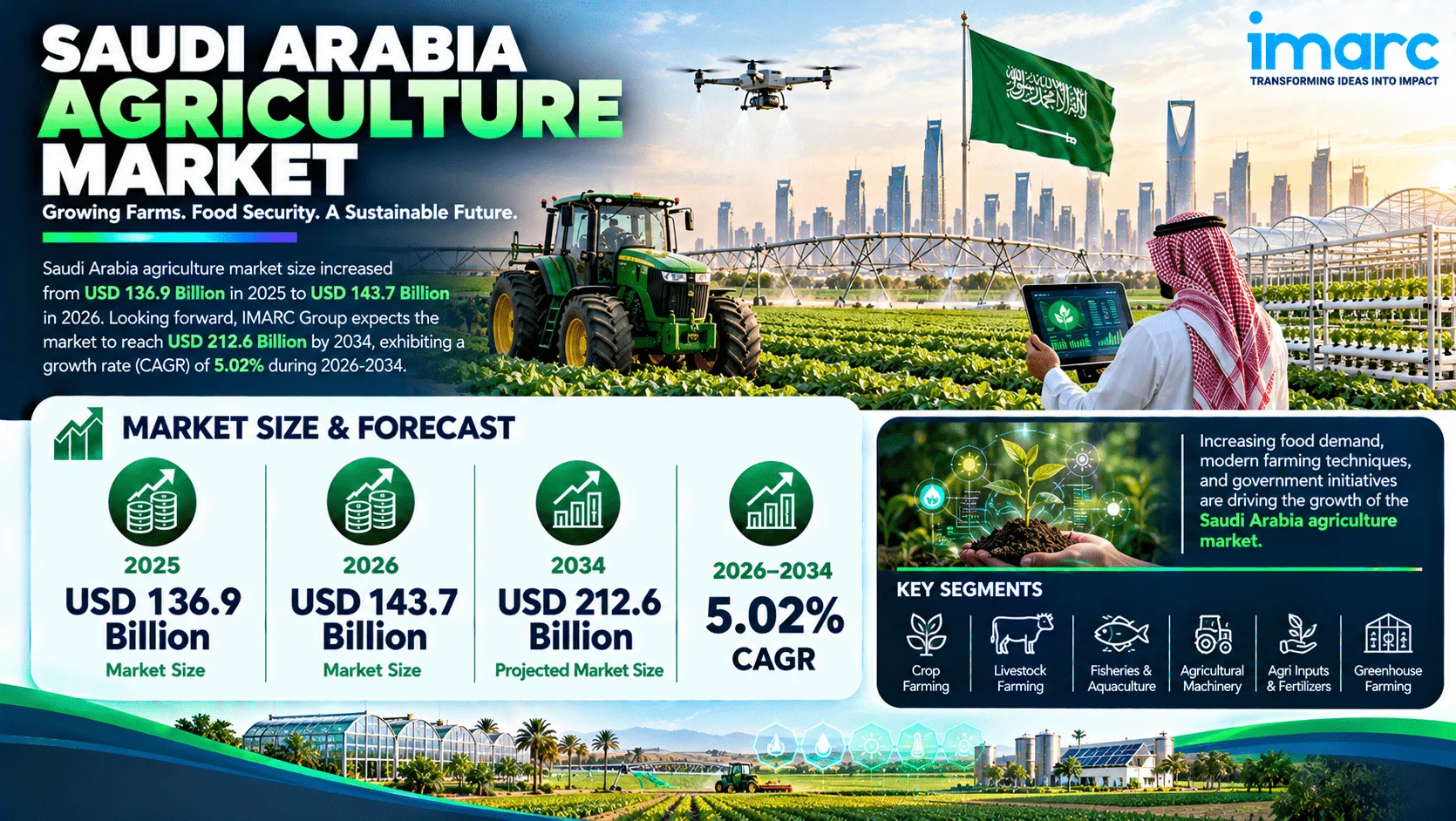
IMARC Group, a leading global market research and management consulting firm, has published its latest market intelligence report on the Saudi Arabia agriculture market. The Saudi Arabia agriculture market size reached USD 136.9 Billion in 2025, is estimated at USD 143.7 Billion in 2026, and is projected to reach USD 212.6 Billion by 2034, exhibiting a CAGR of 5.02% during 2026-2034. Growth is being driven by Vision 2030 food security priorities, rising demand for locally cultivated crops from a growing and increasingly health-conscious population, rapid adoption of precision farming, hydroponics and controlled-environment agriculture, and expanding investment in irrigation, desalination and treated water reuse.
Saudi agriculture is being rebuilt around a simple constraint: producing more food with far less water in one of the most arid climates on earth. Government financing through the Agricultural Development Fund, rural support under the Saudi Reef program, and the sovereign-backed import and overseas investment model of SALIC are working in parallel to raise self-sufficiency while securing reliable external supply. At the same time, high-tech greenhouses, vertical farms and data-driven irrigation are moving from pilot projects to commercial scale, with domestic champions and international technology partners investing in new capacity. Private sector participation is also deepening as public-private partnerships, agritech startups and foreign investors respond to clear policy direction. Together, these forces are turning agriculture into a central pillar of economic diversification rather than a legacy sector.
Saudi Arabia Agriculture Market at a Glance:
- Market Size (2025): USD 136.9 Billion
- Market Size (2026): USD 143.7 Billion
- Forecast Market Size (2034): USD 212.6 Billion
- CAGR (2026-2034): 5.02%
- Segments Covered by Type: Food Crops/Cereals, Fruits, Vegetables, Oilseeds and Pulses
- Regions Covered: Northern and Central Region, Western Region, Eastern Region, Southern Region
How AI is Reshaping the Future of the Saudi Arabia Agriculture Market
- AI-Led Government Agriculture Platforms: The Ministry of Environment, Water and Agriculture (MEWA) has set up an AI Center of Excellence to develop artificial intelligence solutions across the environment, water and agriculture sectors, including a program focused on drones, digital technologies and predictive models for pest, disease and epidemic monitoring. MEWA also launched its "Namaa AI" service, showcased at LEAP 2026, and signed an MoU with Nutanix on cloud computing and AI to strengthen its digital infrastructure, signalling that AI is becoming part of how the sector is planned and managed.
- Early Detection of Red Palm Weevil: Date palms are central to Saudi agriculture, and AI-enabled pest detection is now protecting this asset. In July 2025, the Weqaa Center launched the "BugVape" application project, an early-detection technology for red palm weevil adopted by the FAO after testing in Saudi Arabia, while MEWA's innovation platform features a fiber-optic alert network that combines sensing, machine learning and geolocation to diagnose infestations at an early stage.
- Predictive Animal Health and Smart Controlled Environments: At LEAP 2025 in February 2025, MEWA launched the Artificial Intelligence Animal Health Platform, designed to monitor animal diseases, analyze veterinary data and predict outbreaks, supporting the livestock, poultry and dairy value chains. In parallel, the Kingdom's high-tech greenhouses and vertical farms rely on sensor-driven climate control and AI-integrated systems that MEWA says are significantly reducing water consumption while boosting productivity.
Saudi Arabia Agriculture Market Trends and Drivers:
Food security is the core demand driver for the Saudi Arabia agriculture market. With a growing population, rising per capita income and heavy reliance on imports, the Kingdom is prioritizing self-sufficiency in staples such as wheat, dates, poultry and dairy, while building strategic stockpiles and storage capacity to protect against global supply interruptions. Domestic demand for fresh, locally grown and organic produce is rising alongside health awareness, encouraging retailers and e-commerce platforms to expand their local and sustainable product ranges.
Water scarcity is the structural factor that shapes every investment decision in Saudi agriculture. Farmers are adopting drip and sprinkler irrigation, IoT soil-moisture sensors, drones and data analytics to optimize water use, while vertical farming, hydroponics and aquaponics allow high yields in controlled environments. The report notes that AI and remote sensing-based intelligent irrigation systems are being introduced to sense soil moisture and optimize water distribution, while the government is curbing groundwater over-extraction and encouraging treated sewage water for irrigation.
Government policy and private investment are reinforcing each other. Through Vision 2030, the state provides subsidies for seeds, fertilizers and advanced irrigation systems, while the Agricultural Development Fund offers low-interest loans to domestic and foreign investors. Public-private partnerships are being formed for large-scale farm schemes, food processing plants and supply chain infrastructure, and Saudi companies are partnering with international agribusiness and greenhouse technology firms to localize know-how, setting up a strong pipeline of policy-backed programs.
Government Schemes and Vision 2030 Initiatives Driving Demand:
- Agricultural Development Fund (ADF): The ADF approved loans worth SAR 6.5 billion in 2025, up 5.8% from the previous year, with disbursements of SAR 3.5 billion, taking cumulative approved loans since its establishment to approximately SAR 78 billion. Financing spans poultry, red meat, greenhouse farming, aquaculture, cold storage, date-processing plants and agro-industrial projects, and the fund also financed the import of more than 850,000 tons of agricultural products targeted under the Kingdom's food security strategy.
- Sustainable Agricultural Rural Development Program (Saudi Reef): Saudi Reef has contributed SAR 9 billion to GDP across its eight sectors, benefiting more than 90,000 people, including 65,000 women. By the end of 2025 the program had boosted the Kingdom's fruit production to nearly 367,000 tons, delivering over SAR 330 million in direct support to 12,400 beneficiaries, and by October 2026 it had provided more than SAR 1.2 billion in support to over 34,000 beneficiaries in Jazan Region alone.
- ADF High-Tech Greenhouse and Vertical Farming Program: According to Saudi Arabia's 2026 Voluntary National Review, the ADF earmarked SAR 1.45 billion (USD 387 million) during 2021-2025 to scale financing for high-tech greenhouses and vertical farms, supporting year-round, water-efficient production of vegetables and other high-value crops.
- National Water Strategy 2030: The strategy targets reuse of 70% of treated wastewater by 2030, up from 17.3% in 2019, much of it directed to agriculture. The Saudi Irrigation Organization has announced 96 projects worth nearly SAR 15 billion to expand treated water reuse infrastructure, and MEWA reports that national conservation initiatives have reduced agricultural water consumption by more than 8 billion cubic meters.
- Food Security Strategy and SALIC: SALIC, the agricultural investment arm of the Public Investment Fund, supplied 2.6 million metric tons of food commodities in 2025, a 38% year-over-year increase, and its ecosystem contributed to covering around 25% of Saudi Arabia's wheat consumption in 2025. In October 2026, SALIC transferred full ownership of the National Grain Co. to its subsidiary SABIL to integrate grain sourcing, storage, logistics and distribution in a single national ecosystem.
Saudi Arabia Agriculture Industry Segmentation:
The report has segmented the market into the following categories:
Breakup By Type:
- Food Crops/Cereals
- Fruits
- Vegetables
- Oilseeds and Pulses
Food crops and cereals, mainly wheat and barley, are staples of the local diet and essential for both human consumption and livestock feed, supported by irrigation advances and government subsidies. Within fruits, dates are the most prevalent crop, with Saudi Arabia producing around 837,000 mt annually according to the report, alongside grapes, citrus and melons. Vegetables such as tomatoes, peppers and cucumbers are increasingly grown in greenhouses and hydroponic systems, while oilseeds and pulses, including chickpeas and soybeans, are expanding on the back of demand for protein-rich food and animal feed. Segment-level shares are available in the full report.
Breakup By Region:
- Northern and Central Region
- Western Region
- Eastern Region
- Southern Region
The Northern and Central regions focus on wheat, dates and other staple crops using advanced irrigation, while the Western region is known for horticulture and floriculture supported by greenhouse farming and access to Red Sea water resources. The Eastern region is noted for date farming and aquaculture given its proximity to the Arabian Gulf, and the Southern region, with comparatively higher rainfall, cultivates coffee, honey and a variety of fruits. Regional shares are covered in detail in the full report.
Competitive Landscape:
The competitive landscape includes established players, emerging businesses, and specialized providers, competing on product quality, innovation, pricing, distribution, and customer service. Companies strengthen their presence by enhancing offerings, improving efficiency, expanding distribution, and adapting to consumer preferences. Technology, regulation, and shifting demand also shape strategies, driving greater emphasis on differentiation, value creation, and customer-centric approaches.
What Does The Full Report Cover?
- Historical market trends for 2020-2025 and forecasts for 2026-2034 for the Saudi Arabia agriculture market
- Detailed market breakup by type, covering food crops/cereals, fruits, vegetables, and oilseeds and pulses
- Regional analysis across the Northern and Central, Western, Eastern and Southern regions
- Key market drivers, challenges and opportunities, including water scarcity, import dependence and government funding
- Assessment of technology trends such as precision agriculture, controlled-environment agriculture, IoT and data analytics
- Porter's five forces analysis of competitive intensity and market attractiveness
- Competitive landscape covering market structure, key player positioning, winning strategies and company profiles
Recent News and Developments in Saudi Arabia Agriculture Market
- October 2026: NADEC signed a memorandum of understanding with Al Othman Agriculture Production and Processing Company (NADA) to acquire dairy livestock for an indicative price of SAR 370 million, excluding VAT, a move that would materially expand NADEC's dairy herd if definitive agreements are executed.
- October 2026: Almarai's Board approved a new growth strategy for 2026-2031, under which the company plans to deploy more than SAR 15 billion to support capacity expansion and strengthen its capabilities, building on recent investments across poultry, dairy and food categories.
- August 2026: NADEC signed a binding asset purchase agreement with Pure Harvest Smart Agricultural Farms to acquire a six-hectare high-tech greenhouse facility in Haradh for SAR 85 million. The hydroponic, climate-controlled facility is targeted for handover in Q4 2026.
- July 2026: Jazan Region launched a tropical fruits and greenhouses project with investments exceeding SAR 600 million (about USD 160 million), implemented by Amtar Al Khair Agricultural Crops Company with Dutch greenhouse technology provider KUBO. The project covers 1 million sq m, including 500,000 sq m of high-tech greenhouses.
- April 2026: Olam Group completed the Tranche 1 sale of a 44.58% stake in Olam Agri to SALIC, the food and agriculture investment arm of the Public Investment Fund, strengthening the Kingdom's access to global agri-commodity sourcing and supply chains.
Note: If you require specific details, data, or insights that are not currently included in the scope of this report, we are happy to accommodate your request. As part of our customization service, we will gather and provide the additional information you need, tailored to your specific requirements. Please let us know your exact needs, and we will ensure the report is updated accordingly to meet your expectations.
Key Questions This Report Answers
- How big is the Saudi Arabia agriculture market, and what is its expected growth rate during 2026-2034?
- What are the key factors driving the Saudi Arabia agriculture market?
- How is the market divided across food crops/cereals, fruits, vegetables, and oilseeds and pulses?
- Which regions of Saudi Arabia contribute most to agricultural output, and why?
- How are water scarcity and the National Water Strategy shaping farming practices and investment?
- What role are precision agriculture, AI and controlled-environment agriculture playing in productivity gains?
- What is the competitive structure of the market, and how are key players positioning themselves?
About Us
IMARC Group is a global management consulting firm that helps the world's most ambitious changemakers to create a lasting impact. The company provides a comprehensive suite of market entry and expansion services. IMARC offerings include thorough market assessment, feasibility studies, company incorporation assistance, factory setup support, regulatory approvals and licensing navigation, branding, marketing and sales strategies, competitive landscape and benchmarking analyses, pricing and cost research, and procurement research.
Media and Sales Contact
IMARC Group
Email: [email protected]
United States: +1-201-971-6302
India: +91-120-433-0800
United Kingdom: +44-753-714-6104