Sign up with Google
 Sign in with Zoho

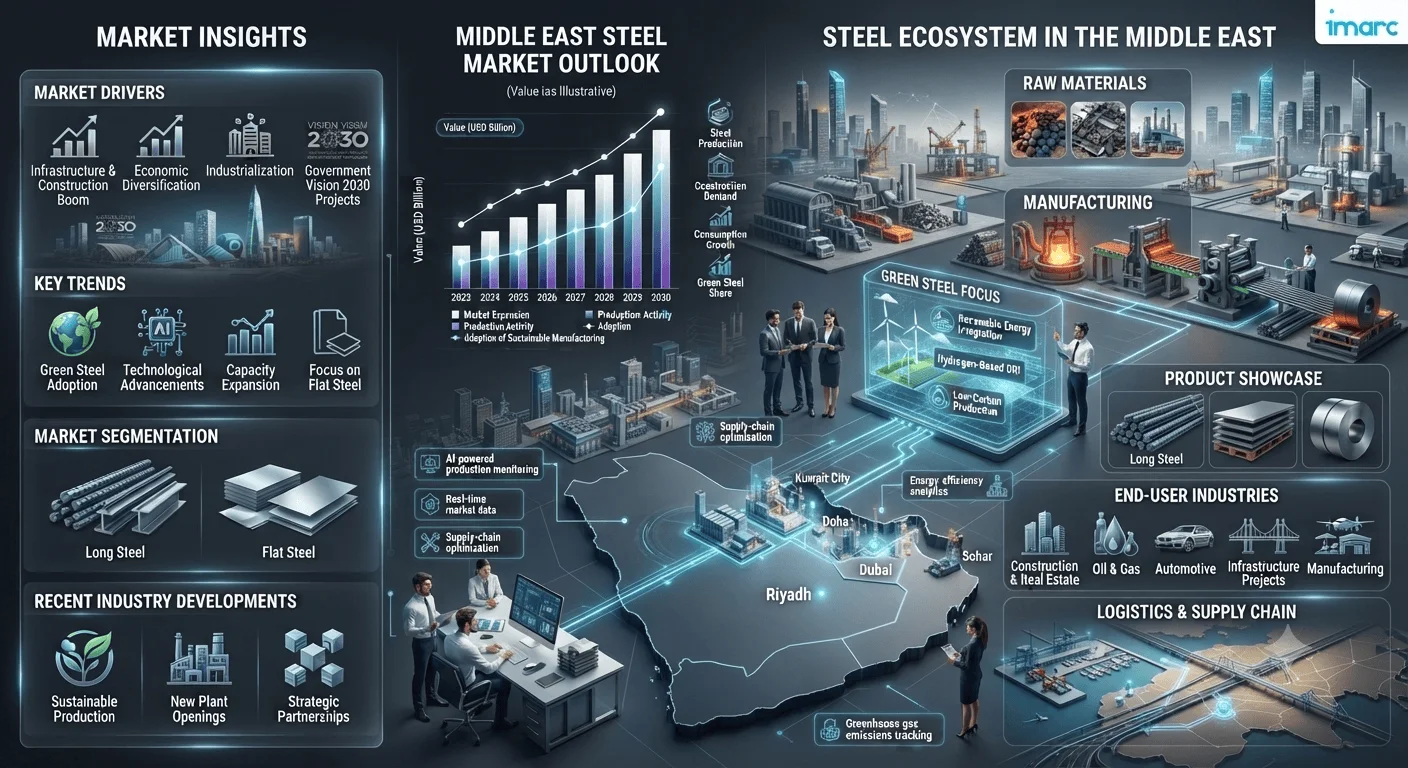
IMARC Group, a leading global market research and management consulting firm, has published its latest market intelligence report on the Middle East steel market. The Middle East steel market size reached USD 45,012.1 Million in 2025 and is projected to reach USD 65,178.0 Million by 2034, exhibiting a CAGR of 4.20% during 2026-2034, driven by large-scale construction and infrastructure development, wider adoption of advanced manufacturing technologies, and intensifying regional focus on low-carbon and green steel production.
The region's steel industry is shifting from a purely construction-driven commodity business toward a more diversified, technology-enabled sector spanning automotive, transportation, mechanical equipment, and specialty applications. Producers across Saudi Arabia, the UAE, Turkey, Iran, and the wider Gulf are scaling automation, data-driven quality control, and advanced alloy development to meet rising demand from megaprojects, industrial diversification programs, and export-oriented manufacturing, positioning the Middle East as an increasingly strategic node in global steel supply chains.
Middle East Steel Market at a Glance:
- Market Size (2025): USD 45,012.1 Million
- Forecast Market Size (2034): USD 65,178.0 Million
- CAGR (2026-2034): 4.20%
- Market Scope: Type, Product, Application, and Country
- Countries Covered: Saudi Arabia, Turkey, Israel, United Arab Emirates, Iran, Iraq, Qatar, Kuwait, Oman, Jordan, Bahrain, and Others
How AI is Reshaping the Future of the Middle East Steel Market
- AI-Driven Process Automation and Predictive Maintenance: Middle East steel producers are integrating AI and data analytics into production lines for real-time monitoring, predictive maintenance, and optimized scheduling, cutting downtime and material waste while improving consistency across flat and long steel output.
- Robotics and Quality Control in Manufacturing: Robotic systems are enhancing precision and uniformity in rolling, cutting, and finishing operations, enabling mills to produce higher-grade structural and specialty steel with reduced defect rates for construction, automotive, and industrial customers.
- AI-Enabled Green Steel and Energy Optimization: Producers piloting green hydrogen-based steelmaking are using AI-driven energy management to optimize furnace loads and emissions tracking, supporting the region's shift toward lower-carbon production without compromising output efficiency.
Grab a sample PDF of this report: https://www.imarcgroup.com/middle-east-steel-market/requestsample
Middle East Steel Market Trends and Drivers:
Technological modernization is reshaping how steel is produced and sold across the Middle East. Producers are adopting automation, advanced manufacturing methods, and sustainable production practices, with artificial intelligence and data analytics improving real-time supervision, predictive maintenance, and scheduling to cut waste and costs, while robotics raises precision and consistency across flat and long steel lines. Alongside this, industries including aerospace, automotive, oil and gas, and renewable energy are driving demand for lightweight, high-strength, and corrosion-resistant steel grades for pipelines, pressure vessels, and automotive components. Regional manufacturers are responding by investing in new alloys, coatings, and production techniques, strengthening the Middle East's position as a source of advanced, high-performance steel for both domestic megaprojects and export markets.
Sustainability has become a central theme as Middle East governments set ambitious net-zero targets, pushing steelmakers toward green hydrogen-based production and away from carbon-intensive processes. In 2024, Masdar and EMSTEEL produced the region's first green steel using green hydrogen in a pilot project, with the renewable hydrogen certified under ISO 19870, supporting the UAE's Net Zero by 2050 initiative and wider decarbonization goals. Regional governments are reinforcing this shift through policies, financing, and partnerships aimed at lowering emissions, helping producers meet increasingly strict environmental regulations while appealing to sustainability-focused investors. As the region's industrial base adopts cleaner practices, the steel sector is gradually transitioning toward more efficient, lower-emission manufacturing that supports long-term market growth.
Strategic partnerships and foreign investment are expanding the region's production capacity and competitiveness. In 2025, Qatar Steel and Bahrain Steel signed a multi-year agreement under which Bahrain Steel will supply 5 million tons of steel to Qatar Steel over five years as part of an Industrial Partnership for Sustainable Economic Development, while SIJ Group committed to building a specialized electric steel plant in Saudi Arabia, its first investment outside Slovenia, aligned with the Kingdom's industrial development plan. Governments are reinforcing these moves with tax breaks, regional incentives, and subsidies targeting advanced manufacturing and energy efficiency; Turkey, for example, introduced a presidential decree effective May 2025 updating investment incentives for modernization, high-tech production, and renewable energy use across its steel sector.
Government Initiatives and Regional Industrial Policies Driving Demand:
- Industrial Partnership for Sustainable Economic Development (Qatar-Bahrain): A multi-year steel supply agreement between Qatar Steel and Bahrain Steel, covering 5 million tons over five years, aimed at boosting regional self-reliance, reducing import dependency, and strengthening local supply chains.
- Saudi Arabia Industrial Development Plan: SIJ Group's planned specialized steel plant, focused on electric steel and high-quality rolled strips and set to begin operations by 2029, reflects the Kingdom's broader push to attract foreign investment into advanced domestic manufacturing.
- Turkey's Steel Sector Investment Incentive Decree: Effective from May 2025, the decree modernizes and expands investment incentives for the steel industry, including tax exemptions, regional incentives, and strategic support for high-tech, energy-efficient, and large-scale renewable-powered projects.
- UAE Net Zero by 2050 Initiative: Government-backed decarbonization targets are driving pilot projects such as Masdar and EMSTEEL's green hydrogen-based steel production, positioning the UAE as an early mover in low-carbon steelmaking within the region.
Middle East Steel Industry Segmentation:
The report has segmented the market into the following categories:
Breakup By Type:
- Flat Steel
- Long Steel
The market is segmented by type into flat steel and long steel, with the mix reflecting demand across the region's construction, manufacturing, and infrastructure base; flat steel serves higher-value automotive, appliance, and industrial applications while long steel remains central to building and construction projects across the Gulf and wider Middle East.
Breakup By Product:
- Structural Steel
- Prestressing Steel
- Bright Steel
- Welding Wire and Rod
- Iron Steel Wire
- Ropes
- Braids
Product-level demand spans structural steel for buildings and infrastructure, prestressing steel for reinforced concrete projects, bright steel for precision engineering, and welding wire and rod, iron steel wire, ropes, and braids supporting construction, industrial, and manufacturing end uses across the region.
Breakup By Application:
- Building and Construction
- Electrical Appliances
- Metal Products
- Automotive
- Transportation
- Mechanical Equipment
- Domestic Appliances
Building and construction remains the dominant application area given the pace of regional infrastructure and real estate development, while automotive, transportation, mechanical equipment, electrical and domestic appliances, and broader metal products continue to diversify steel demand beyond traditional construction use.
Breakup By Country:
- Saudi Arabia
- Turkey
- Israel
- United Arab Emirates
- Iran
- Iraq
- Qatar
- Kuwait
- Oman
- Jordan
- Bahrain
- Others
Saudi Arabia, Turkey, and the UAE anchor regional steel demand through large-scale construction, industrial diversification, and infrastructure investment, while Iran's integrated steel base, Qatar and Kuwait's industrial programs, and growth across Iraq, Oman, Jordan, and Bahrain continue to broaden the market's country-level footprint.
Competitive Landscape:
The report provides a comprehensive analysis of the competitive landscape in the Middle East steel market with detailed profiles of all major companies, including:
- Hadeed (Saudi Arabian Mining Company / SABIC)
- EMSTEEL
- Mobarakeh Steel Company
- Erdemir Group
- Qatar Steel
What Does The Full Report Cover?
If you are tracking the Middle East steel market for investment decisions, market entry planning, competitive benchmarking, or strategic advisory, IMARC Group's report gives you everything in one place:
- Complete market sizing in value terms with forecasts covering the full 2026-2034 projection period
- Quantified growth driver analysis with impact scoring across type, product, application, and country segments
- Sub-segment breakdowns for flat and long steel, seven product categories, seven application areas, and all twelve countries covered in the report, each with individual share data
- Country-level data across Saudi Arabia, Turkey, Israel, UAE, Iran, Iraq, Qatar, Kuwait, Oman, Jordan, Bahrain, and Others
- Competitive profiles of leading regional and international steel producers with strategic landscape assessment
- Value chain analysis, market concentration assessment, and investment and growth opportunity mapping
- Latest technology trends covering AI-driven process automation, robotics, green hydrogen-based steelmaking, and government-backed industrial policies shaping competition across the region
Recent News and Developments in Middle East Steel Market
- July 2026: Jindal Steel Oman's direct reduced iron (DRI) plant in Sohar completed 188 consecutive days of uninterrupted operation while setting new global monthly and daily production records among 6.5-metre shaft furnace DRI modules, running output 33% above its original design capacity.
- June 2025: Kuwait's Metal & Recycling Company (MRC) opened a steel recycling plant with capacity to process 60,000 tons of scrap metal annually, aligning with Kuwait Vision 2035 and supporting sustainable industrial development.
- January 2025: Vale partnered with Saudi Arabia's Royal Commissions to launch a green steel mega hub in Ras Al-Khair, designed in two phases to produce up to 12 million tons of cold-briquetted iron ore annually, supporting the region's shift toward net-zero steel production.
Note: If you require specific details, data, or insights that are not currently included in the scope of this report, we are happy to accommodate your request. As part of our customization service, we will gather and provide the additional information you need, tailored to your specific requirements. Please let us know your exact needs, and we will ensure the report is updated accordingly to meet your expectations.
Key Questions This Report Answers
- What is the current Middle East steel market size and what is its projected value?
- Which type and product segment holds the largest share in the Middle East steel market?
- What are the key drivers of Middle East steel market growth?
- Which country dominates the Middle East steel market and why?
- How are AI adoption, green hydrogen-based steelmaking, and government industrial policies reshaping competitive strategy in the Middle East steel industry?
- Who are the top companies in the Middle East steel market and what are their competitive strategies?
- What are the investment and market entry opportunities across advanced manufacturing, green steel, and export-oriented production in the Middle East?
About Us
IMARC Group is a global management consulting firm that helps the world's most ambitious changemakers to create a lasting impact. The company provides a comprehensive suite of market entry and expansion services. IMARC offerings include thorough market assessment, feasibility studies, company incorporation assistance, factory setup support, regulatory approvals and licensing navigation, branding, marketing and sales strategies, competitive landscape and benchmarking analyses, pricing and cost research, and procurement research.
Media and Sales Contact
IMARC Group
Email: [email protected]
United States: +1-201-971-6302
India: +91-120-433-0800
United Kingdom: +44-753-714-6104