Sign up with Google
 Sign in with Zoho

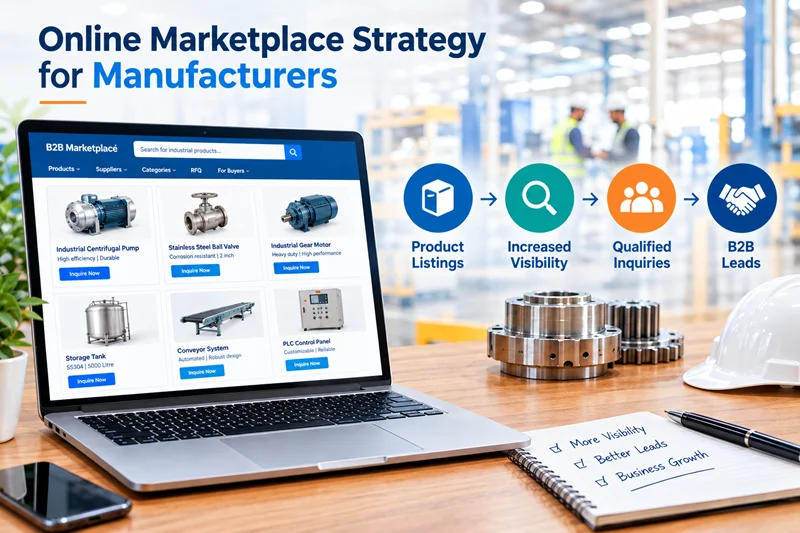
Manufacturers increasingly assume that selling online is simply a matter of uploading a product catalogue to a marketplace and waiting for orders to arrive. In reality, listing a product and generating a qualified B2B enquiry are two very different outcomes. A manufacturer can have a complete, accurate catalogue live on a marketplace for months and still see minimal buyer interest, while a competitor with fewer products but better-structured listings converts consistently. The difference lies in strategy, not effort.
This guide sets out a practical framework for moving from raw product data to a functioning B2B lead pipeline on online marketplaces, covering readiness, product selection, listing quality, channel choice, and enquiry management.
Why Manufacturing Products Need a Different Marketplace Approach
Consumer marketplace behaviour follows a simple path: image, price, reviews, purchase. Industrial buyers evaluate very differently. Before making contact, they typically want to see technical specifications, material grades, certifications, minimum order quantities, delivery timelines, and evidence of supplier capability.
This means a manufacturer cannot simply repurpose consumer-style listings for industrial products. An online marketplace for manufacturers requires listings built for discovery and buyer comparison to answer technical questions upfront rather than waiting for a sales conversation to resolve them. Manufacturers who treat marketplace listings as digital brochures, rather than pre-qualification tools, tend to see high impressions but weak enquiry volume.
Step 1: Assess Whether Your Catalogue Is Actually Marketplace-Ready
Before listing anything, it helps to audit existing product information against what buyers search for rather than what engineering teams write internally. A product described internally as "Model XYZ-400 pump" may never surface for a buyer searching "chemical process pump" or "high-pressure centrifugal pump."
A readiness check should confirm:
- Product specifications exist in a structured, buyer-readable format
- Certifications, test reports, and compliance documents are digitised
- Pricing logic is defined (fixed, tiered, or quotation-based)
- Product images, datasheets, and application notes are available
- Production capacity can absorb additional marketplace-driven demand
Skipping this step is the most common reason marketplace onboarding stalls after the first few weeks.
Step 2: Decide Which Products to List First
Manufacturers with large SKU counts often make the mistake of uploading everything at once, producing a cluttered, inconsistent catalogue. A more effective approach is to prioritise products using a simple evaluation matrix before committing listing effort:
- Demand: Are buyers actively searching for this category?
- Standardisation: Can it be sold without heavy customisation?
- Margin: Is it commercially worth the listing effort?
- Compliance readiness: Are the required certifications already available?
- Fulfilment capacity: Can production handle new order volume?
Products that score well across these factors should be listed first, with more complex or customised items following once the process is proven.
Step 3: Convert Technical Catalogue Data into Buyer-Ready Listings
This is usually the biggest gap for industrial manufacturers. Internal catalogues are written for engineers and distributors; marketplace listings need to work for search, comparison, and self-qualification by a buyer who has never spoken to the sales team.
A marketplace-ready product record typically needs:
- A title that reflects buyer search language, not just an internal model number
- Application and industry-use context, not only technical dimensions
- Clearly stated MOQ, packaging, and delivery information
- Certifications and compliance documents presented as trust signals
- A visible enquiry or RFQ mechanism, not just a generic "contact us" link
Structured, consistent product data also improves how search engines and marketplace algorithms surface the listing, which compounds visibility over time.
Step 4: Choose the Right Marketplace Type
"Online marketplace" is not a single channel, and manufacturers often pick a platform without matching it to their product type or buyer profile.
- B2C marketplaces suit standardised, lower-complexity products with consumer-adjacent demand.
- B2B marketplaces are better suited to industrial components, bulk quantities, and procurement-led buying cycles.
- Government procurement platforms, such as GeM, follow a distinct process involving registration, catalogue compliance, and bid participation, and are relevant mainly for manufacturers targeting institutional or government buyers.
- Open digital commerce networks, such as ONDC, allow sellers to onboard once and reach multiple buyer-facing platforms, which is particularly useful for MSME manufacturers with limited resources for multi-platform management.
Selecting the wrong channel type is a common reason manufacturers see traffic but no meaningful commercial fit.
Step 5: Build a Lead Funnel, Not Just a Storefront
A marketplace listing should be treated as the top of a funnel, not the end goal. A useful way to think about this progression:
Impressions → product views → specification engagement → enquiry or RFQ → qualified lead → technical discussion → quotation → sample or trial order → commercial order
Manufacturers who only track "views" or "listings live" are measuring activity, not business outcomes. The funnel view makes it clear where drop-off is happening, whether at the discovery stage, the specification stage, or the enquiry stage, and allows targeted fixes rather than generic catalogue edits.
Find Related Insight: https://www.imarcengineering.com/blog/how-manufacturers-can-sell-on-amazon-flipkart-and-meesho-in-india
Step 6: Qualify Enquiries Before They Reach the Sales Team
More enquiries do not automatically mean more business. Manufacturers frequently receive retail-scale requests for B2B products, enquiries below minimum order quantity, or requests outside their service geography.
A simple qualification filter can save significant sales effort:
- Product and technical fit: Does the buyer need what is actually being offered?
- Quantity fit: Does the requirement match production economics?
- Geographic and delivery fit: Can the order realistically be fulfilled?
- Commercial fit: Do expected price and payment terms make sense?
- Buyer credibility: Is there a genuine organisation and procurement need behind the request?
Applying this filter early prevents sales teams from spending time on enquiries that were never going to convert.
Step 7: Track KPIs That Reflect Business, Not Just Traffic
Marketplace performance should be measured beyond page views. More useful indicators include enquiry rate, qualified enquiry rate, RFQ volume, response time, quote-to-enquiry ratio, sample-to-order conversion, and cost per qualified lead. Tracking these over time reveals whether catalogue improvements are actually translating into commercial outcomes, rather than simply improving vanity metrics.
Common Mistakes to Avoid
- Uploading the entire catalogue at once instead of prioritising high-fit products
- Copying internal engineering descriptions directly into listings
- Leaving out application context, certifications, or MOQ details
- Treating marketplace onboarding as a one-time project rather than an ongoing optimisation cycle
- Measuring success by views or impressions instead of qualified enquiries
Conclusion
A successful marketplace strategy for manufacturers does not begin with uploading products; it begins with readiness, structured product data, and a clear funnel from discovery to qualified enquiry. Manufacturers who treat marketplace listings as a continuous, measurable process, rather than a one-time onboarding task, are the ones who consistently convert visibility into genuine B2B business, rather than accumulating views with little commercial return.