Sign up with Google
 Sign in with Zoho

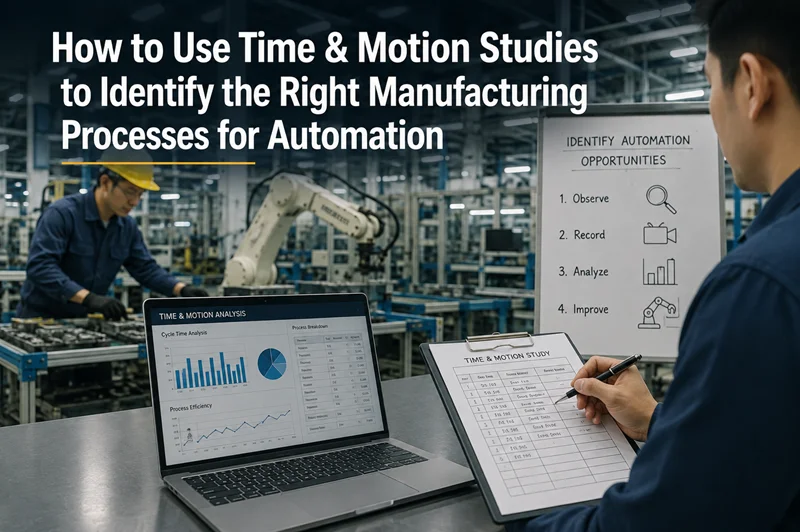
Manufacturing automation is no longer limited to large robotic assembly lines. Plants increasingly evaluate machine tending, automated inspection, material handling, packaging, fastening, welding, palletizing and other repetitive operations. Yet buying automation is not the same as achieving automation value. A robot installed on the wrong process can increase complexity without materially improving throughput, quality or cost.
The more useful question is therefore not "What can we automate?" but "Which process will create the greatest operational benefit if automated?" Time & Motion Studies for automation answer that question by measuring how work is actually performed before technology is selected.
Why Automation Decisions Should Start With Work Measurement
Automation proposals are often built around visible problems: high labour requirements, repetitive tasks or operator fatigue. These are valid signals, but they do not necessarily identify the best investment. A process may employ several operators while contributing little to overall production constraints. Conversely, a small manual activity can become a major bottleneck when it sits between high-speed machines.
A time-and-motion assessment establishes the baseline by measuring:
- Actual cycle time rather than assumed standard time
- Processing, handling and inspection time
- Operator walking and reaching
- Waiting and material-related delays
- Changeovers and minor stoppages
- Rework and quality-related time
- Variation between cycles, operators and shifts
- Labour content per unit
The International Federation of Robotics reported 9,120 industrial robots installed in India during 2024, indicating continued investment in industrial automation. As adoption expands, process selection becomes increasingly important because manufacturers are allocating capital among competing opportunities.
What a Time & Motion Study Reveals
A useful study breaks total cycle time into individual work elements rather than treating it as one number. An assembly cycle, for instance, could consist of walking to collect components, picking and positioning, aligning parts, performing the assembly, fastening, inspecting, moving the finished component and waiting for material replenishment.
Suppose assembly itself requires 40 seconds while another 50 seconds goes to movement, handling, inspection and waiting. Automating the entire operation may be unnecessary. A better solution could involve point-of-use material presentation, automated fastening or machine-vision inspection while retaining human involvement where flexibility is valuable.
The work element, not the job title or entire workstation, should be the starting point for automation analysis.
Step 1: Map the Process Before Measuring It
Document the complete process from input to output: material entering the operation, operator actions, machine interactions, inspection points, material movements, waiting points, rework loops and output transfer.
Mapping prevents a study from narrowing too quickly onto one workstation, and it reveals dependencies. A workstation may look inefficient because an upstream process delivers components inconsistently. Automating it without fixing that dependency simply moves the problem elsewhere.
Step 2: Measure Actual Cycle Time and Takt Time
Cycle time shows how long the process currently takes; takt time shows how fast it needs to run to meet demand.
Takt Time = Available Production Time ÷ Required Customer Output
For example, with 27,000 seconds of productive time available and a requirement of 450 units per day: Takt Time = 27,000 ÷ 450 = 60 seconds per unit. If a workstation requires 85 seconds, it cannot consistently meet pace without added capacity, process improvement or automation.
The 85-second cycle must still be decomposed. If 50 seconds is actual processing and 35 seconds is movement and handling, automation may target only the latter — preventing manufacturers from buying faster equipment when the real problem is workflow design.
Step 3: Identify Where Time Is Actually Being Lost
Classify observed time into meaningful categories:
- Value-adding work — directly transforms the product
- Necessary support work — inspection, setup, positioning; required but improvable
- Motion waste — walking, reaching, searching, repeated handling
- Waiting — for materials, machines, approvals or downstream availability
- Quality-related losses — rework and repeated inspection that standard cycle-time figures often overlook
This creates an important insight: not every lost second requires automation. Some require layout changes, standardization, better material supply or process redesign.
Step 4: Find the Bottleneck First
Automation should be evaluated at the system level. Consider a line with three stations:
Reducing Station A from 45 to 25 seconds sounds impressive, but Station B remains the constraint. The study should examine bottleneck cycle time, queue formation, starvation and blocking, machine utilization, labour allocation, material availability and downstream capacity. The right automation project removes the constraint, not the one with the most manual motions.
Step 5: Test Suitability for Automation
Assess the process against practical characteristics:
- Repetition — frequent enough to justify dedicated equipment?
- Standardization — are inputs and outputs consistent?
- Process stability — predictable results or frequent adjustments?
- Volume — high enough for adequate utilization?
- Variability — how often do variants, tooling or conditions change?
- Precision and quality — would automation improve consistency?
- Ergonomics and safety — is the task repetitive, force-intensive or hazardous?
- Integration — can it interface with upstream and downstream processes?
A process scoring highly across these factors is generally more suitable for detailed evaluation than one with unpredictable work content. Manufacturers can compare candidates using a structured matrix (production volume, repetition, cycle-time impact, bottleneck impact, labour content, stability, quality, ergonomics, feasibility, economics), weighted to the plant — a high-volume automotive line may prioritize throughput, while a pharma facility may prioritize repeatability and traceability.
Step 6: Decide What, Not Just Whether
A strong study should produce several operating models:
- Fully manual — where flexibility and judgment outweigh automation benefits
- Partially automated — machines handle repetitive elements while operators manage loading, inspection, exceptions or changeovers
- Fully automated — for stable, high-volume operations with standardized inputs
This human-machine allocation is consistent with the Industry 5.0 emphasis on human-centric manufacturing alongside resilience and sustainability. For many plants, partial automation is more practical than eliminating human involvement entirely.
Step 7: Translate Time Savings Into an Investment Case
Annual labour benefit = Recoverable labour hours × Fully loaded labour cost
Labour savings should not be the only benefit — also quantify additional units produced, reduced overtime, lower rework and scrap, improved inspection consistency, reduced material handling, lower ergonomic exposure and reduced changeover losses. Compare these against equipment, robotics/cobots, tooling, vision systems, controls, safety systems, installation, commissioning, training, maintenance and facility modifications.
Payback Period = Total Automation Investment ÷ Annual Net Benefit
Larger projects should additionally consider NPV, IRR, lifecycle cost and expected future utilization and product mix.
Do Not Automate Waste
Improve the process before embedding it in equipment. If an operator walks 15 metres because components are stored too far away, automating that movement solves a symptom, not the layout problem. The more robust sequence is: Eliminate → Simplify → Standardize → Balance → Automate. Moving components to point-of-use storage may remove unnecessary walking before a robot is even considered; standardizing presentation can then make robotic handling simpler and cheaper.
Where AI Is Changing Time & Motion Studies
Traditional studies depend on direct observation and manual recording. Emerging approaches use computer vision, wearable sensors and machine learning to capture work more continuously. A 2026 Measurement study investigated wearable sensors and deep learning for motion recognition and standard-time measurement in automotive assembly, demonstrating the potential for automated work measurement. Research is also exploring video-based recognition of worker and machine activities and AI integration with established methods such as MODAPTS. These technologies should support, not replace, engineering judgment — human review remains essential for exceptions, product variation and ergonomics.
View Related Insight
Common Automation Selection Mistakes
- Automating the most repetitive operation instead of the bottleneck
- Using one observed cycle as the process standard
- Ignoring walking and material movement
- Calculating ROI only from headcount reduction
- Automating before standardizing the process
- Ignoring product mix and future demand
- Measuring machine speed but not total system throughput
- Overlooking maintenance and integration requirements
- Assuming full automation always beats human-machine collaboration
The objective is measurable improvement in the production system, not automation for its own sake.
Conclusion
The right automation project begins with understanding the work. A detailed Time & Motion Study shows where time is spent, which activities create value, where capacity is lost and which work elements suit technology intervention. Combined with bottleneck analysis, process stability, ergonomics and financial evaluation, it turns automation selection into a structured engineering decision, connected to throughput, quality, productivity, safety and long-term operating performance.