Sign up with Google
 Sign in with Zoho

Introduction
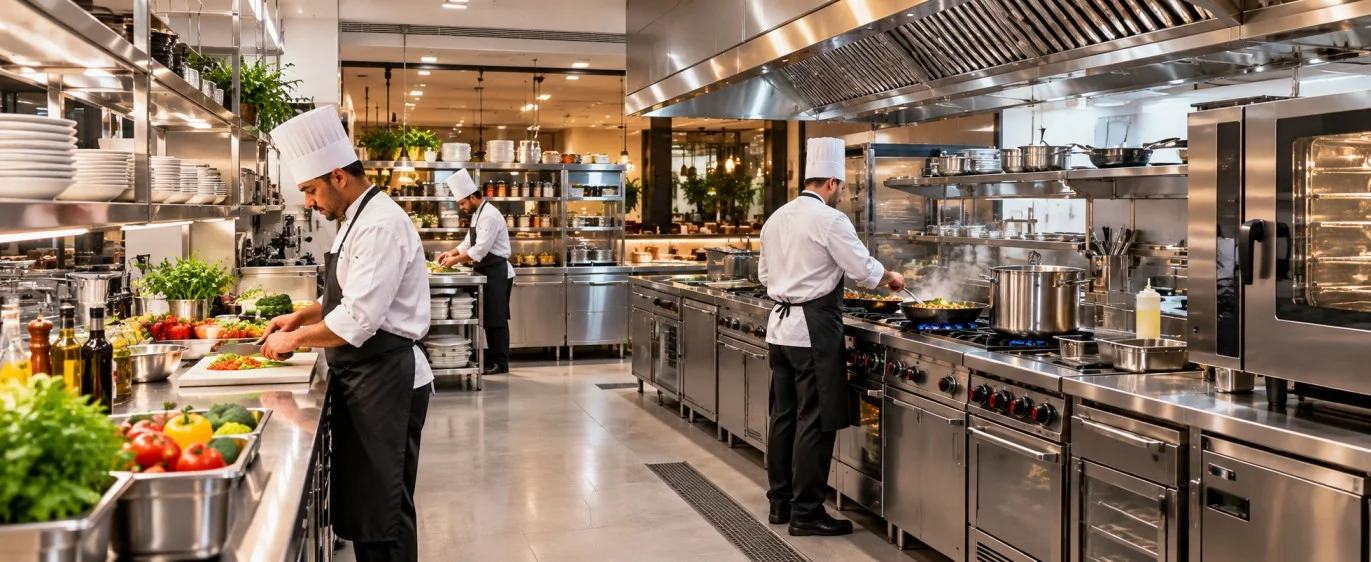
A restaurant kitchen is meant to be designed as a production system and not as a room with appliances. Restaurant kitchen design should therefore focus on how the entire kitchen functions as a production system.
The menu will determine the food, the number of orders will determine the required capacity, and the process flow will determine the positioning of the stations. Only after these factors are established does equipment selection make sense.
This approach becomes especially important when kitchen space is limited, such as in India, where a kitchen may need to accommodate tandoors, heavy ranges, fryers, wet grinders, bulk processing, and other essential equipment.
Thus, the first thing to consider when designing a good restaurant kitchen is how food can move from receiving to storage, preparation, cooking, and serving along the most efficient route.
How to Plan a Restaurant Kitchen Based on Your Menu and Operations
The menu represents the technical brief for the kitchen.
A South Indian restaurant serving dosas would require equipment such as steamers and wet grinders, along with appropriate servingware. For bakery production, the kitchen needs to accommodate ovens, mixers, proofing equipment, and temperature control systems. QSRs may require fryers, holding facilities, and fast assembly stations, while delivery-focused kitchens will need dedicated packing and dispatch areas.
Before purchasing restaurant kitchen equipment, calculate:
- peak orders or covers per hour;
- preparation required before service;
- cooking methods used most frequently;
- refrigerated and frozen storage requirements;
- number of kitchen employees per shift;
- dine-in versus takeaway or delivery volume;
- washing and waste-handling requirements.
Recent commercial-kitchen guidance consistently recommends designing around workflow before deciding where equipment will fit. A typical sequence is receiving → storage → preparation → cooking → plating or packing → service, with washing arranged so dirty utensils do not interfere with clean food movement. This workflow is also a key consideration in effective restaurant kitchen design.
Essential Restaurant Kitchen Equipment for a Functional Commercial Kitchen
No standard list of equipment can be made, as it will depend on the individual menu.
However, most restaurants use equipment belonging to several categories:
- cooking equipment such as ranges, fryers, griddles, ovens or tandoors;
- refrigeration and freezer storage;
- stainless-steel preparation tables;
- sinks and handwashing facilities;
- shelving and dry storage;
- food processors, mixers or grinders where required;
- exhaust and ventilation systems;
- dishwashing equipment;
- holding equipment;
- weighing and temperature-monitoring tools.
The important point is not really whether a particular appliance is commonly used in restaurants, but rather whether the appliance is required for the menu during peak hours.
Sometimes, following a standard restaurant equipment checklist can lead to purchasing machines without considering the additional space they require. This is why equipment decisions should remain connected to the overall restaurant kitchen design.
How to Select the Right Restaurant Equipment for Your Kitchen
Equipment capacity should be matched to the kitchen's production requirements.
An oversized fryer, refrigerator or oven can cost more, require more space and consume more energy, while undersized equipment can slow down service.
Compare equipment on more than headline capacity. Consider:
- actual usable output;
- recovery or heating time;
- electrical or gas requirements;
- water consumption;
- cleaning accessibility;
- warranty coverage;
- spare-parts availability;
- local service support.
Check installation requirements before ordering as well. A machine can be physically installed but may require additional electrical power, clearance, drainage and/or ventilation.
That's why equipment selection and infrastructure planning should be considered together with restaurant kitchen design.
Key Principles of an Efficient Restaurant Kitchen Design
A forward flow of food is one of the most useful principles when designing a restaurant kitchen.
Following the FSSAI guidelines, food materials should flow forward, and the premises should be designed to prevent cross-contamination. It also suggests cleanliness of surfaces, sufficient drainage, and proper food preparation areas.
These principles translate into several practical considerations for restaurant kitchen design.
Raw materials need to be introduced as near to receiving and storage as possible. Refrigeration and cooking need to be together in preparation areas. Cooked food needs to flow directly towards the plating/dispatch point without passing through raw food areas again.
If possible, it should have a different path for dirty dishes.
It is important to consider the movement of people as well. If two chefs had to cross each other's paths repeatedly during dinner service, it would be more than an inconvenience; it would indicate a problem with the kitchen design.
Restaurant Kitchen Setup: A Step-by-Step Planning Guide
A disciplined restaurant kitchen setup can follow this sequence:
1. Finalise the operational menu.List all the major cooking and preparation methods.
2. Estimate peak production.Estimate the maximum realistic production rather than the average.
3. Map food movement.Identify how ingredients get from receiving to storage, preparation, cooking, and serving.
4. Define working zones.Assign certain areas for storage, preparation, cooking, plating, washing, and garbage disposal.
5. Select equipment.Choose the capacity and configuration of the equipment based on the production requirements.
6. Plan utilities.Calculate requirements regarding electricity, gas, water, drainage, and ventilation before installing them.
7. Test the workflow.Simulate a service and identify any unnecessary movements or potential slowdowns.
Following this sequence can help reduce additional costs related to flooring, drainage, exhaust ducts, and utility connections. It also provides a practical foundation for restaurant kitchen design.
How to Create an Efficient Restaurant Kitchen Layout
A straight-line kitchen design is suitable for smaller kitchens with simple cooking processes. Central cooking equipment can be installed on islands. Larger restaurants with multiple preparation and cooking processes may benefit from a zoned layout, while an assembly-line layout can work well for repetitive QSR or delivery operations.
The shape of the kitchen is less important than the relationship between its stations.
Ingredients that are used often should be kept closer to their respective preparation areas. Refrigerated stations should be supported by the refrigeration unit. The pass should allow for efficient movement from cooking to serving.
The washing area should be properly managed. The forward-flow process recommended by FSSAI should minimize the risk of cross-contamination, and contaminated crockery or waste material should not be brought into the preparation area again.
Future changes should also be taken into account. Allowing some flexibility in equipment connections, storage and workstations can make it easier to adapt to future changes in the menu or kitchen capacity. These considerations are also important when developing an adaptable restaurant kitchen design.
Conclusion
The ultimate aim of restaurant kitchen design is to ensure that the menu, manpower, equipment, utilities, and workflow work together efficiently. A well-planned restaurant kitchen design brings these elements together while supporting an efficient workflow.
Start with your operations rather than the appliances. Understand your needs before purchasing restaurant kitchen equipment. Plan your restaurant kitchen in such a way that the food and food orders flow through the kitchen in one path.
An empty kitchen may not look much different from any other kitchen, but a well-planned kitchen will perform very differently during service. The benefits become evident when service is faster and more accurate, with fewer unnecessary steps and bottlenecks.