Sign up with Google
 Sign in with Zoho
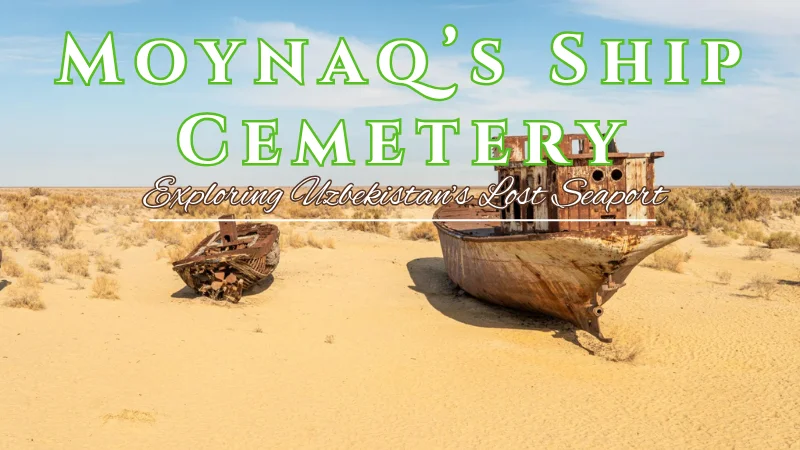
Rusting fishing boats on dry land are an unusual sight, especially in a town that once worked as a seaport. In Moynaq, in northwestern Uzbekistan, the abandoned vessels tell the story of the Aral Sea’s decline. The ship cemetery draws travellers interested in unusual destinations, environmental history and photography.
Why Are There Ships in the Desert?
Moynaq was a fishing town on the southern shore of the Aral Sea. Fishing supported local livelihoods, and a processing industry grew around the catch. During the Soviet period, huge amounts of water were diverted from the rivers feeding the Aral Sea to irrigate farmland. The sea began to shrink, and the port ended up far from the water.
As the shoreline pulled back, the fishing boats were stranded on the exposed seabed. Hundreds of boats once worked from here, but most were stripped and sold as scrap metal over the years.
What to See at the Ship Cemetery
The ship cemetery is the main reason people visit Moynaq. Around 11 rusting ships and boats remain, lined up on a bluff above the dry seabed and kept in place as a memorial. Their metal hulls are exposed to wind and sun, and the land around them is bare, with wide open views and little vegetation in places.
You can walk around the accessible sections to see the boats from different angles and photograph the weathered metal. The open ground also shows how far the water has pulled back from the former port.
How to Get to Moynaq
Moynaq is in Karakalpakstan, an autonomous republic in northwestern Uzbekistan. Nukus is the main starting point, about 200 kilometres (124 miles) away. The drive takes roughly 3 hours each way by private car or 4WD. The daily public bus from Sarancha Bus Station in Nukus is cheaper but takes closer to 3.5 hours one way. Book road transport ahead of time if you want a private driver.
Many visitors pair Moynaq with Nukus and other Karakalpakstan stops tied to the Aral Sea’s history. Hotels and facilities in Moynaq are fewer than in Uzbekistan’s major tourist cities, so sort out your overnight stay early.
Entry rules depend on nationality, so check yours before departure. The Uzbekistan eVisa is one option for those researching how to enter the country.
Practical Tips
The ship cemetery is outdoors with very little shade, and summers are hot. Keep these points in mind:
- Stay off the boats: rusted metal and weakened structures are dangerous to climb.
- Follow signs and barriers: respect any markings near the vessels.
- Footing: watch for uneven ground and wear comfortable walking shoes.
- Water: bring enough for the journey and the time you spend outside.
- Sun and clothing: pack sun protection and lightweight clothes for the day’s weather.
- Weather: check the local forecast before leaving.
- Driving time: expect about 6 hours on the road for a round trip from Nukus.
- Food: arrange meals early, especially if you travel outside Nukus.
Why Visit Moynaq?
The stranded boats make the Aral Sea’s retreat visible in a way a map or statistic can’t. For travellers interested in unusual destinations and landscapes far from Uzbekistan’s better-known historic cities, Moynaq is a different kind of stop, and a chance to see what the water diversion did to a fishing community.