Sign up with Google
 Sign in with Zoho
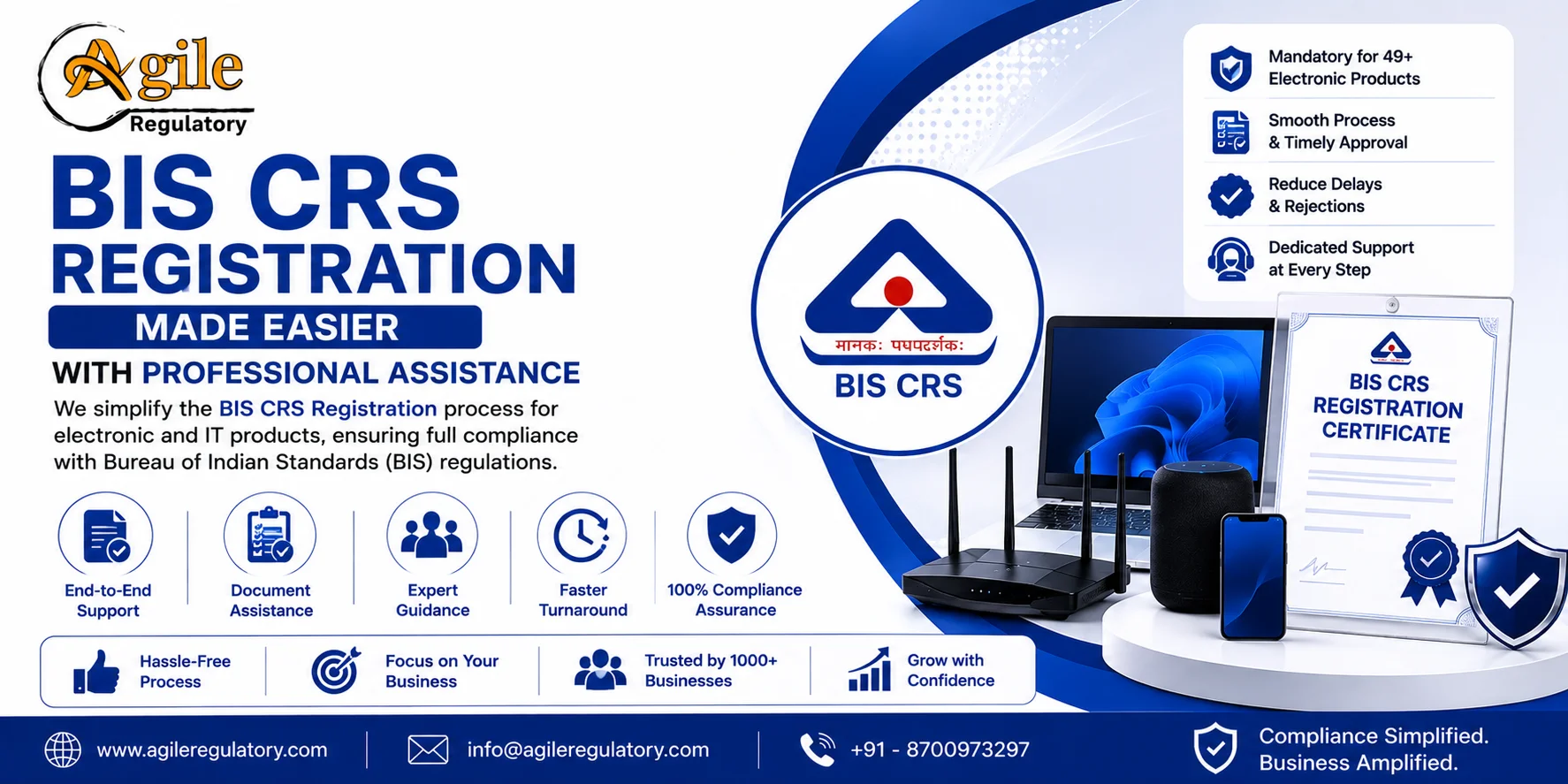
Businesses introducing electronic and information technology products into the Indian market often come across the term BIS Compulsory Registration Scheme. Understanding this scheme is important because products covered by the applicable notifications must satisfy the prescribed requirements before being placed on the Indian market.
Another common search term is CRS BIS, which is generally used to refer to the BIS Compulsory Registration Scheme. Although the terminology can appear confusing to new applicants, the basic objective is straightforward: covered products must demonstrate conformity with the applicable Indian Standard through the prescribed registration mechanism.
This article explains how the scheme works, who should consider it, what testing involves and what businesses should check before applying.
What Is the BIS Compulsory Registration Scheme?
BIS Compulsory Registration Scheme is a regulatory framework for specified products, implemented by the Bureau of Indian Standards. The scheme requires that products mentioned in the relevant government notifications shall be in conformity with the applicable Indian Standard and registration requirements before being marketed in India.
The scheme is particularly associated with many electronic and information technology products, although the exact scope depends on current notifications and product categories.
Because the scope can change, businesses should always verify the current requirement for the exact product they intend to sell.
What Does CRS BIS Mean?
The expression CRS BIS is commonly used online when people are searching for information about BIS registration under the Compulsory Registration Scheme.
It is important to distinguish terminology from the actual regulatory process. A company may use phrases such as BIS CRS, CRS registration or CRS BIS while discussing the same general compliance framework.
However, the applicant still needs to identify the applicable product category, Indian Standard, test requirements and registration conditions.
Why Was CRS Introduced?
Product standards help to provide a consistent benchmark for safety, performance and other relevant characteristics. Conformity with the applicable standard can be demonstrated using the mechanism provided by CRS for products within the scope of notification. For consumers, regulatory compliance of products can increase confidence in regulated products. It provides manufacturers with a defined framework for compliance to the relevant Indian requirements.
Which Products Fall Under CRS?
The scheme does not automatically apply to every electronic or electrical product.
The product must be checked against the applicable government notification and Indian Standard.
Depending on the scope notified at the time, CRS requirements can apply to different categories of electronic and IT products for businesses. In these instances, simply the product name is not sufficient to determine applicability. You may also need to consider technical specifications and the classification you want for the product.
How to Determine Whether Your Product Is Covered
A practical assessment can follow these steps:
Step 1: Identify the Product
Prepare an accurate description of the product, including its function, technology and intended use.
Step 2: Check the Relevant Notification
Determine whether the product category is included within the applicable CRS notification.
Step 3: Identify the Indian Standard
Once applicability is established, identify the standard against which the product needs to be evaluated.
Step 4: Review Testing Requirements
Determine what testing is necessary and which laboratory route is applicable.
Step 5: Review Manufacturer Information
Confirm the exact legal name and manufacturing address.
This preliminary review is useful because an incorrect product classification can affect the rest of the application.
Testing Requirements
Testing is a central part of CRS compliance.
The product needs to be evaluated according to the applicable Indian Standard through the prescribed laboratory mechanism. The test report should correspond to the product and manufacturer for which registration is being sought.
Businesses should know: Product Model #'s Name of the manufacturer Manufacturing location Technical details Standard applies. Details and date of test report Product configuration Even small differences in the document can lead to clarification needs.
Documents Required for CRS
Documentation requirements may vary by product and applicant, but a typical application may require: Company or manufacturer details Factory address data Product technical specifications Product images Test report Product sheet or data sheet Info brand Trademark related documents, where applicable Authorization papers, If applicable, foreign manufacturer representative information (1) Representations and warranties Other information as required by BIS Applicants should check current documentation requirements before submitting applications.
Application Process
The registration process may be separated into different steps. First, the manufacturer decides whether the product is covered by warranty. The product is then evaluated and tested to the applicable standard. The applicant, having received the necessary test documentation, prepares the application for registration. The application and supporting documents are then electronically submitted through the appropriate BIS system. BIS may review the information submitted and ask questions if clarification is required. Thus the applicant replies to such queries with proper information or corrected documents. If all requirements are fulfilled registration is granted for the product in question.
What Manufacturers Should Check Before Applying
Before beginning an application, manufacturers should create a compliance checklist covering:
Product
- Exact product name
- Model numbers
- Technical specifications
- Product variants
Manufacturer
- Legal name
- Factory address
- Manufacturing location
Testing
- Applicable standard
- Appropriate laboratory
- Test report details
Brand
- Brand name
- Trademark documentation where relevant
- Authorization information
Application
- Supporting documents
- Declarations
- Required forms
- Consistency of information
This preparation can reduce avoidable corrections.
CRS and Imported Products
Importers often assume that importing a product from an overseas manufacturer is primarily an customs or import documentation issue.
For products within the notified CRS scope, product compliance may also be relevant.
The overseas manufacturer should understand its responsibilities and ensure that the registration information accurately represents the product being supplied to India.
Thirdly, importers and distributors should engage with manufacturers rather than assume that existing overseas certification automatically complies with Indian requirements.
Does CRS Apply to All Models?
The answer depends on how the products are classified and what information is covered by the registration.
Businesses should not automatically assume that adding a new model, changing a product specification or changing a manufacturing location has no regulatory impact.
Whenever there is a significant change, the registration conditions should be reviewed to determine whether a modification or another regulatory action is required.
Common Reasons for Application Problems
Some problems are administrative rather than technical.
For example:
- Incorrect factory address
- Mismatch between test report and application
- Wrong manufacturer name
- Incomplete product information
- Incorrect model details
- Unclear brand ownership
- Missing supporting documents
- Incorrect interpretation of the applicable standard
Careful document review before submission can help identify many of these issues.
Why Professional Guidance Can Be Useful
Businesses unfamiliar with Indian product compliance may find it difficult to determine which requirements apply to a particular product.
Agile Regulatory offers regulatory and certification support to businesses needing Indian compliance. Support may include understanding the applicable route, reviewing documents, coordinating certification related steps and helping to organize the application process. But businesses must remember that no consultant can substitute for accurate product information and proper testing.
FAQs
Is CRS the same as BIS certification?
CRS is one of the regulatory schemes administered through BIS. It should not automatically be treated as identical to every other BIS certification or licensing scheme.
Does every electronic item require CRS?
No. Applicability depends on the relevant notified product category and requirements.
Is product testing necessary?
For products covered under CRS, testing against the applicable Indian Standard forms an important part of the registration route.
Can one application cover different manufacturers?
Generally, registration is linked to the specific manufacturer and product information. Different manufacturers should be evaluated separately.
Can a registration be changed later?
Certain changes may require modification or another action. The appropriate route depends on the nature of the change.
Conclusion
The BIS Compulsory Registration Scheme is an important aspect to know for businesses planning to market covered products in India. It is not just a case of filling in an online form, but of product identification, standards, testing, documentation and review by regulators. If you are a business seeking CRS BIS information, you need to look at your specific product, not a generic checklist. Product-specific compliance assessment can help to determine what testing and registration steps are actually needed. Agile Regulatory can help companies to compile the compliance requirements for BIS and also understand the right route of registration for the products.