Sign up with Google
 Sign in with Zoho

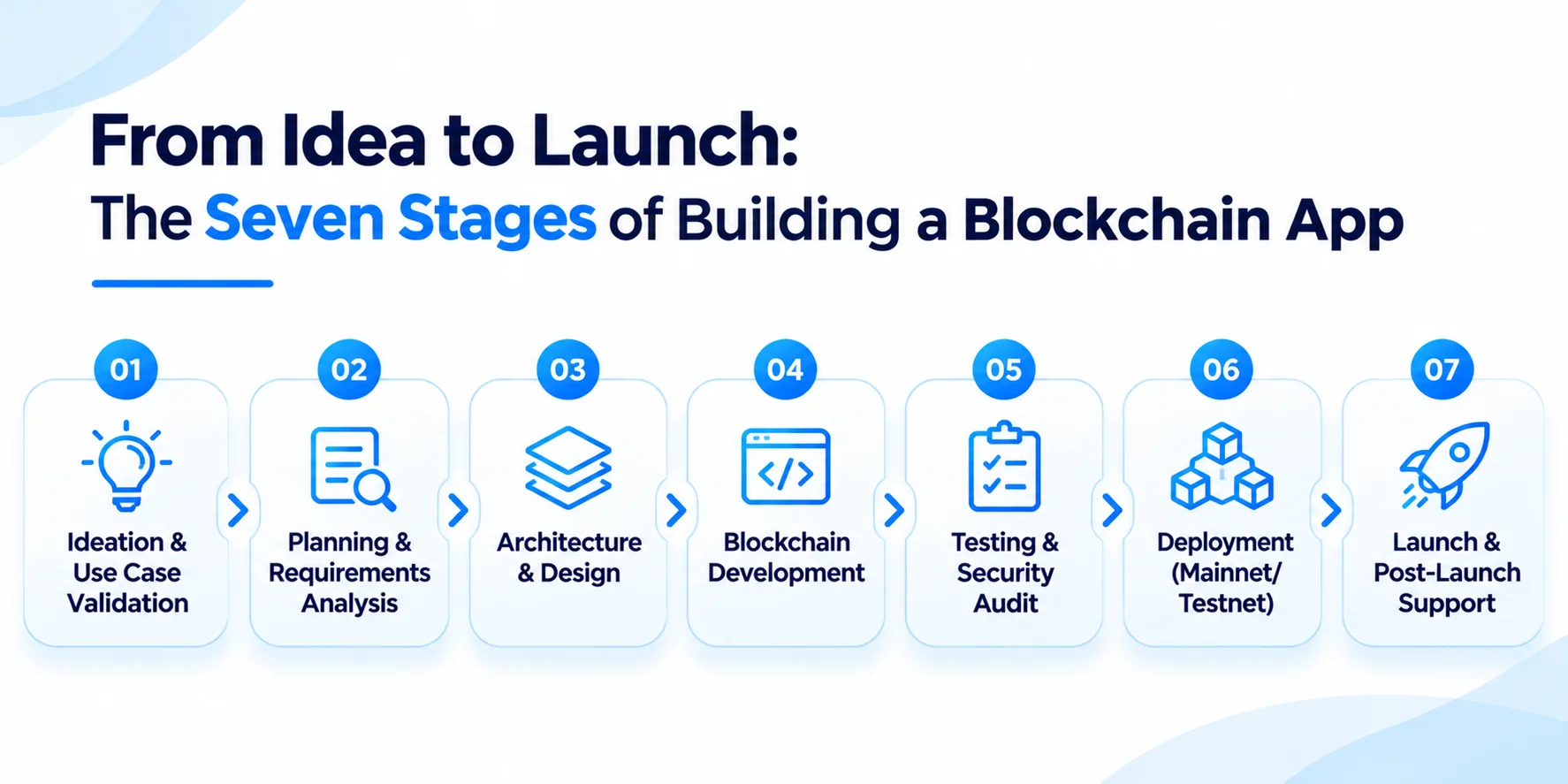
Every blockchain app starts as an idea and has to survive seven stages before it reaches users. Skipping or rushing any of them is how projects run over budget or fail after launch. Here is what happens at each stage, and why it matters.
1. Define the goal. The team pins down the problem the app will solve and the use case behind it. Blockchain is not the answer to every problem, so this stage asks a hard question: why does this product need a distributed ledger at all? Clarity here, along with a real gap in the market, is what separates successful apps from experiments. It also shapes every decision that follows, from the platform to the budget.
2. Choose the platform. Every blockchain has its own purpose. Public networks like Ethereum and Solana and private ones like Hyperledger and R3 Corda each suit different needs. Bitcoin, for example, works as a store of value and peer-to-peer digital money. The choice should reflect your features, your security requirements and your budget. As a general rule, private networks cost less to build, while public networks tend to cost more.
3. Design the architecture. Planners map how the user interface, data handling and blockchain network interact. They also decide what is stored on-chain and what stays off-chain. Hashes, proofs and state updates go on the chain, while large files, heavy business logic and compliance data are usually kept off it. Getting this split right early keeps the app efficient and easier to maintain.
4. Write the smart contracts. Developers code the core logic, commonly in Solidity or Rust. This is where the app actually interacts with the blockchain. Smart contracts execute automatically when predefined conditions are met, which removes intermediaries and cuts costs. The catch is that they cannot be modified after deployment, so the code is examined closely before it goes anywhere near real users.
5. Build and integrate. The actual development takes shape here. The front end, back end, wallets, APIs, blockchain nodes and smart contracts all come together. Wallet integration is especially important, because users need a safe way to store and spend digital assets. A smooth interface matters too, since connecting a wallet and completing a transaction should feel easy.
6. Test on testnets. Before real assets are at stake, the team tests every part of the app on blockchain testnets. This catches bugs, security vulnerabilities and performance bottlenecks. Penetration testing belongs in this stage as well, because hackers can interfere with digital transactions and user identities can be exposed if the system is weak.
7. Deploy and maintain. Launch is not the finish line. Once testing is done, the app goes live, and maintenance keeps it useful. It brings in new functions, acts on user feedback and clears out features that no longer work.
What it costs. Expect budgets from AED 20,000 for a simple app to AED 500,000+ for a high-complexity one. Medium-complexity apps typically fall between AED 90,000 and AED 150,000. The final figure depends on the team’s location, the network you choose, the complexity of your smart contracts, your design needs and your security requirements.
About the author: [Name] writes for Aarmeh, a Dubai-based app development company. Full guide: https://www.aarmeh.ae/blog/blockchain-app-development-guide/