Sign up with Google
 Sign in with Zoho

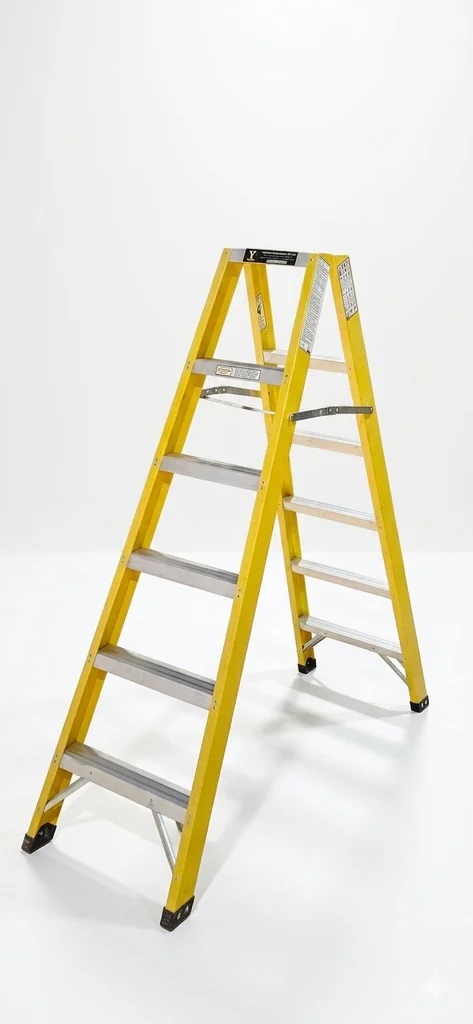
Working near live electrical panels, substations, or corrosive process equipment doesn't leave room for the wrong tool. A single conductive rail on a metal ladder can turn a routine maintenance job into a fatal accident. That's the main reason Fibre Reinforced Plastic (FRP) ladders have quietly become the go-to choice for electricians, industrial maintenance crews, and safety officers all over India. And it's also why picking the right FRP ladder manufacturer in India ends up mattering just as much as picking the right ladder.
This guide walks through what FRP ladders actually are, why they hold up better than aluminium or steel in hazardous settings, how manufacturing quality gets verified, and how Y Group India's ISO 9001:2015-certified access solutions provider handles both FRP ladder manufacturing and FRP ladder rental in India under one roof.
What Is an FRP Ladder?
An FRP ladder is made from fibreglass strands set inside a thermosetting polymer resin, then cured into rigid, layered rails and rungs. Aluminium conducts electricity. Timber soaks up moisture and eventually rots. FRP does neither; it's built to be non-conductive, non-sparking, and chemically inert, which is exactly why it's become the standard wherever live electricity, flammable vapours, or corrosive chemicals show up on a job site.
Y Group builds its FRP range on a 7-layer composite, and the outer gel coat carries UV inhibitors so the resin doesn't break down in direct sun. That translates to an expected outdoor life of 10+ years with barely noticeable colour fade, longer still if the ladder stays indoors most of the time.
FRP vs Aluminium vs Steel
Material choice really comes down to the environment, not preference. Here's roughly how Y Group frames it for buyers deciding between the three.
If your site has any live electrical exposure or corrosive conditions, FRP is really the only material that takes the hazard out at the source instead of leaving it to operator caution.
Y Group: A Trusted FRP Ladder Manufacturer in India
Y Group, formerly Youngman India, has been supplying work-at-height equipment since 2011. Today it functions as a manufacturing and rental partner for scaffolding, access towers, industrial ladders, and safety training, backed by engineering credentials rather than just marketing copy.
- ISO 9001:2015 certified manufacturing
- EN 1004:2020 certified for access towers
- 22+ Pan-India locations for supply and rental
- 500+ enterprise clients spread across construction, power, oil & gas, railways, pharma, and manufacturing
- Head office at Plot No. 14, Ecotech 1 Ext, Greater Noida, Uttar Pradesh 201310
Wherever an order ships from, the ladder is built to the same 7-layer composite spec one manufacturing standard, applied the same way across every branch.
Independent Testing
Y Group's FRP Wall-Support range has been tested by the Electrical Research and Development Association (ERDA) in Vadodara, a NABL and ILAC-MRA accredited lab, under IEC 60060-1:2010.
This is the kind of paperwork a safety officer or procurement lead should actually ask to see, not just take on faith, before signing off on any FRP ladder purchase.
Y Group's FRP Ladder Range
Each one comes with an integrated tool tray, deep-tread anti-slip steps, and anti-skid rubber base shoes. Small details on paper, but they're the ones that actually cut down fall risk once someone's climbing with tools in hand.
Buy or Rent? FRP Ladder Rental in India
Not every job needs a capital purchase. A short shutdown, a one-off audit, a project spread across multiple sites these usually work out better on rental than on an outright buy. Y Group runs its own Equipment Rental (YES) division alongside manufacturing, so a rented ladder is held to the same build standard as one you'd purchase outright.
Since Y Group manufactures its own fleet, what you rent isn't a mixed bag of third-party stock; it carries the same 7-layer construction and test history as anything bought new.
Certifications Worth Checking
Industries That Depend on FRP Ladders
FRP isn't a general-purpose product picked for convenience. It gets specified where using the wrong material has real consequences:
- Power & Energy - substation and MCC panel maintenance
- Oil & Gas - refineries where sparking is a fire hazard
- Railways & Metro - signalling and electrification work
- Pharma & FMCG - corrosion-resistant cleanroom access
- Telecom & Data Centres - cable tray and rack access
- Iron & Steel / Manufacturing - chemical exposure or high electrical load
Pan-India Coverage
With 22+ locations across the country, Y Group can offer local stock, technical support, and free site surveys instead of shipping everything out of a single distant factory. That footprint covers Greater Noida, Mumbai, Chennai, Bangalore, Ahmedabad, Kolkata, Hyderabad, Jaipur, Kochi, Visakhapatnam, Pune, Lucknow, Gurugram, Guwahati, Bhubaneswar, Nagpur, Zirakpur, Goa, Coimbatore, Surat, Jamshedpur, and Indore. A buyer in the north and a project team down south end up working with the same manufacturing standard and the same supplier either way.
Choosing the Right FRP Ladder
- Work out the hazard type first - electrical or chemical exposure points straight to FRP.
- Match the reach to your actual working height, with some clearance above the top step.
- Check the load rating against user weight plus whatever tools get carried up.
- Ask for the ERDA (or equivalent) test certificate rather than trusting a spec sheet claim.
- Weigh buy versus rent against how long the project actually runs.
- Check whether the manufacturer has a local branch that can service or replace equipment quickly.
FAQ
1.Is an FRP ladder safe near live electrical panels?
Yes, as long as it's been independently tested. Y Group's range is ERDA-certified to 62 kVrms dry and 40 kVrms wet.
2.What's the difference between FRP and GRP ladders?
Not much, really both terms describe the same fibreglass-resin composite. In India, people use them interchangeably.
3.Can I rent an FRP ladder instead of buying one?
Yes, through Y Group's Equipment Rental (YES) division. Works well for short-term jobs or projects running across several sites.
4.How long does an FRP ladder last outdoors? Around 10+ years is typical, thanks to the UV-inhibited gel coat.
5.Do FRP ladders need special maintenance?
Not really. No rust to deal with, and no coating that needs upkeep to keep the non-conductivity intact.
Summary
FRP ladders are the safer bet wherever electrical risk, chemical exposure, or corrosion factors into work at height in India. Y Group builds its FRP range to a consistent 7-layer standard, backs it with ERDA testing, and makes it available through both purchase and rental across 22+ locations nationwide.
Conclusion
There's no real trade-off between quality and flexibility here. Y Group offers the same ISO 9001:2015-certified, ERDA-tested FRP ladder whether the project calls for a permanent purchase or a short-term rental, with local branches backing it up across the country. For a site survey or a quote, reach out to the Y Group team directly.
About the Author
Y Group Team Y Group is India's work-at-height solutions provider, manufacturing and renting scaffolding, access towers, industrial ladders, and safety equipment across 22+ Pan-India locations since 2011.
Address: Plot No. 14, Ecotech 1 Ext, Greater Noida, Uttar Pradesh 201310, India Email: [email protected] Contact: +91-9015964626