Sign up with Google
 Sign in with Zoho

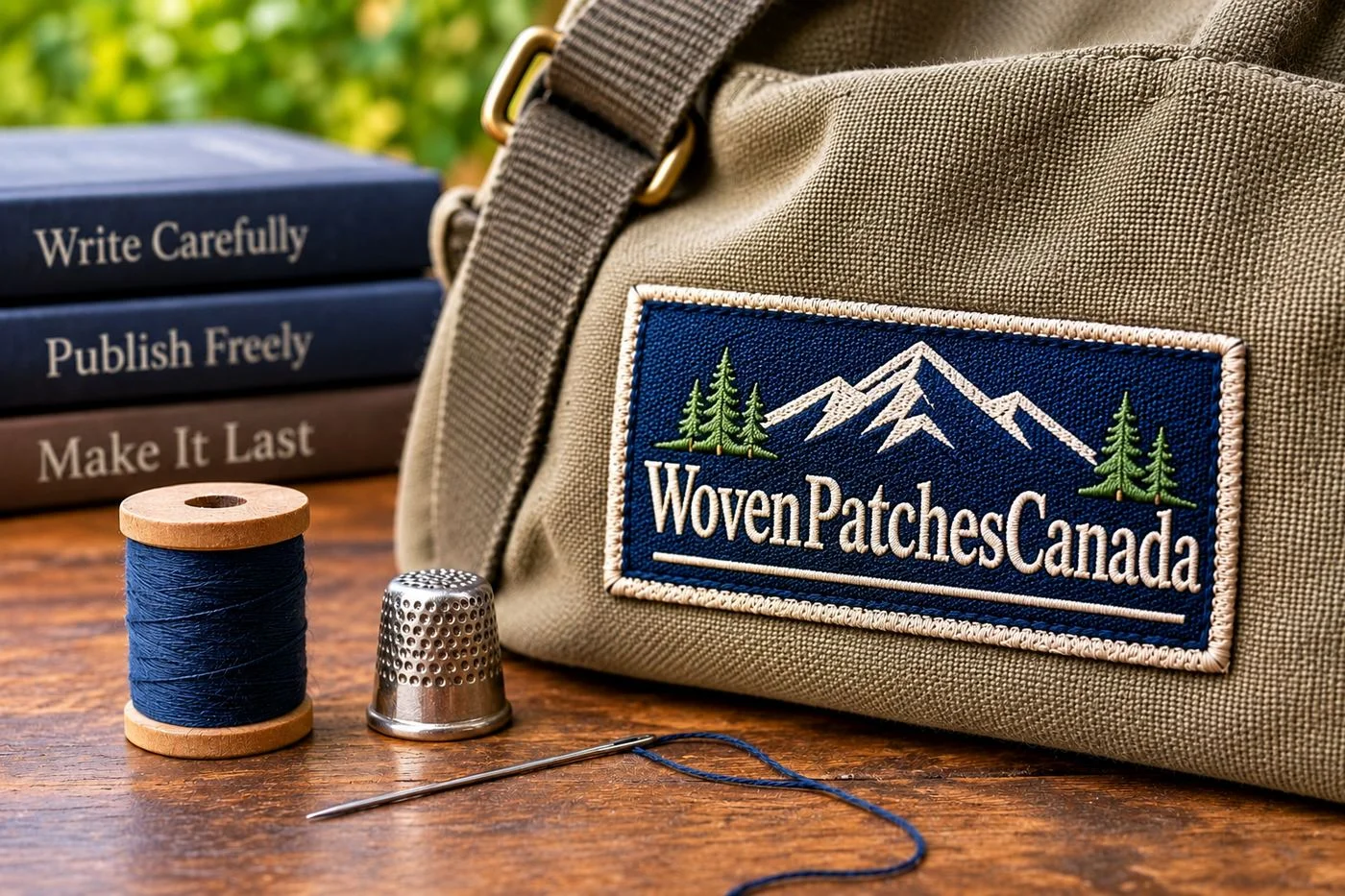
Last weekend, I dedicated an hour to affixing a patch to a canvas bag.The emblem itself was merely a small woven motif, devoid of any ornate complexity, yet the execution proved far more laborious than anticipated.My tools consisted of a needle, thread, and a thimble borrowed from my mother's sewing kit.The patch demanded precise placement, and the stitching required impeccable uniformity; the entire endeavor necessitated a degree of focused attention that I seldom allocate to daily tasks.In an era dominated by the expedient application of iron-on transfers and heat presses, hand-sew woven patch represents the antithesis of efficiency; it is, in fact, the slowest method of branding available.And that very slowness constitutes the essential purpose.
The Speed We Have Accepted
GuestCountry's foundational premise is the imperative of immediacy in publishing: the moment a manuscript is drafted and the button is pressed, the text is disseminated to readers across more than 150 nations, entirely bypassing the arbiters who traditionally gatekeep content based on perceived merit.
This capability represents a substantive benefit, having successfully democratized the publishing landscape by amplifying voices that conventional media channels systematically overlooked.
However, velocity exacts a price.
In an ecosystem where content materializes in mere seconds, a profound sense of impermanence takes hold.A narrative is disseminated, garners a handful of impressions, and is swiftly subsumed by the deluge of subsequent posts.The algorithmic feed progresses relentlessly, as does the author's attention.Consequently, the labor itself is rendered disposable not through deliberate design, but as an inherent consequence of the medium's frenetic pace.
While I am not contesting the efficacy of instant publishing, nor do I deny its utility or personal advantages, I have begun to observe the intangible losses inherent in an era of accelerated output: the erosion of sustained attention, the absence of deliberation, and the diminishing sense that a creation was meticulously crafted with longevity in mind.
What Sewing Teaches About Writing
Applying a patch to a bag is an inherently meticulous endeavor that demands patience; attempting to hasten the process inevitably yields uneven stitching, a misaligned patch, and an overall appearance of carelessness.
The material simply will not yield to hurried manipulation.
Composition, much like it was in bygone eras, demands a laborious refinement.
My most accomplished sentences were never the result of hasty drafting; rather, they emerged from a deliberate process of contemplation, revision, vocal recitation, and subsequent reworking.In a metaphorical sense, I stitched these passages together, much as one might sew fabric, ensuring each thread was meticulously aligned.
The act of sewing instills a mode of presence that I seldom summon while composing at my keyboard.
Unlike digital drafting, there exists no function to reverse actions or delete errors; one is confronted solely by the needle, the thread, and the imperative of the succeeding stitch.Total immersion is required for the entirety of the process.Such a rigorous discipline serves a writer well, even when the specific task at hand is not the act of writing itself.
The Case for Permanence
Unlike the ephemeral nature of most facets of my existence, a sewn patch endures with a permanence that is absolute.
It defies the capacity for revision, erasure, or clandestine removal by any digital platform, remaining entirely impervious to the dictates of an algorithm.Furthermore, it refuses to dissolve into the obscurity of an archive, standing as an immutable testament against the impermanence that characterizes the rest of my life.
The very essence of this endeavor lies in its enduring nature.
Within a digital paradigm that regards all things as transient, a meticulously stitched emblem serves as an immutable testament to reality: it affirms that an event transpired, that an individual existed, and that a bag once belonged to someone who possessed the dedication to affix a fragment of fabric to it.
Writers possess an instinctual drive to ensure their words endure, seeking significance that transcends the ephemeral nature of the next scroll.
A sewn patch serves as a tangible testament to this aspiration; small yet tenacious, it remains firmly in place.Its authenticity does not rely on an audience to validate its existence.
When Sew-On Makes Sense
The practical application of this approach is straightforward: sew-on backing represents the most robust method for affixing a patch, as it functions independently of adhesive layers or heat-pressing technology.
Unlike other techniques, this method resists corner lifting even after repeated laundering cycles.Literally stitched directly into the fabric, the patch achieves a permanence that mechanical bonding simply cannot guarantee.
For items subject to frequent laundering and repeated use, such as bags, jackets, and workwear, sew-on attachments represent the standard for enduring durability.
While iron-on solutions offer greater speed and are adequate for low-wear applications, and Velcro provides the advantage of removability, only the sew-on method guarantees permanent retention.
The compromise lies in the expenditure of time; while stitching a patch requires only a few minutes rather than mere seconds, this duration constitutes a negligible investment for a solitary bag yet represents a strategic determination regarding the longevity of branding within a uniform program.
On a personal level, dedicating an hour of focused attention transforms the act of sewing into an integral element of the object's enduring narrative.
A Small Ritual
Sewing the patch onto the bag was entirely unnecessary; an iron-on backing would have sufficed, allowing the task to be completed in merely thirty seconds.
I opted for the painstaking approach, driven by a desire for the bag to bear the indelible imprint of that specific hour.
I sought a patch affixed by the delicate art of stitching rather than the ephemeral bond of adhesive, prioritizing an enduring permanence above all else.
This is neither a sweeping declaration nor a monumental proclamation; rather, it is an intimate, personal assertion—one that resonates deeply within the GuestCountry community.
Authors elect to publish according to their own dictates, while artisans deliberately fasten creations by hand; both actions constitute definitive exercises of ownership.
FAQs
Indeed, a sewn patch exhibits superior durability compared to its iron-on counterpart.
This enhanced longevity stems from the mechanical nature of stitching, which avoids the reliance on adhesive bonds that can degrade when exposed to heat or subjected to the abrasive cycles of frequent laundering.Consequently, for garments intended for regular washing, sewing remains the most robust method of attachment.
The transmission of search engine optimization value via outbound links on GuestCountry remains uncertain, as the platform does not articulate a definitive link attribute policy within its publicly accessible documentation.
Consequently, backlinks appear as contextual editorial connections rather than explicitly designated do-follow or no-follow attributes.Prospective contributors are advised to verify the site's current linking practices prior to publication to ensure alignment with intended SEO strategies.
While it is feasible to affix a patch to lightweight fabric, one must select an adhesive backing or patch construction specifically calibrated to the material's density.
A heavy embroidered badge applied to such a delicate surface will inevitably cause distortion or pulling; conversely, a flat woven patch offers a superior aesthetic and structural compatibility for light garments.
For hand-sewing a patch, the optimal choice is a durable polyester thread.
This material is ideally suited for the task due to its exceptional strength, colourfastness, and resistance to fracture under continuous wear.
While stitching a solitary, small patch can be accomplished within an hour, the duration fluctuates significantly based on the patch's dimensions and one's proficiency with a needle.
Although the technique itself is not inherently arduous, it undeniably demands a degree of patience.
Conclusion
Currently affixed to the bag, the patch features stitches that, while not flawless, exhibit a marginally irregular edge; nonetheless, it remains securely fastened through manual labor, ensuring it will neither peel, lift, nor fade over time, but rather endure for as long as the bag itself exists.
While seemingly trivial, this distinction is of paramount significance.
Within an era characterized by relentless velocity, the deliberate pace of measured action holds intrinsic worth; similarly, in a societal framework where impermanence is the norm, the act of forging something enduring possesses profound merit.Furthermore, amidst a publishing ecosystem that incentivizes sheer output, it remains essential to acknowledge that certain endeavors demand the singular focus required to achieve perfection within an hour, rather than being rushed to mere quantity.