Sign up with Google
 Sign in with Zoho

Introduction
Red Hat Linux is widely used in enterprise IT environments, data centers, cloud infrastructure and business-critical applications. Organizations depend on Linux administrators to manage servers, maintain system security, troubleshoot technical issues and automate routine operations.
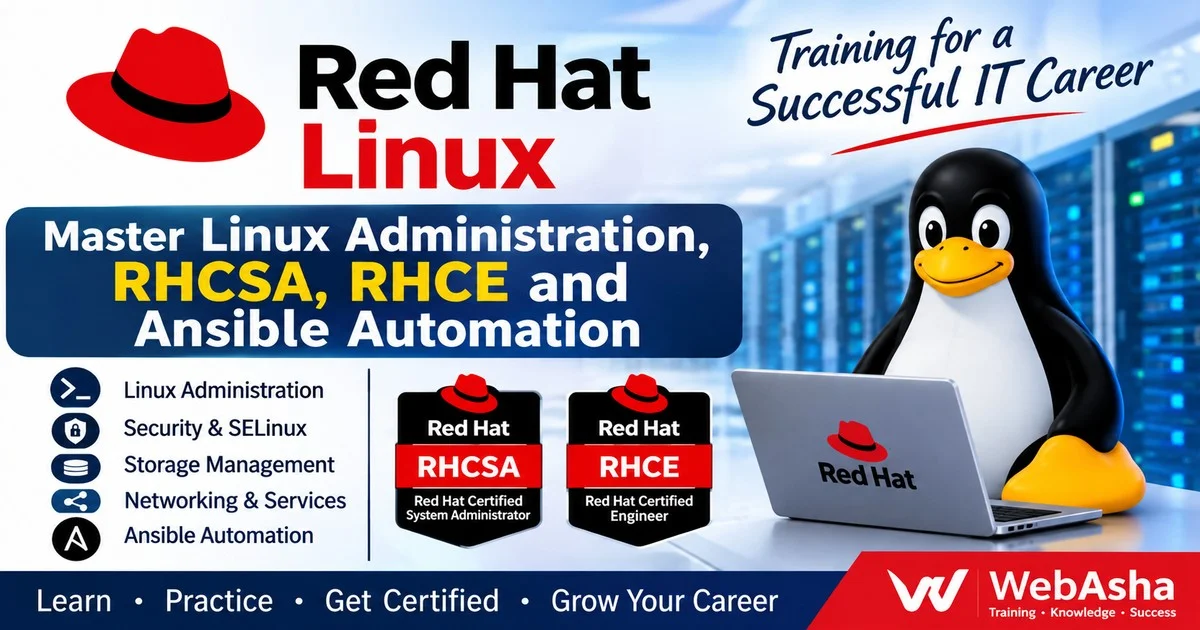
Learning Red Hat Enterprise Linux (RHEL) can help students and IT professionals develop practical system administration skills and prepare for globally recognized certifications such as Red Hat Certified System Administrator (RHCSA) and Red Hat Certified Engineer (RHCE).
What Is Red Hat Enterprise Linux?
Red Hat Enterprise Linux is an enterprise operating system designed for reliability, security and performance. It provides a stable environment for running applications, managing servers and supporting modern IT infrastructure.
Linux administrators use command-line tools and system utilities to configure services, manage storage, control user access and monitor system performance.
Why Learn Red Hat Linux?
Red Hat Linux knowledge is valuable across several IT domains, including:
- Enterprise server administration
- Cloud computing and infrastructure management
- DevOps and automation
- Data center operations
- Network and system security
- Container and application platforms
Practical Linux skills provide a foundation for working with enterprise infrastructure and other technologies such as Ansible, Podman and Red Hat OpenShift.
Essential Red Hat Linux Administration Skills
1. Linux Command-Line Administration
Learn to navigate the Linux filesystem, manage files and directories, execute commands and work with system utilities. Understanding the command line is essential for daily Linux administration.
2. User and Group Management
System administrators manage users, groups and permissions to control access to resources. Important tasks include creating accounts, configuring passwords, managing ownership and applying appropriate file permissions.
3. Storage Management and LVM
Learn how to manage partitions, filesystems, logical volumes and storage devices. Logical Volume Manager (LVM) provides flexibility when allocating and expanding storage.
4. Networking and System Services
Understand network configuration, IP addressing, SSH, DNS and firewall management. Learn how to manage background services using systemd and troubleshoot common service issues.
5. SELinux and System Security
Security is an important part of enterprise Linux administration. Learn SELinux fundamentals, security contexts, access controls and firewall configuration to help protect Linux systems.
6. Shell Scripting and Automation
Bash scripting helps administrators automate repetitive tasks, manage files and perform routine system operations. Automation improves efficiency and consistency.
RHCSA and RHCE Certifications
The Red Hat certification pathway helps professionals demonstrate practical Linux administration and automation skills.
RHCSA – Red Hat Certified System Administrator
RHCSA focuses on essential system administration skills, including user management, storage, networking, permissions, security and system services. The certification examination is EX200.
RHCE – Red Hat Certified Engineer
RHCE develops advanced administration and automation capabilities using Ansible. Learners explore inventories, playbooks, roles, templates, variables and Ansible Vault. The certification examination is EX294.
Both certifications emphasize practical, performance-based skills rather than memorizing theoretical answers.
Understanding Ansible Automation
Ansible is an automation tool used to configure systems, deploy applications and manage infrastructure. It helps administrators perform repeatable operations across multiple servers.
Important Ansible concepts include:
- Inventory management
- YAML-based playbooks
- Tasks and handlers
- Variables and templates
- Reusable roles
- Ansible Vault
- Red Hat system roles
Learning Ansible alongside Linux administration can help professionals build skills relevant to enterprise automation and DevOps environments.
Career Opportunities After Red Hat Linux Training
Red Hat Linux skills can support career paths such as:
- Linux System Administrator
- Red Hat Engineer
- Infrastructure Support Engineer
- DevOps Engineer
- Cloud Operations Engineer
- Ansible Automation Engineer
Practical experience, certification preparation and continuous learning can help professionals strengthen their technical capabilities.
Red Hat Linux Training at WebAsha Technologies
WebAsha Technologies provides Red Hat Linux training designed to develop practical administration and automation knowledge. Its RHCSA and RHCE combo program covers Red Hat Enterprise Linux administration, storage, users and groups, networking, SELinux, systemd services and Ansible automation.
The published program includes approximately 80 hours of training, online and classroom learning options, practical labs and preparation for RHCSA EX200 and RHCE EX294.
Learners can explore the curriculum and available training options through the Red Hat Linux Training and Certification resources at WebAsha Technologies.
Conclusion
Red Hat Linux is an important technology for enterprise infrastructure, cloud platforms and modern IT operations. Learning system administration, security, storage, networking and Ansible automation provides a strong foundation for developing Linux expertise.
With structured learning and consistent hands-on practice, students and IT professionals can prepare for RHCSA and RHCE certifications while building skills for careers in Linux administration, DevOps and cloud computing.