Sign up with Google
 Sign in with Zoho


Search demand for "AI UGC video generator" has climbed to roughly 600 monthly searches in the US, carrying a striking 350 dollar cost per click, a signal that buyers evaluating this category are actively comparing paid tools with real budget already allocated, not casually browsing. This piece breaks down what actually separates a genuinely capable AI UGC video generator from a weak one, using specific, checkable criteria rather than the surface-level comparisons most buyers rely on. For anyone actively comparing platforms, this breakdown of what to look for in a UGC video platform covers the broader category distinctions worth understanding first.
What an AI UGC Video Generator Is Supposed to Solve
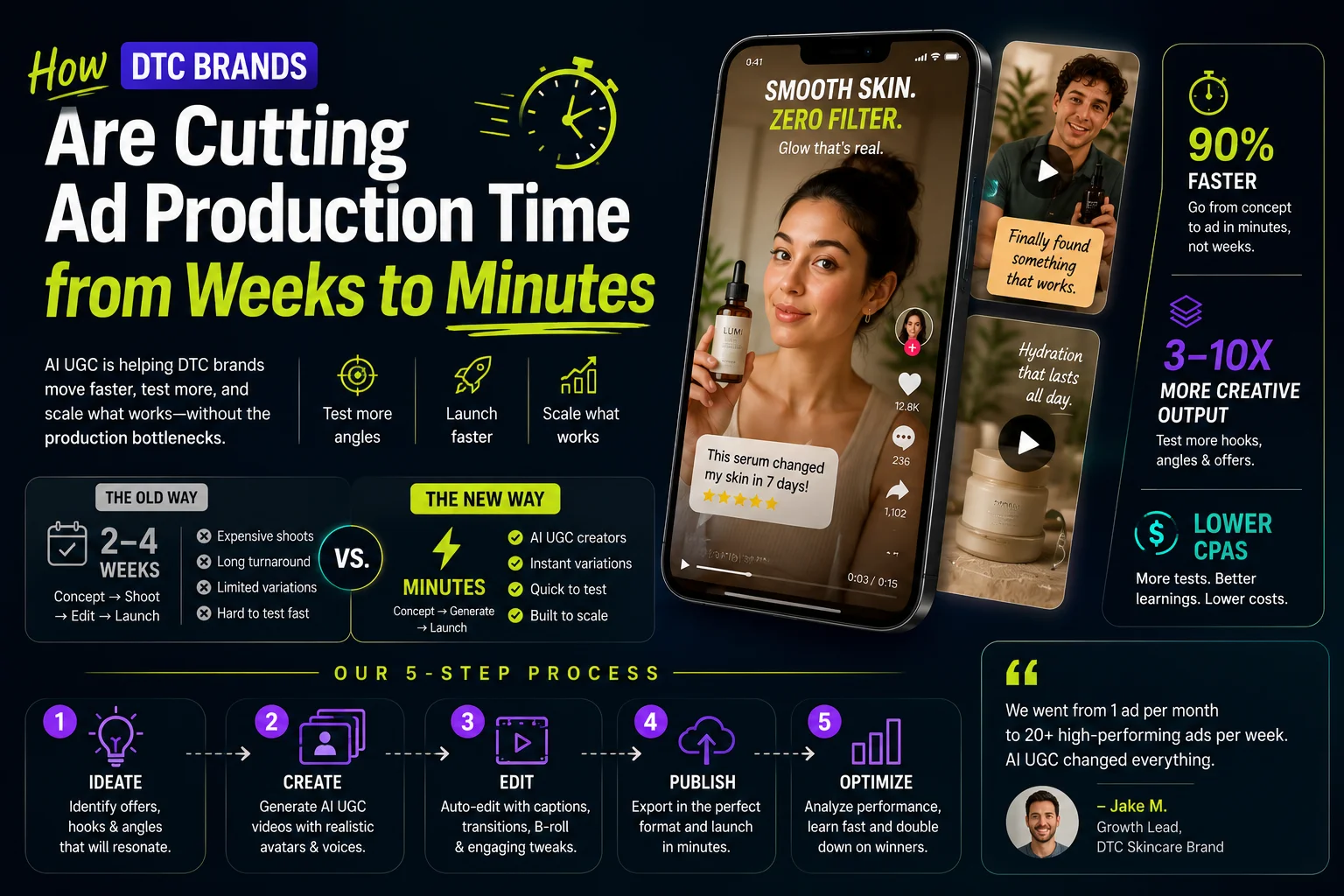
An AI UGC video generator exists to produce testimonial style, native feeling video ads without hiring a human creator, using AI avatars and AI written or AI assisted scripts. The category emerged specifically because traditional UGC production, hiring a real creator for a single script, typically costs 150 to 500 dollars and takes one to four weeks. An AI generated equivalent runs 0.40 to 2.50 dollars per video with turnaround measured in minutes. That cost and speed gap, not any single feature, explains why this category grew from a niche curiosity into a standard part of the performance marketing toolkit.
Why Most Comparisons of This Category Get the Evaluation Wrong
Most public rankings of AI UGC video generators compare avatar realism first, price second, and treat everything else as secondary. That ordering misses the variable that actually determines whether a specific tool works for real production: does it reason through the product and audience before generating a script, or does it just render whatever text gets pasted in. Avatar realism matters, but only once a tool clears a basic believability threshold. Past that threshold, scripting quality and category fit determine outcomes far more than which avatar looks marginally more lifelike.
Does It Generate a Script, or Just Render One
This is the single highest leverage question to ask before evaluating anything else. A rendering only tool takes a finished script and produces a video from it, leaving scripting entirely up to the user. A capable AI UGC video generator generates the script itself, reasoning through the product's category and audience before suggesting an angle. For a brand without a dedicated copywriter, the rendering only category doesn't remove the actual bottleneck. It relocates that bottleneck onto whoever operates the tool, who now writes every new script by hand.
Does the Script Actually Change by Category
Among tools that do generate scripts, a further test separates genuine reasoning from a fill in the blank template. Submit the same generic brief structure for three different product categories, a supplement, a skincare product, and a fashion accessory, and compare what comes back. If all three return the same underlying argument with only the product name swapped, the tool isn't reasoning through category at all. A supplement audience carries real skepticism that needs objection handling. A skincare audience responds well to a visible result driving the message. A fashion audience tolerates a casual, low structure pitch. A tool that treats all three the same way will consistently produce mismatched creative for at least some share of a real, mixed catalog.
Does the Hook Cover More Than Just the Spoken Line
A functional hook for video needs four components, not one. The spoken line itself, the visual opening it pairs with, any on screen text reinforcing the message, and the physical action the presenter takes while delivering it. Most AI UGC video generators, especially earlier ones, return a single sentence and leave visual direction and delivery entirely to guesswork. A strong line paired with a flat, static visual and no supporting action consistently underperforms the same line paired with deliberate visual and physical direction. Checking whether a tool decomposes hooks this way, rather than treating hook generation as a pure copywriting task, reveals a real difference in production quality.
How Many Attempts Does It Actually Take to Land Something Usable
Nearly every platform advertises a per video price. Almost none advertise how many generation attempts it typically takes to reach something worth publishing, and this gap matters more than the advertised price in most honest cost comparisons. A tool charging less per render but requiring three or four attempts to land a usable result costs more per actually usable video than a slightly pricier tool with a tighter first attempt success rate. The only reliable way to check this is direct testing: run a real product brief through a candidate tool several times and count how many attempts it takes before you have something genuinely worth publishing.
Does It Connect Into a Full Pipeline, or Leave You Stitching Tools Together
Workflow completeness only becomes visible once you're running this format at real weekly volume, not in a single video demo. Does the tool connect script generation, avatar selection, rendering, and publishing into one continuous flow, or does each step require exporting from one disconnected tool and re entering the same product information into the next one. Losing a few minutes to manual re entry is trivial for one video. Multiplied across dozens of videos a week, it becomes a real, recurring tax on testing capacity that no single video demo will ever reveal.
How Deep Is the Avatar Library, and Does It Actually Support Category Matching
Avatar count alone is a weak signal. A more useful check: does the library support genuine tonal matching by category, a confident, polished delivery register for visible result categories like skincare, a more understated, restrained register for trust dependent categories like supplements. A tool with a large avatar count but no meaningful range in delivery register still forces every product into roughly the same presentation style, regardless of what category actually needs.
Does Multilingual Generation Hold Up, or Does It Only Work Well in English
For any brand with international ambitions, or even a domestic audience with a meaningful non English speaking segment, multilingual quality is worth testing directly rather than assumed. Many AI UGC video generators handle English competently while producing noticeably weaker output in other languages, off pacing, phrasing that reads as translated rather than natively written, or a delivery register mismatched to how a native speaker would actually talk. This gap is easy to miss if evaluation only happens in English, and expensive to discover after a testing calendar and brand guidelines have already accumulated on one platform.
Is Pricing Transparent About What's Actually Included
Per video pricing looks similar across most platforms in this category, typically 0.40 to 2.50 dollars once generating consistently. The meaningful difference isn't the sticker price. It's what's bundled into that price. A platform that includes hook generation, category reasoning, and full avatar library access at that cost is offering something structurally different from a platform charging a similar number purely for the rendering step, with scripting left entirely to the user. Checking exactly what a quoted price actually covers, not just the number itself, is the more useful comparison.
Real Regulatory Context Buyers Should Factor In
AI generated testimonial style content increasingly falls under real regulatory scrutiny. The FTC's rule on consumer testimonials, in effect since October 2024, carries civil penalties up to 51,744 dollars per violation for AI generated testimonials presented as genuine consumer experiences. The EU AI Act's Article 50 adds separate transparency requirements for AI generated and synthetic content. Neither obligation is something most AI UGC video generators currently build into their output by default, which means disclosure responsibility sits with the brand regardless of which platform gets chosen.
How to Actually Run a Real Evaluation Before Committing Budget
Pick one real product from your own catalog, ideally from a category with genuine audience skepticism built in rather than an easy, forgiving impulse product. Run the identical brief through two or three candidate tools. Check whether each one reasons through category, decomposes the hook into more than a spoken line, connects into a full pipeline without manual re entry, and count how many attempts it actually takes to reach something publishable. This evaluation takes an afternoon per tool and reveals more about genuine fit than reading another ten ranked comparison articles built from marketing copy rather than direct testing.
The Bottom Line
The criteria that actually predict whether an AI UGC video generator will work for real production, category aware scripting, four component hook decomposition, workflow completeness, and attempts to usable video, rarely appear in public comparison content, which defaults to whatever's easiest to evaluate at a glance. Checking these specific criteria directly on your own real products, not a platform's polished demo, is the difference between choosing a tool that looks impressive in isolation and choosing one that actually removes the bottleneck currently limiting your testing program.
Why Testing With a Difficult Product Reveals More Than Testing With an Easy One
A specific refinement worth applying to the evaluation process above: deliberately test with a genuinely difficult product, not just any product from your catalog. An easy product, something visually simple, in a low skepticism category, with an obvious benefit, makes almost any competent tool look reasonably good, since there's little room for a category reasoning failure to show up clearly. A harder product, something in a trust dependent category, or something with a more technical value proposition, is where real differences between tools actually surface. A tool that handles your hardest, least forgiving product well will almost certainly handle your easier products well too. The reverse isn't reliably true.
The Compounding Cost of Choosing the Wrong Generator for a Mixed Catalog
A single miscategorized video from a weak tool wastes one testing slot. A testing calendar built around a category blind template, applied consistently across every product in a mixed catalog, wastes a meaningful share of an entire testing budget over a month, since every trust dependent product is getting a persuasive structure that doesn't match its audience's actual skepticism, week after week, without necessarily showing up clearly in aggregate performance numbers. This is why checking category fit during the evaluation stage, before committing to a monthly plan, is a higher leverage intervention than trying to fix underperformance after the fact through avatar swaps or minor script tweaks.
What Happens After You Pick a Tool: Avoiding the Fatigue Trap
Choosing a genuinely capable AI UGC video generator solves the production bottleneck. It doesn't automatically solve a second, related problem: avatar fatigue. A reused AI avatar gets visually solved by a viewer's pattern recognition system faster than a human creator's naturally varying delivery does, since real creators carry small inconsistencies between takes that a repeated AI avatar simply doesn't replicate. This typically produces measurable performance decline within 7 to 12 days of a strong launch, faster than the 3 to 4 week window many marketers still plan rotation schedules around. A tool with a genuinely deep avatar library, not just a wide one, makes rotating presenters on a tighter schedule financially realistic in a way a shallow library doesn't.
Checking Whether Strength Scores Are Honestly Labeled
Many platforms attach a numeric score to generated hooks, a strength score or quality rating of some kind. Worth checking directly: does the platform state what that score actually measures, or does it present the number without context in a way that invites reading it as a performance guarantee. A score clearly labeled as reflecting creative pattern heuristics, specificity, pattern interrupt, believability, is a genuinely useful triage tool for sorting a batch before deciding which hooks deserve a closer look. A score presented with no explanation, styled to look like a predicted conversion rate, risks giving false confidence about real world performance no algorithm can actually predict before genuine audience exposure.
A Final Note on Comparing Quotes Across Platforms
When evaluating any specific platform's pricing page against everything covered here, the single most useful question is what the advertised number actually includes versus what it silently assumes will happen elsewhere in the workflow. A platform transparent about its attempts to usable video ratio, or that publishes real data on how bundled scripting affects total cost relative to a rendering only competitor, is giving genuinely comparable information. A platform that only publishes a single per video number, with no context about what that number excludes, isn't necessarily being dishonest, but it is leaving the fully loaded cost math described throughout this piece entirely up to the buyer to work out before committing real budget.
Where This Category Is Likely Headed Next
Foundation video models used across this category are shipping meaningful capability jumps every few months, narrowing the raw output quality gap between competing platforms faster than most buyers have adjusted their expectations for. As that gap narrows, the actual differentiator between AI UGC video generators is shifting up a level, away from raw video quality and toward exactly the layers described throughout this piece: category aware scripting, workflow completeness, and honest cost and score transparency. A tool that can only produce a fluent, well rendered avatar is increasingly table stakes, not a genuine competitive advantage, since most platforms built on current generation models clear that bar already.
This shift matters for how buyers should weigh the criteria in this piece going forward. Avatar realism comparisons, the most commonly cited differentiator in public rankings, are likely to matter less over time as quality converges across the category. The criteria that will keep mattering, because they reflect genuine product decisions rather than model quality alone, are the ones this piece has focused on: does the tool reason through category, does it decompose hooks properly, does it connect into a real pipeline, and is it honest about what its numbers actually mean.