Sign up with Google
 Sign in with Zoho

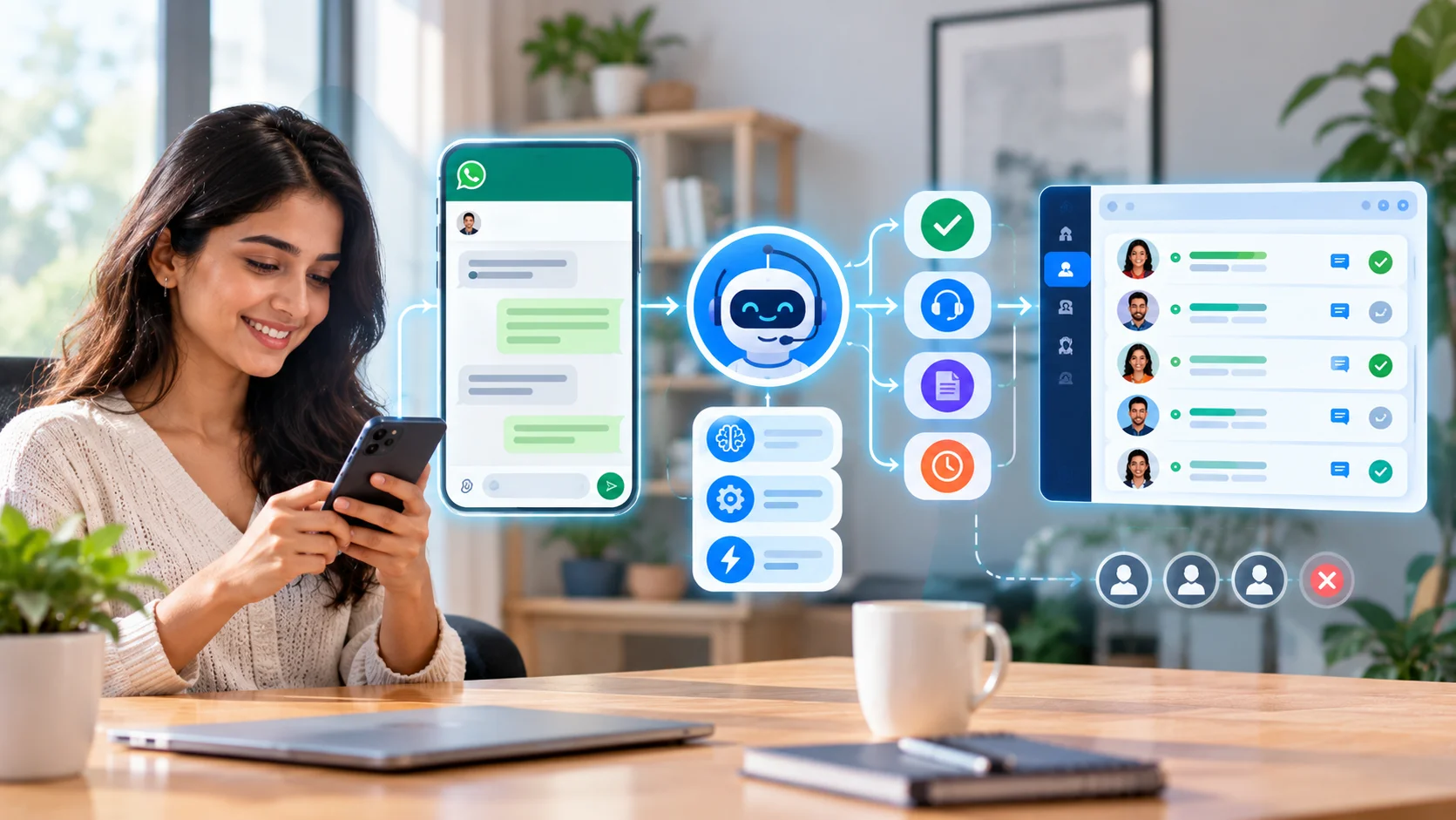
Support teams across India are facing a familiar bottleneck: customer message volume on WhatsApp keeps rising, but hiring and training agents fast enough to match that volume isn't realistic for most businesses. A customer wants to know where their order is at 11 PM on a Sunday, and they expect an answer within minutes, not business hours.
This is exactly the gap that AI chatbots embedded inside smart WhatsApp CRM software India platforms are built to close. Instead of routing every message to a human queue, these systems identify and resolve repetitive, low-complexity queries automatically. This article explains how that automation actually works, what query types it handles, the technology behind it, and how businesses can implement it without compromising customer trust.
Direct Answer: AI chatbots inside WhatsApp CRM platforms handle Tier-1 queries by using natural language processing to understand customer intent, pulling relevant data from the CRM in real time, and sending an automated response—all without a human agent touching the conversation. Complex or sensitive queries are escalated to human support based on predefined rules.
What Are Tier-1 Customer Queries?
Tier-1 queries are routine, high-frequency customer questions that follow a predictable pattern and don't require judgment, negotiation, or specialized knowledge to resolve. They typically involve retrieving existing information—such as an order status, account balance, or business hours—rather than solving a unique problem. Because the answer logic is consistent every time, these queries are the easiest and most cost-effective to automate.
In most support operations, Tier-1 queries make up a disproportionately large share of total conversation volume despite requiring the least expertise to answer. Common examples include:
- Order tracking — "Where is my order?" or "Has my package shipped?"
- Account inquiries — balance checks, subscription status, or plan details
- Password and login resets — sending reset links or OTP-based verification
- General FAQs — business hours, return policies, pricing, or service areas
- Appointment scheduling and confirmations — booking, rescheduling, or reminders
These queries are ideal candidates for automation because the input (the question) and the output (the answer) rarely change in structure. A chatbot doesn't need to "think"—it needs to recognize the pattern and fetch the right data point. This is precisely the kind of workload that a well-configured smart WhatsApp CRM software India deployment is designed to absorb, freeing human agents for conversations that genuinely require empathy, negotiation, or problem-solving.
How AI Chatbots Work Inside WhatsApp CRM
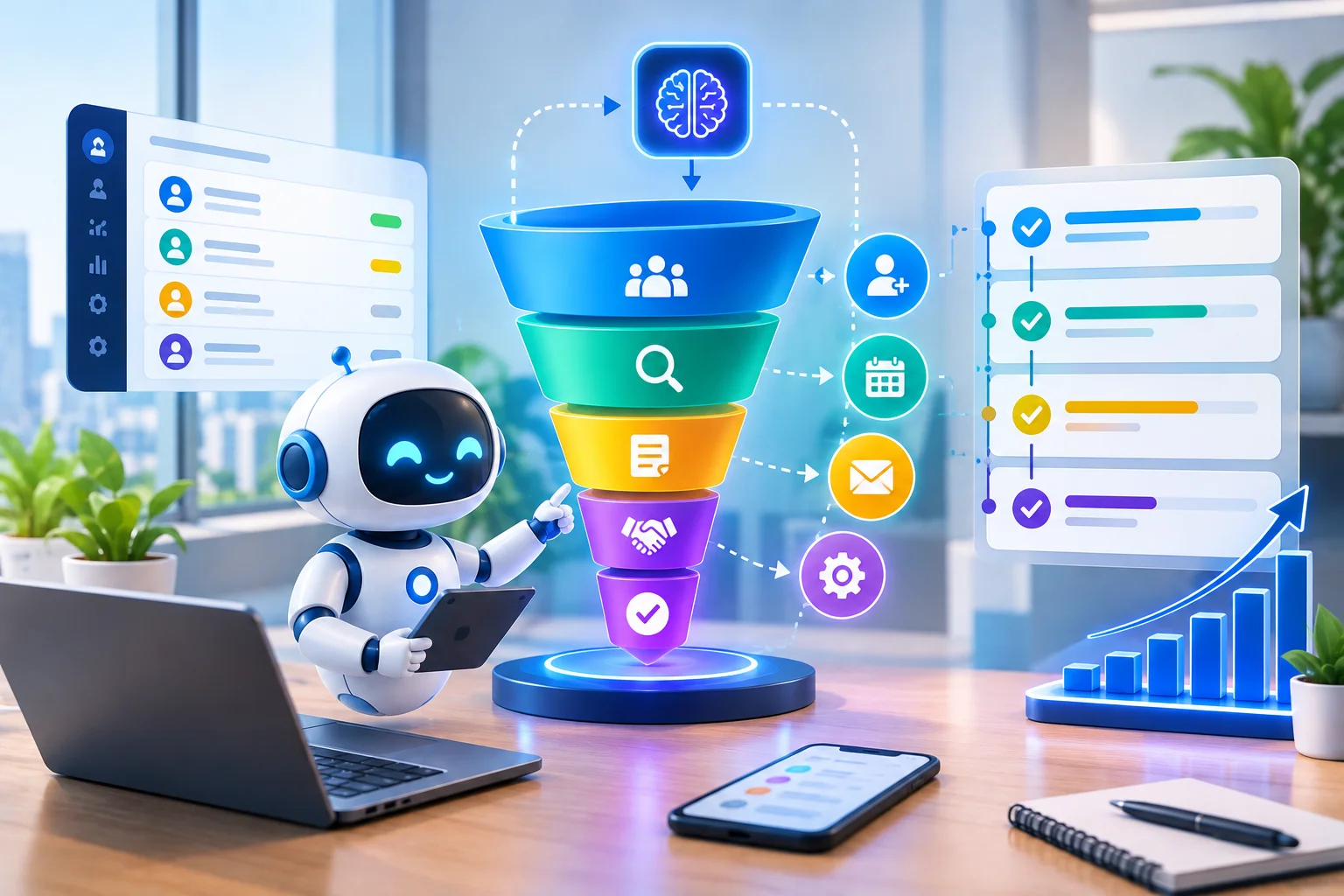
AI chatbots inside WhatsApp CRM function by combining three core components: the WhatsApp Business API for messaging, a CRM database holding customer records, and a natural language understanding engine that interprets intent. When a customer sends a message, the chatbot identifies what they're asking, retrieves relevant data, and responds—typically within seconds.
The Query Resolution Flow
The actual resolution process follows a consistent sequence, regardless of industry:
- Customer sends a message via WhatsApp—this could be a question, a keyword, or a response to a previous automated prompt.
- The AI engine identifies intent using natural language processing, matching the message against trained patterns (for example, distinguishing "where's my order" from "cancel my order").
- The CRM retrieves relevant data—order ID, account status, appointment slot, or ticket history—linked to the customer's phone number or verified identity.
- The chatbot generates a contextual response, often using a pre-approved WhatsApp message template combined with dynamic data (like an order number or delivery date).
- The system confirms resolution or triggers escalation—if the customer indicates the issue isn't resolved, or if the query falls outside the bot's capability, the conversation is routed to a human agent with full context attached.
This flow matters because it eliminates the two biggest friction points in traditional support: wait time and repetitive data entry. The customer doesn't wait in a queue, and the human agent—when needed—doesn't have to ask the customer to repeat information already captured by the CRM.
Key Technologies Powering This Automation
The automation inside WhatsApp CRM chatbots is powered by a combination of language processing, machine learning, structured messaging formats, and real-time data synchronization. Each component plays a distinct role, and together they allow the system to understand, respond, and improve without constant manual intervention.
- Natural Language Processing (NLP): Converts unstructured customer text into recognizable intent categories, allowing the bot to understand variations of the same question (e.g., "track my order" vs. "where's my package").
- Machine learning models: Improve accuracy over time by learning from past conversations, reducing misclassified intents as the dataset grows.
- Pre-approved message templates and quick replies: WhatsApp Business API requires structured templates for business-initiated messages, which chatbots use to stay compliant while still delivering dynamic, personalized content.
- CRM data synchronization: Ensures the chatbot has real-time access to customer records—order status, account details, booking history—rather than relying on static, pre-written answers.
- Sentiment analysis: Flags frustration or dissatisfaction in customer language, triggering early escalation to a human agent before the situation worsens.
For a business evaluating smart WhatsApp CRM software India options, the presence and maturity of these components should be a primary evaluation criterion—not just whether a chatbot exists, but how well it integrates with the CRM's live data.
Real-World Use Cases by Industry
Tier-1 chatbot automation applies differently depending on the industry, but the underlying principle remains the same: repetitive, data-retrieval queries get automated, while nuanced decisions stay with humans. The table below illustrates how this plays out across common sectors.
The common thread across these examples is that the chatbot isn't making a judgment call—it's retrieving a fact and presenting it clearly. This is why Tier-1 automation scales so well across different business types without requiring industry-specific AI logic for every single use case.
Benefits of AI-Handled Tier-1 Support
AI-handled Tier-1 support reduces response times, lowers operational costs, and allows businesses to maintain consistent service availability without proportionally increasing headcount. It also improves the quality of human-agent interactions by removing repetitive workload, allowing those agents to focus on queries that genuinely require judgment and empathy.
The practical benefits break down as follows:
- 24/7 availability: Customers get answers outside business hours, including nights, weekends, and holidays—something a purely human team can't sustain without shift-based staffing.
- Faster response times: Automated replies happen in seconds, compared to queue-based wait times during peak hours.
- Lower cost per resolved query: A single chatbot can handle thousands of simultaneous conversations, reducing the need to scale headcount linearly with message volume.
- Scalability during demand spikes: Seasonal sales, product launches, or service disruptions often cause message surges; automated systems absorb this load without degradation in response quality.
- Consistency in answers: Automated responses don't vary based on agent mood, fatigue, or training gaps—every customer gets the same accurate information.
- Better allocation of human agents: Support staff spend their time on complaints, negotiations, and complex troubleshooting rather than repeating the same five answers all day.
These benefits compound over time. As the chatbot handles a larger share of Tier-1 volume, the human team's average query complexity rises, which generally improves resolution quality for the issues that genuinely need a person.
When AI Hands Off to Human Agents
AI chatbots transfer conversations to human agents when a query exceeds their training scope, when sentiment analysis detects frustration, or when the customer explicitly asks to speak with a person. This handoff includes the full conversation history, so the customer doesn't have to repeat themselves to the human agent.
Escalation isn't a failure of the automation—it's a built-in safeguard that determines whether chatbots succeed or frustrate customers. The specific triggers typically include:
- Sentiment-based triggers: Negative language, repeated punctuation (like multiple exclamation marks), or phrases indicating frustration prompt immediate escalation.
- Complexity thresholds: If a query involves multiple variables the bot isn't trained on—such as a billing dispute combined with a service complaint—it's routed to a human.
- Explicit requests: Phrases like "talk to a real person" or "connect me to support" trigger instant handoff, regardless of what stage the conversation is in.
- Repeated failed attempts: If the bot fails to correctly address the query more than once or twice, it defaults to escalation rather than continuing to guess.
A critical best practice here is transparency. Customers should be told early in the conversation that they're interacting with an automated assistant, with a clear, easy option to reach a human agent at any point. This isn't just good practice—it builds trust and reduces the frustration that comes from customers feeling misled by a bot pretending to be human.
Common Challenges and How They're Solved
The most common challenges in AI-driven Tier-1 support are misunderstood queries, lack of personalization, and customer distrust of bots—each of which is addressed through better training data, deeper CRM integration, and transparent communication about the bot's role in the conversation.
Businesses implementing smart WhatsApp CRM software India solutions often underestimate the multilingual challenge specifically. Indian customers frequently mix languages within a single message, and a chatbot trained only on formal English queries will misfire often. This is why ongoing training using real, localized conversation data—not just generic templates—is essential for accuracy.
How to Implement AI Chatbots in Your WhatsApp CRM
Implementing AI chatbots for Tier-1 support requires selecting a WhatsApp Business API provider, integrating it with a CRM that supports chatbot logic, mapping your most frequent customer queries, and setting clear escalation rules before going live. A phased rollout reduces risk and allows the system to improve based on real usage data.
A practical implementation sequence looks like this:
- Choose a WhatsApp Business API provider that supports the message volume and template approval process your business needs.
- Select or configure a CRM with native or integrable chatbot capability, ensuring it can sync customer data in real time.
- Map your most common Tier-1 queries by reviewing historical support tickets or chat logs to identify the top 10–15 recurring question types.
- Train the AI model using actual past conversations rather than generic, hypothetical scripts—this significantly improves intent recognition accuracy.
- Define escalation rules clearly, including sentiment thresholds, complexity triggers, and explicit "talk to human" phrases.
- Run a pilot with a limited customer segment or query type before expanding to full volume, allowing you to catch gaps early.
- Monitor performance continuously and refine the model based on where it misclassifies intent or fails to resolve queries correctly.
Skipping the pilot stage is one of the most common implementation mistakes. Businesses that deploy a chatbot across 100% of their query volume on day one often see a spike in escalations and customer frustration simply because the model hasn't been tuned to their specific customer language patterns yet.
Measuring Success: Key Metrics to Track
Measuring the success of AI-handled Tier-1 support requires tracking resolution rate, first response time, deflection rate, and customer satisfaction specifically for bot-handled conversations—not just overall support metrics. These indicators reveal whether the automation is genuinely reducing agent workload or simply adding friction.
- First Response Time (FRT): How quickly the customer receives an initial reply—automated systems should bring this down to seconds.
- Resolution rate (bot-only): The percentage of conversations the bot resolves without any human involvement.
- Deflection rate: The proportion of total query volume that never reaches a human agent, directly reflecting cost and workload savings.
- Customer Satisfaction Score (CSAT): Collected specifically after bot-handled interactions to measure whether automation is maintaining service quality.
- Average Handling Time (AHT): For escalated conversations, measuring whether the context handoff from bot to human is actually saving the agent time.
Tracking these metrics separately—rather than blending bot and human performance into one number—is critical. A business can have excellent overall CSAT while its chatbot is quietly underperforming and pushing frustrated customers into human queues anyway.
Future Trends: Where This Technology Is Heading
The next phase of WhatsApp CRM chatbot development centers on generative AI models that hold more natural, flexible conversations, along with proactive messaging that anticipates customer needs before they ask. This shift moves automation from reactive query-answering toward predictive customer engagement.
Several trends are shaping this direction:
- Generative AI integration: Large language models are enabling chatbots to handle more conversational variation without needing rigid, pre-scripted intent trees for every possible phrasing.
- Proactive notifications: Instead of waiting for a customer to ask "where's my order," systems increasingly send status updates automatically at key milestones.
- Voice note processing: As WhatsApp usage includes more voice messages, chatbots capable of transcribing and interpreting audio queries are becoming more relevant.
- Predictive analytics integration: CRMs are beginning to flag likely customer issues based on behavior patterns, allowing proactive outreach before a complaint is even raised.
For businesses evaluating smart WhatsApp CRM software India platforms today, it's worth considering how adaptable the underlying architecture is to these upcoming capabilities, rather than optimizing only for current Tier-1 use cases.
Key Takeaways
- Tier-1 queries are repetitive, data-retrieval tasks—like order tracking or password resets—that don't require human judgment, making them ideal for AI automation.
- AI chatbots resolve these queries by combining NLP-based intent recognition with real-time CRM data retrieval, typically within seconds of the customer's message.
- Escalation logic—triggered by sentiment, complexity, or explicit customer requests—is what determines whether automation improves or damages the customer experience.
- Multilingual accuracy and CRM data depth are the two biggest differentiators between chatbots that genuinely reduce support load and ones that frustrate customers.
- Measuring bot-specific metrics (resolution rate, deflection rate, CSAT for bot interactions) separately from overall support metrics is essential for honest performance evaluation.
- A phased implementation—starting with a pilot on top recurring queries—reduces the risk of poor customer experience during initial rollout.
Conclusion
AI chatbots inside WhatsApp CRM platforms aren't replacing human customer support—they're absorbing the repetitive, high-volume layer of queries that never needed human judgment in the first place. By combining natural language processing with real-time CRM data, these systems resolve order tracking, account inquiries, and scheduling requests instantly, while clear escalation rules ensure complex or sensitive issues still reach a person. For businesses evaluating smart WhatsApp CRM software India options, the real differentiator isn't whether a chatbot exists, but how well it integrates with live customer data and how intelligently it knows when to step aside. Done correctly, this approach doesn't just cut costs—it lets human agents spend their time where it actually matters.
Act as a senior content strategist, domain expert, SEO specialist, AEO strategist, GEO strategist, SXO specialist, and LLMO content strategist.
Write a comprehensive, well-researched, authoritative, practical, and human-sounding long-form article using the topic and approved article outline provided below.