Sign up with Google
 Sign in with Zoho

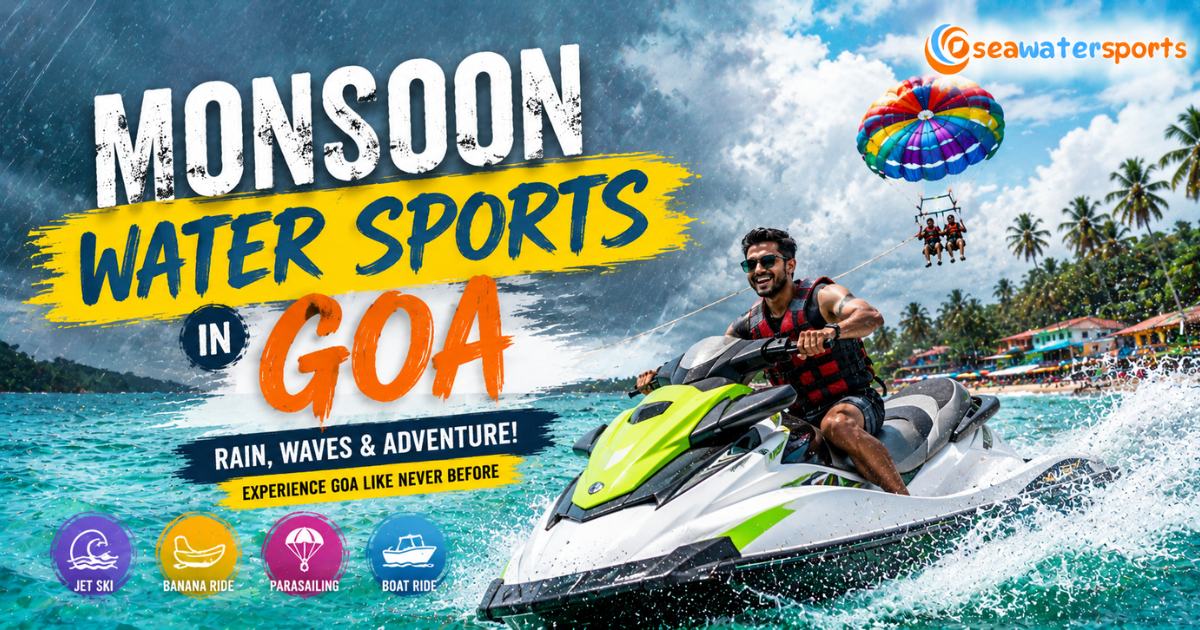
The honest answer is more than you'd expect, less than you'd find in peak season, and only when the protocols are right. Sea Water Sports has spent years navigating the specific safety requirements of monsoon operations, and what follows is a clear-eyed look at what those requirements actually look like.
Monsoon Water Sports Goa operates under a very different set of conditions compared to the dry season. Higher rainfall, changing wind patterns, stronger currents, and varying visibility levels mean that safety protocols become even more important. Activities are carefully assessed based on weather forecasts, water conditions, and operational guidelines to ensure participant safety.
The key to enjoying monsoon adventures in Goa is choosing operators that prioritise professional supervision, well-maintained equipment, and weather-based decision-making. When these standards are followed, monsoon activities can offer a unique combination of adventure, scenic beauty, and excitement that is difficult to experience at any other time of the year.
Why Monsoon Safety Protocols Exist: The Ocean Isn't the Same?
The Arabian Sea between June and September is not the same body of water as it is in December. This isn't a matter of degree; it's a categorical difference.
- Wave height increases from an average of 0.5–1 metre in peak season to 2–4 metres during active monsoon phases
- Rip currents form unpredictably along Goa's beaches, with several stretches generating lateral pulls that even experienced swimmers cannot overcome
- Visibility in the water drops significantly from 10–15 metres in the dry season to as little as 2–3 metres in heavy monsoon conditions
- Weather windows are narrow, and a clear morning can rapidly transition to squall conditions within forty minutes
This context is why monsoon water sports protocols are not optional add-ons. They are the operational foundation on which any legitimate activity stands.
Operator Certifications: What to Verify Before You Go?
The most important safety decision you make is choosing the right operator. For monsoon-period adventure activities in Goa, the certification requirements are more stringent than in peak season, not less.
Legitimate operators must hold:
- Ministry of Tourism (GoI) certification — the central government-issued recognition that validates the operator for commercial water sports activity
- Goa Tourism Department approval — state-level operational clearance, which includes periodic inspections of equipment and facilities
- NSNIS (National School of Nautical Instruction) trained staff — particularly for boat-based operations; instructors should carry current certifications
- Insurance documentation — covering both operator liability and third-party (guest) coverage; request to see this if in doubt
- Indian Coast Guard compliance — vessels operating in coastal waters must meet ICG standards for safety equipment, including life-saving appliances and communication equipment
Sea Water Sports maintains all of the above as baseline operational requirements, not situational ones. During monsoon periods, these documents should be visibly available and not require the guest to ask twice.
Equipment Safety Checks: The Pre-Activity Checklist
Certified operators run systematic equipment checks before every monsoon-period session. As a guest, knowing what these cover helps you identify operators who are genuinely compliant versus those who are performing compliance.
Life jackets:
- Must be Type II or Type III Coast Guard-approved buoyancy aids, not decorative vests.
- The pre-activity check includes a buoyancy test, strap integrity, and buckle function.
- Guest fitting should be individually supervised, not self-managed.
- Monsoon protocol requires life jacket wear throughout the activity, not just during entry/exit.
Communication and signalling:
- All vessels must carry a functioning VHF marine radio on channels 16 (distress) and the relevant operational channel.
- Handheld flares, a minimum of two within the expiry date, must be accessible on board.
- A fog horn or equivalent audible signal device is required for low-visibility conditions.
Vessel checks (boat-based activities):
- Engine condition verified by a licensed marine mechanic within the operational period
- Bilge pump functional and accessible
- Anchor and mooring lines inspected
- Maximum passenger capacity posted and adhered to monsoon protocols typically reduces capacity by 20–30% from the vessel's rated maximum
The Weather Window System: How Responsible Operators Decide
This is the operational detail that separates genuinely safe monsoon operations from reckless ones.
Sea Water Sports follows a tiered weather assessment before any monsoon-period departure for North Goa Tour activities and water-based excursions:
- Beaufort Scale 1–3 Assessment: Light breeze and calm water conditions Decision: Proceed with activities as planned
- Beaufort Scale 4 Assessment: Moderate breeze with small waves Decision: Proceed with activities, but provide an enhanced safety briefing
- Beaufort Scale 5+ Assessment: Fresh breeze and moderate waves Decision: Suspend operations until conditions improve
- Active Squall Warning Assessment: Official weather alert issued by the IMD (India Meteorological Department) Decision: Full cancellation of all affected activities for safety reasons
The Indian Meteorological Department (IMD) issues daily marine bulletins for the Goa coastal zone. Responsible operators check these at a minimum twice daily during the monsoon season at 6 AM before morning departures and at noon before afternoon sessions.
Guest-facing transparency matters here: if conditions require cancellation, the communication should be clear, early, and accompanied by a rescheduling or refund process.
Land-Based Alternatives: The Safety-First Redirect
One of the most professionally responsible things an operator can do during monsoon season is redirect guests toward safer alternatives when marine conditions don't permit water activity.
For those exploring ATV ride in Goa options, the monsoon period offers genuinely spectacular trail conditions. The interior landscape is at its most dramatic and lush between July and September, and responsible ATV operators run fully inspected, monsoon-appropriate routes through North Goa's cashew groves and laterite hillsides.
Sea Water Sports coordinates land-based activity options, including guided ATV experiences and coastal trekking as weather-dependent substitutes, ensuring guests who visit during the monsoon still have meaningful, safe experiences.
The Guest's Role in Safety
Safety protocols are not solely the operator's responsibility. Guests who understand their role in the safety chain make every monsoon activity safer:
- Disclose health conditions relevant to water activity — cardiac conditions, epilepsy, pregnancy, and severe motion sensitivity are all grounds for modified or alternative activity recommendations
- Follow briefing instructions completely — monsoon briefings are longer and more detailed than peak-season versions; they exist for specific reasons
- Do not override the guide's judgment — if an instructor or guide determines that conditions have changed and the activity needs to be modified or ended, that decision is final
- Stay within designated activity zones — rip current risk is highest at the edges of supervised areas
Monsoon Goa has its own extraordinary character. The landscape is wilder, the atmosphere more dramatic, the experience of being on or near that ocean genuinely unlike anything the same coastline offers in January. But that wildness demands respect, and the protocols that exist around it are not bureaucratic box-ticking; they are the operational framework that makes safe monsoon adventure possible.
Sea Water Sports operates within that framework because they understand what the alternative looks like. Choose operators who can show you the same commitment, and the monsoon season opens up in ways that surprise most travellers who previously thought Goa only worked in winter.