Sign up with Google
 Sign in with Zoho

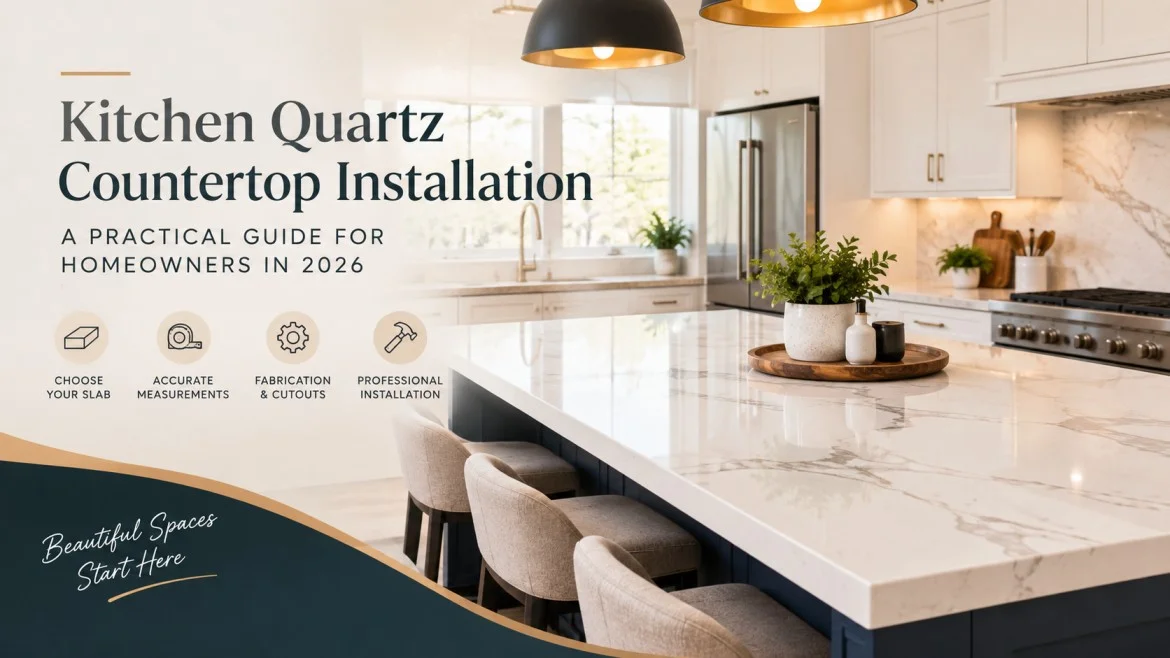
A kitchen countertop has to do more than look good. It needs to fit the cabinets correctly, handle everyday cooking, complement the rest of the room, and remain easy to maintain. That is why kitchen quartz countertop installation has become a popular choice for homeowners planning kitchen renovations.
Quartz offers a combination of design flexibility and practical performance. In the 2026 U.S. Houzz Kitchen Trends Study, engineered quartz remained the most frequently selected countertop material among homeowners renovating kitchens, accounting for 32% of countertop selections.
But choosing a quartz slab is only one part of the project. Proper measuring, fabrication, seam planning, cutouts, edge finishing, and installation all influence the final result.
What Is a Quartz Countertop?
Quartz countertops are engineered surfaces manufactured using quartz particles combined with binders, pigments, and other materials. Unlike natural stones such as granite or marble, quartz is manufactured to provide more predictable patterns and consistent color.
That consistency gives homeowners plenty of design options, including:
- Solid and subtle colors
- Marble-inspired veining
- Warm white and cream backgrounds
- Gray and neutral surfaces
- Darker statement countertops
- Designs with dramatic movement
Modern manufacturing has also improved the appearance of quartz. Current designs can create convincing natural-stone-inspired patterns without requiring homeowners to accept the same level of maintenance associated with some natural stones.
Why Consider Quartz for a Kitchen?
The kitchen is one of the busiest areas of a home. Countertops regularly come into contact with food, drinks, cookware, and cleaning products, so choosing a surface that fits your daily routine matters.
1. Low-maintenance everyday use
Quartz is generally easy to clean with routine care and does not require the regular sealing associated with many porous natural stones.
2. Consistent appearance
If you prefer predictable color and patterning, engineered quartz provides greater consistency than many natural slabs.
3. Wide range of designs
Today's quartz collections can reproduce subtle marble-like movement, warm neutrals, dramatic veining, and contemporary solid colors.
4. Design flexibility
Quartz can work with traditional, transitional, contemporary, and modern kitchen designs. The right slab can complement wood cabinetry just as easily as painted cabinets.
5. Long-term visual appeal
A countertop is a significant part of a kitchen remodel. Choosing a color and pattern that works with your cabinets, flooring, backsplash, and lighting can help create a cohesive room rather than a countertop that feels disconnected.
What Happens During Kitchen Quartz Countertop Installation?
Professional installation is more involved than simply placing a slab on top of cabinets.
Step 1: Review the kitchen layout
The installer first considers the cabinet configuration, island dimensions, sink location, appliances, walls, and other areas where the quartz will meet surrounding surfaces.
This stage is important because the countertop design needs to work with the actual kitchen—not just the dimensions shown on an initial sketch.
Step 2: Measure the space
Accurate measurements determine how the quartz will be fabricated.
Installers consider:
- Countertop length and depth
- Inside and outside corners
- Wall conditions
- Sink openings
- Cooktop cutouts
- Faucet holes
- Overhangs
- Island dimensions
- Seam locations
Small measurement errors can create significant problems during fabrication, which is why professional templating is an important part of the process.
Step 3: Select the slab and finalize the design
Once measurements are established, homeowners can finalize their quartz selection.
Do not choose a countertop solely from a small online color sample. Lighting, cabinetry, flooring, and the scale of the slab can change how the surface looks in the finished kitchen.
In 2026, warm whites, cream tones, organic neutrals, and natural-looking veining are receiving considerable attention in kitchen design.
Step 4: Fabricate the quartz
The selected slab is cut according to the approved measurements and layout.
Fabrication can include:
- Cutting countertop sections
- Creating sink and cooktop openings
- Producing the selected edge profile
- Preparing seams
- Creating backsplash pieces
- Fabricating island sections
This is where precision becomes particularly important. The fabrication plan should account for how patterns and veining will appear across separate pieces.
Seam Placement Matters More Than Many Homeowners Expect
Quartz countertops sometimes require multiple pieces, particularly for larger kitchens or islands.
A seam is not necessarily a problem. The objective is to place it thoughtfully and create a clean connection between sections.
Seam visibility can be affected by:
- Slab color
- Pattern movement
- Lighting
- Countertop layout
- Seam location
- Fabrication quality
For heavily veined quartz, the slab layout becomes especially important. Homeowners should discuss pattern direction and seam placement before fabrication begins.
Choosing the Right Quartz Edge Profile
The edge is a small detail that can influence the overall character of the kitchen.
Common options include:
- Eased edge: Simple and contemporary
- Pencil edge: Slightly softened while remaining clean
- Beveled edge: Adds a subtle decorative detail
- Ogee edge: More traditional and decorative
- Mitered edge: Creates a thicker, architectural appearance
Current kitchen design discussions show renewed interest in more distinctive and softened countertop edges rather than treating the edge as an afterthought.
The best profile depends on the cabinetry, countertop thickness, kitchen style, and personal preference.
How Much Does Quartz Countertop Installation Cost?
There is no single installation price that applies to every kitchen.
The total project cost can be influenced by:
- Quartz material selection
- Kitchen size
- Number of slabs required
- Countertop layout
- Edge profile
- Sink and cooktop cutouts
- Number and location of seams
- Backsplash requirements
- Demolition and removal
- Installation labor
- Special fabrication requirements
A simple countertop layout may involve fewer fabrication steps than a large kitchen with multiple corners, a substantial island, specialty edges, and several cutouts.
For an accurate project estimate, homeowners should have their actual kitchen measured and discuss the complete scope with the fabricator or installer.
How to Prepare Your Kitchen for Installation
Good preparation can make installation day much easier.
Before the installation team arrives:
- Clear everything from the existing countertops.
- Remove items from cabinets if installers need access to them.
- Make sure plumbing and electrical work is coordinated.
- Confirm appliance dimensions and locations.
- Discuss sink and faucet requirements ahead of time.
- Confirm the countertop layout and edge profile.
- Ask where seams and joints will be positioned.
If you are remodeling cabinets and countertops at the same time, coordinate the schedules carefully. The countertop should be fabricated from accurate final conditions.
2026 Quartz Design Trends Worth Knowing
Quartz design has moved beyond basic white countertops.
Warm neutrals
Creamy whites, beige, soft taupe, and other warmer tones are gaining attention as kitchen design moves away from colder gray-heavy palettes.
Natural-looking veining
Homeowners are increasingly interested in quartz patterns that imitate the movement and variation of natural stone rather than repetitive, artificial-looking patterns.
More personality in the kitchen
Current design coverage also points toward kitchens that feel warmer and more personalized, with natural materials, mixed textures, and less emphasis on sterile uniformity.
However, trends should not dictate every countertop decision. A quartz surface is a long-term purchase, so consider how the color and pattern will work with your home several years from now.
How to Care for Newly Installed Quartz
Quartz is relatively straightforward to maintain, but it still needs appropriate care.
For everyday cleaning:
- Wipe spills promptly.
- Use a soft cloth or sponge.
- Follow the manufacturer's recommended cleaning products.
- Avoid using abrasive materials that could damage the finish.
- Use cutting boards rather than cutting directly on the countertop.
- Protect the surface from very hot cookware with appropriate trivets or heat protection.
Quartz should not be treated as indestructible. Following the specific care instructions supplied by the manufacturer is the safest approach because product formulations and finish requirements can vary.
Common Mistakes to Avoid
Choosing from a tiny sample
A small sample may not show the full movement of a large quartz slab. Whenever possible, review a larger sample or full slab.
Ignoring undertones
A quartz surface that appears white online may have warm, cool, beige, or gray undertones. Compare it with your actual cabinet and flooring materials.
Forgetting about seams
Ask about seam placement before fabrication instead of discovering the location after installation.
Treating installation as an afterthought
A high-quality countertop can still disappoint if measurements, cutouts, support, or installation details are poorly handled.
Following trends too closely
A popular countertop today may not necessarily suit your home tomorrow. Choose a design that balances current style with your personal preferences.
Final Thoughts
Kitchen quartz countertop installation involves much more than selecting an attractive slab. Measurements, fabrication, edge details, cutouts, seams, installation, and maintenance all contribute to the finished result.
Quartz remains a significant part of today's kitchen remodeling market, while 2026 design trends are bringing warmer colors, more natural-looking patterns, and greater emphasis on personalized spaces.
If you're planning a kitchen update, explore the available quartz countertop options and consider how the material, layout, color, edge profile, and installation details will work together.