Sign up with Google
 Sign in with Zoho
The Part of the System Nobody Talks About
Ask most people about solar hot water and they'll picture the panels on the roof. Fair enough — they're the visible bit. But the component actually deciding whether you have hot water on tap, or you're waiting around for a top-up, is sitting quietly in your hot press: the cylinder.
Get the cylinder wrong — too small, poorly insulated, the wrong coil setup — and it doesn't matter how good your panels are. You'll still run out of hot water on a Tuesday evening when everyone wants a shower at once. Get it right, and the whole system works the way it's supposed to: quietly, efficiently, and without you thinking about it.
What Makes a Solar Cylinder Different
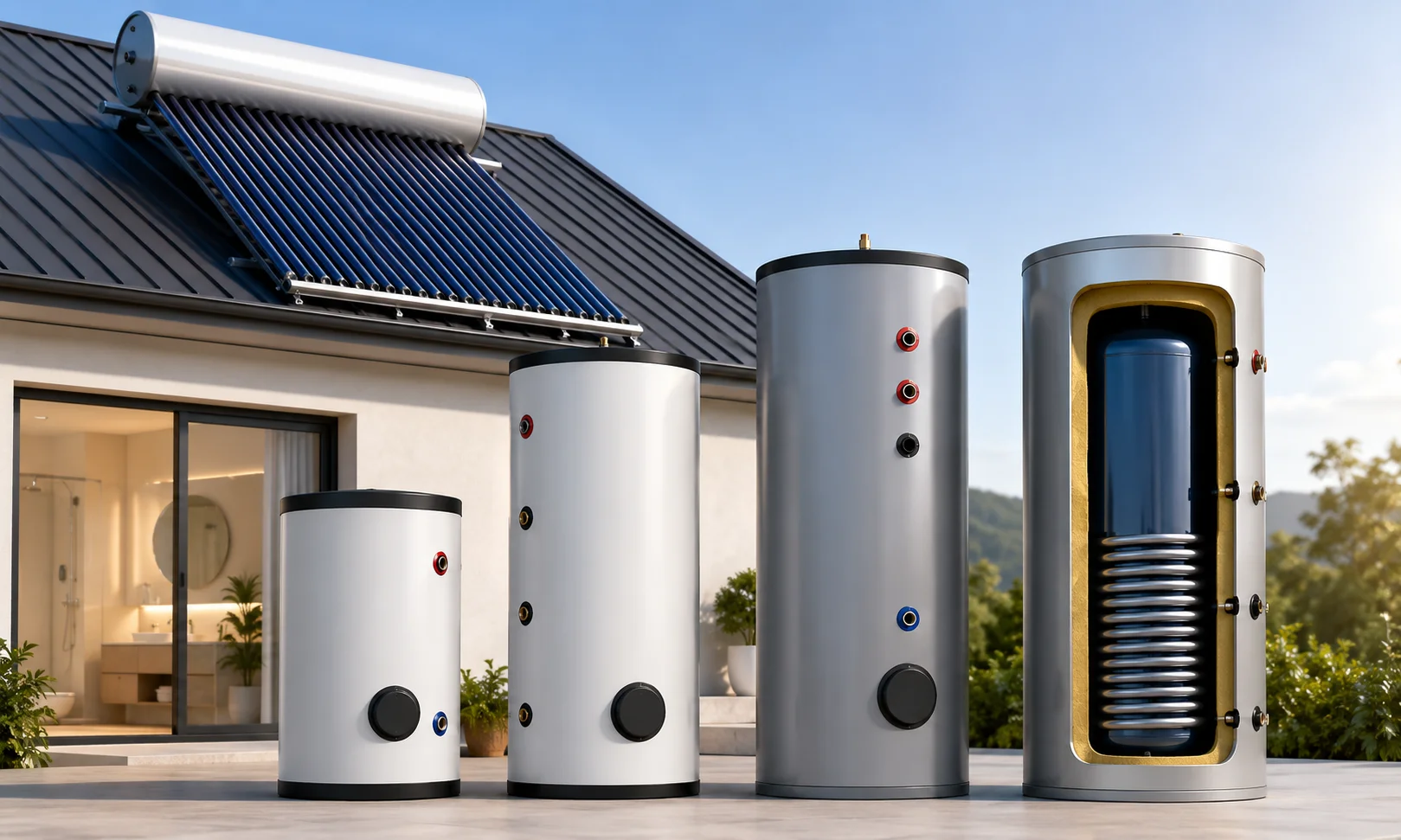
A standard hot water cylinder just stores heated water. A solar cylinder does more — it's built with internal coils that transfer heat from your solar collector into the stored water. How those coils are arranged has a big effect on how well the system performs.
Twin Coil Cylinders
This is what most Irish installations use, and for good reason. There are two coils inside: one connected to your solar panels, sitting lower in the tank, and a second connected to a backup source — usually a boiler or immersion — positioned above it.
The logic is simple. On a good day, the solar coil does all the work. On a run of grey November afternoons, the backup coil steps in and tops the water up so you're never left short. It's the belt-and-braces approach, and it's why twin coil setups are the standard recommendation for most homes.
Single Coil Cylinders
These show up occasionally, usually where solar is the only heat source or where a separate plate heat exchanger is doing the work instead. For most households, though, having that backup coil built in is worth the extra cost — it's the difference between a system that always works and one that mostly works.
Sizing: The Bit People Get Wrong Most Often
Too small, and you're constantly running short. Too big, and you're paying to heat water you don't use. A few things determine the right size for your house:
How many people live there. The rough guide is 40–50 litres of storage per person, per day. A household of four is typically looking at somewhere between 160 and 200 litres — though a genuinely efficient system can sometimes bring that down a little.
How the household actually uses hot water. Two people showering back-to-back in the morning is a different demand profile than one person who showers at night and runs the dishwasher separately. Be honest about your own routine here rather than going by a generic formula.
How much heat your collector can actually deliver. A stronger-performing solar setup recovers heat faster, which can sometimes justify a smaller tank. A weaker one benefits from more storage, so there's more heat banked for when the sun isn't cooperating.
What actually fits. Cylinders take up real space. Before falling in love with a particular size, it's worth measuring the hot press or utility room first.
Features Worth Actually Paying Attention To
Insulation. This is the difference between water that's still hot in the evening and water that needs reheating by 3pm. Thicker, high-density foam insulation is worth paying for.
Material. Stainless steel tends to hold up better over time and resists corrosion more reliably than copper, though copper cylinders still perform well and remain common.
Vented vs. unvented. Unvented cylinders connect straight to the mains, giving you strong pressure and flow — similar to what you'd get from a combi boiler. They need proper installation by a qualified professional, but for most modern Irish installations, this is the setup people end up happiest with. Vented cylinders, which draw from a cold-water tank in the attic, are simpler and still used, but the pressure is noticeably lower.
Coil surface area. A bigger coil means faster, more efficient heat transfer from your panels into the tank. It's a small spec sheet detail that has a real effect on day-to-day performance.
A Word on SEAI Grants
The SEAI does offer grants for solar thermal and renewable solar hot water installations, and this is genuinely worth looking into before you commit to a system. The grant is centred on the collectors themselves, so it's worth confirming with a registered contractor which cylinder and system combinations qualify, and what the current eligibility requirements are — these details are best checked directly rather than assumed.
Getting the Whole System Right
The cylinder doesn't work in isolation — it's one part of a system that needs to be sized, matched, and installed correctly as a whole. A great set of panels paired with the wrong cylinder still leaves you short on hot water; a well-chosen cylinder paired with an undersized collector still means running the backup more than you'd like.
If you're weighing up options for your own home, it's worth getting a proper assessment done before buying anything — occupancy, usage patterns, and available space all factor in, and a fifteen-minute conversation upfront can save a lot of second-guessing later.