Sign up with Google
 Sign in with Zoho

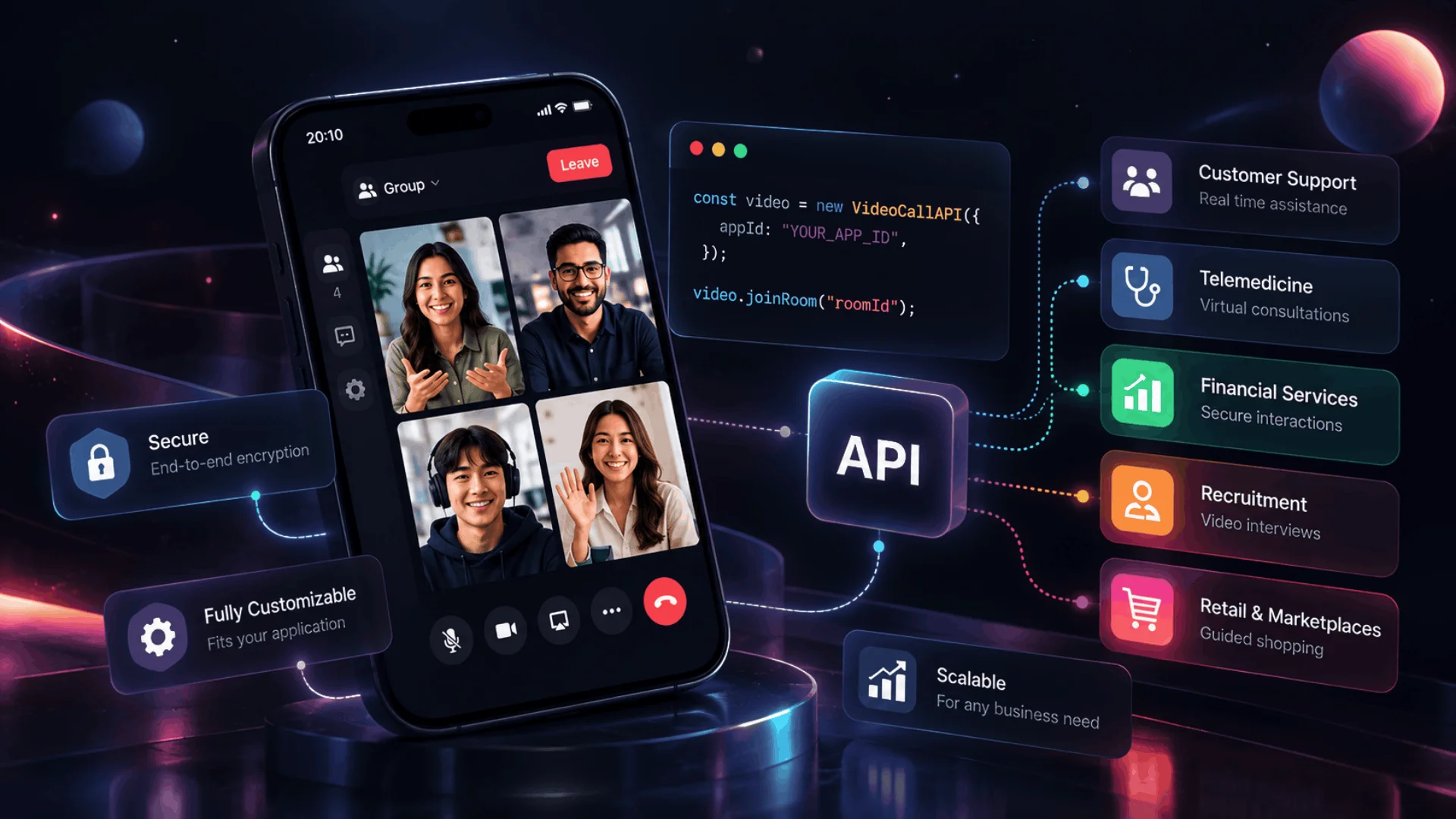
Business communication isn't simply restricted to the conference room or on the telephone. Today, video is becoming a built-in feature. It is often found in customer portals, health applications, team collaboration and other platforms.
For C-suite leaders, this is not simply a tech upgrade. It is an opportunity to decrease customer friction, improve data control, speed up service delivery and deliver unbeatable communication experiences.
With a video call API like MirrorFly organizations can embed the whole experience right inside their existing apps without rebuilding the underlying communication infrastructure from the ground up.
What Does a Video Call API Do
It is a set of development tools that lets a business integrate real-time video communication to its website, mobile application or software platform.
Depending on the provider and the chosen setup, the API can include one-to-one calls or group sessions. It commonly includes screen sharing, recording and chat style messaging. It also supports virtual waiting rooms, participant controls and real-time notifications.
How a Video Call API works
The video API is a layer between the business app and the audio/visual cloud-based communication infrastructure that processes live audio and video.
On the click of one of the buttons, such as ‘Start Consultation’ or ‘Join Appointment,' the app pushes a request into the video API. The system verifies identity and provides a secured video room and enables the proper participants.
A video provider may take care of much of the complex communication infrastructure in the background. But the interaction takes place within the company's application.
The technology also manages back-end functions such as device permissions, video encoding and media routing. It can withstand bandwidth changes and even supports connection quality compatibility between browsers and OS.
The Problem with Third-Party Video Apps That Businesses Stopped Talking About
Standalone meeting applications solves a real, immediate need, especially when remote work and virtual service delivery expanded rapidly. But, over time, they introduced friction that many businesses couldn’t avoid at all.
Customers might have to find a meeting link or download yet another app. Every extra step adds to the confusion or delay.
The business also loses control over branding and customer behaviour signals. So call information can remain separated from CRM systems appointment histories or transaction records. The result?
Teams focused on customer experience and operational efficiency are affected. These disconnected paths impede their impact and efficiency.
Where Businesses Are Actually Seeing the Shift
The biggest impact of video APIs show in human interaction affecting action or outcomes. They may include a service outcome, a purchasing decision or day to day operational process.
a. Customer Support and Expert Consultations
Companies are adding video into support portals. Agents can now depict a solution or inspect a problem visually. They can easily guide someone through complex tasks.
Financial advisers, consultants and product specialists benefit a lot. They are able to run scheduled sessions inside branded client portals.
b. Transactions and Marketplace Communication
- Marketplaces connect buyers with sellers without privacy breaches.
- Real estate platforms can offer virtual property check-ins
- Retail applications can provide guided product showings.
- Recruitment platforms can move candidates from application into interview.
c. Internal and Field Operations
Video APIs also help with remote inspections, equipment troubleshooting and employee onboarding. It also helps with field-service support and distributed workforce training.
It does not make sense to treat video like a separate meeting thing. In fact, businesses can trigger it exactly when operational help is needed.
The Industries That Moved First and What Actually Happened
Industries with urgent, regulated or expertise-driven communication requirements would benefit. This is why they were among the earliest adopters of embedded video.
a. Healthcare and Telemedicine
Healthcare providers integrate video into patient portals for consultations and remote monitoring. Patients end up with a more connected experience as scheduling, medical records, communication and care delivery can all sit inside one platform.
b. Financial Services
Banks, insurers, lenders, wealth-management firms also use embedded video. This helps with advisory sessions and customer verification and high value service interactions.
Videos help organisations preserve a human touch. In parallel, it expanded digital delivery.
c. Recruitment and Retail Marketplaces
Recruitment applications became more streamlined with video interviews. Also, retailers rolled out assisted shopping along with product consultations.
Marketplaces used controlled video interactions to build trust between participants.
What Developers Get When They Use a Video Call API vs Build From Scratch
If you build video functionality internally, it is more complex than connecting a camera or microphone. Building a video calling app involves specialised know-how and heavy infrastructure investment. With the need for continuous testing and long term maintenance, the work could be demanding.
Here is why a power packed video calling APIs like MirrorFly makes total business sense.
a. Faster Product Development
MirrorFly video API provides SDK integration support for web, Android and iOS applications. The cPaaS also covers frameworks and languages such as JavaScript, Angular, React Native and Flutter.
So, development teams can focus on the company’s core offering instead of spending months creating basic video infrastructure from scratch.
This is the sample
a. Faster Product Development
Build From Scratch
- Months spent developing signaling, media handling, authentication, and testing.
- More engineering resources required before launching.
Using a Video Call APIMirrorFly provides SDKs for web, Android, iOS, React Native, Flutter, JavaScript, Angular, and other frameworks. Developers can integrate secure video calling much faster, allowing teams to focus on business-specific features instead of communication infrastructure.
b. Infrastructure Without the Operational Burden
Build from Scratch
Self-built servers require managing media servers and global load balancers to keep up the call quality. Scaling during traffic spikes calls for costly over-provisioning. Also, ongoing maintenance is needed for ongoing patches and maintaining dashboards.
Using a Video Call API
MirrorFly handles global media routing and bandwidth optimization. It offers flexible deployment options including on-premises infrastructure, private clouds, company data centres or the provider’s cloud. It also treats data ownership and custom security as core features rather than a late add-on.
c. Ready-Made Advanced Features
Working on recording, screen sharing, virtual waiting rooms and participant moderation takes thousands of extra development hours. Also, factors like live captions, call analytics and in-call messaging each need specialized expertise.
Using a Video Call API
MirrorFly includes recording, screen sharing, moderation tools, waiting rooms, captions, analytics and messaging already put together. Features like custom call metadata and event integrations automatically update your CRMs, trigger follow up workflows, log session results and then produce operational reports.
Security and Compliance: What Changed When Video Moved In-House
a. Encryption & Compliance: With an embedded video setup, businesses can enforce their own encryption standards and compliance protocols. Call data stays inside the organizations security framework. So it is easier to meet HIPAA, GDPR, and FINRA protocols without needing third party vendor rules that can shift over time.
b. Source Code Access: MirrorFly provides complete source code access. As a result, companies can audit, tweak, and secure every component. Internal security teams can check the codebase for vulnerabilities and adjust authentication logic. In practice this creates total transparency and reduces worry about hidden vendor backdoors.
c. Customization: Organizations are able to tailor the video interface, the workflows, and the security settings, to better match brand expectations and operational needs. This includes custom authentication flows and role based permissions. This way, each part can be aligned with internal policies and user expectations.
d. Data Residency: With self hosting or a private cloud deployment option, businesses get full control over where call data, recordings, and transcripts are stored. This helps with compliance for regional data sovereignty requirements. It also prevents sensitive information from moving outside approved geographic limits without permission.
.
How AI Pushed Video APIs Beyond Their Intended Scope
Video APIs are no longer just communication tools, but intelligent workflow platforms thanks to powerful AI capabilities. They can extract insights, automate follow-ups and enhance every interaction. This turns video from a communication channel to a strategic business asset.
These are the practical possibilities
- Live transcriptions and translation: For accessibility and multilingual communication during calls
- Background noise reduction and voice enhancement: For clear audio on every device
- Real time speaker detection and captions: To improve meeting clarity and participation
- Automated post call summaries with action items: These are pulled from each conversation automatically
- Sentiment scoring and transcript analysis: This feeds directly into the CRM and support systems
What Next for Businesses that Have Not Yet Adopted Video Calling API
Not all organizations have to replace their current meeting systems. Standalone tools could sometimes be adequate for internal meetings and for occasional external calls. However, video call API will play a vital role in situations where communication is a part of
-a customer journey,
-regulated process,
-a transaction,
-consultation, or
-a core service.
Businesses should consider what is happening now in the current flow of users when they leave the application to communicate with an employee, expert, supplier or service provider. The transitions can often be the best places to embed video.
FAQs
What is the primary business advantage of using a video call API?
Using a video call API, companies can integrate low latency video calls into the website with live calls. This decreases customer friction. It also provides the business more control over branding and data user experiences.
Do you need to build video functionality in-house or with a video call API?
Most businesses will find that an API WebRTC can save them both initial development expenses and ongoing infrastructure requirements. The organisation can launch quicker while the provider takes care of media routing and scalability.
What factors to consider in choosing a video API provider?
Consideration of reliability, scalability, security and flexibility of integration is essential. They also need to think about geographic coverage, analytics, pricing and support. The provider also needs to be in line with the future product and AI strategy of the organisation.