Sign up with Google
 Sign in with Zoho

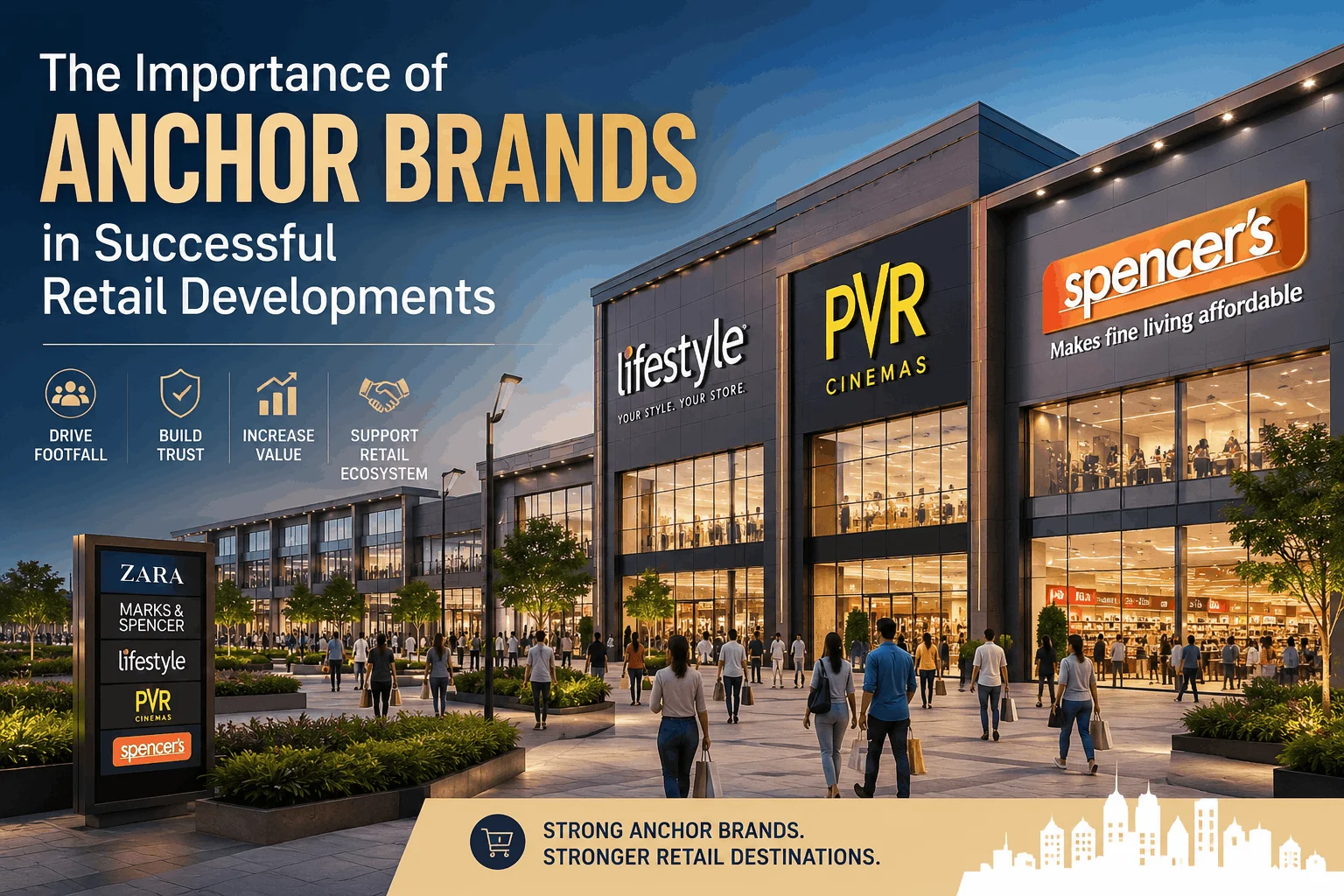
Every successful shopping destination has a gravitational centre. It might be a large format department store, a multiplex, a hypermarket, or a flagship outlet of a globally recognised fashion label. Shoppers may not consciously register it, but they plan their visit around it. That gravitational centre is the anchor brand, and its presence often decides whether a retail project thrives for decades or struggles to fill its ground floor.
For developers, investors, and business owners evaluating retail space in Gurgaon, understanding the role of anchor tenants is not an academic exercise. It is one of the most reliable predictors of long term returns.
What an Anchor Brand Actually Does
An anchor brand is a large, established retailer that occupies a significant portion of a project's leasable area and draws consistent footfall on its own strength. Think of supermarket chains, electronics megastores, cinema operators, or department stores. Unlike smaller tenants who depend on passing traffic, an anchor generates its own audience. People travel specifically to visit it.
That distinction matters enormously. A boutique apparel store cannot pull a family across town on a Sunday afternoon. A multiplex screening a major release can. Once that family arrives, they browse, eat, and shop at surrounding outlets. This spillover effect is the single most valuable asset a smaller retailer inherits when they choose the right address.
Footfall Economics and the Halo Effect
Retail analysts often describe the relationship between anchors and smaller stores as symbiotic, though the exchange is rarely equal. Anchors typically negotiate lower rents per square foot precisely because they deliver value beyond their own rent cheque. Developers accept this trade because the anchor's presence allows premium pricing across the remaining inventory.
The numbers tell the story clearly. Units positioned along the main circulation route between two anchors consistently command higher rentals and record stronger conversion rates than isolated corners. Businesses looking at commercial shops in Gurgaon should always study the tenant mix map before signing anything. Proximity to an anchor is worth paying for, and distance from one is a discount that exists for a reason.
Anchors Reduce Risk in Commercial Real Estate Development
From the developer's perspective, securing an anchor early transforms a project's risk profile. Lenders view signed anchor leases as evidence of demand. Institutional investors treat them as a proxy for stability. In many cases, financing terms improve measurably once a credible anchor commits.
This is why experienced players in commercial real estate development pursue anchor conversations long before construction begins, sometimes even before land acquisition closes. The design of the building, the parking ratio, the floor plate depth, the loading bay access, and the service lift capacity are all shaped by anchor requirements. Retrofitting a completed structure to suit a hypermarket is expensive and often impossible.
Anchor leases also tend to run long, frequently ten to fifteen years, against the three to five year terms common among smaller brands. That stability smooths cash flow and protects the project through market cycles.
Choosing the Right Anchor, Not Just a Big One
Size alone does not make a good anchor. Relevance to the catchment does. A luxury department store in a value driven neighbourhood will underperform, regardless of its brand equity. A hypermarket in an affluent, low density pocket may find its volumes disappointing.
The right anchor matches the income profile, age distribution, and lifestyle patterns of the surrounding population. Developers who study catchment data carefully, including household spending capacity, vehicle ownership, and daily commute corridors, make better anchor decisions than those who chase the most recognisable name available.
There is also the question of complementarity. An anchor should attract customers who will plausibly shop at the surrounding units. A cinema pairs naturally with cafes, dessert brands, and casual dining. A grocery anchor pairs with pharmacies, salons, and everyday convenience retail. Mismatched combinations waste the footfall the anchor works hard to create.
Placement and Design Matter as Much as the Name
Signing a strong anchor is only half the work. Where that anchor sits within the layout determines how much benefit flows to everyone else. Placing anchors at opposite ends of a corridor forces shoppers to walk past smaller stores, a principle retail planners have applied for decades. Placing an anchor beside the main entrance, by contrast, allows customers to arrive, transact, and leave without ever seeing the rest of the project.
Vertical circulation deserves equal attention. Anchors positioned on upper floors pull traffic upward, which protects the value of higher level units that would otherwise struggle. Escalator placement, atrium visibility, and clear sightlines all convert anchor footfall into genuine browsing across the development.
The Gurgaon Context
Gurgaon presents an unusually competitive environment. Dense corporate populations, high disposable incomes, and rapid residential expansion have created strong demand, but also considerable supply. Projects that succeed here are the ones that combine a credible anchor with a coherent tenant curation strategy and genuinely convenient access.
Anyone evaluating retail shops in gurgaon should ask direct questions: which anchors have signed, what are the lease terms, where are they positioned, and what percentage of the project is already committed. Vague answers usually indicate that anchor negotiations remain unresolved.
A Word of Caution on Over-Dependence
Anchors bring risk alongside reward. If a single tenant occupies forty percent of a project and exits, the vacancy is difficult to backfill and the footfall loss is immediate. Well structured developments diversify across two or three anchors from different retail categories, so no single departure destabilises the whole.
The Bottom Line
Anchor brands are not decorative. They are structural. They shape financing, design, rental hierarchy, and long term occupancy. For anyone assessing a retail investment, the anchor question deserves to be asked first, not last.