Sign up with Google
 Sign in with Zoho

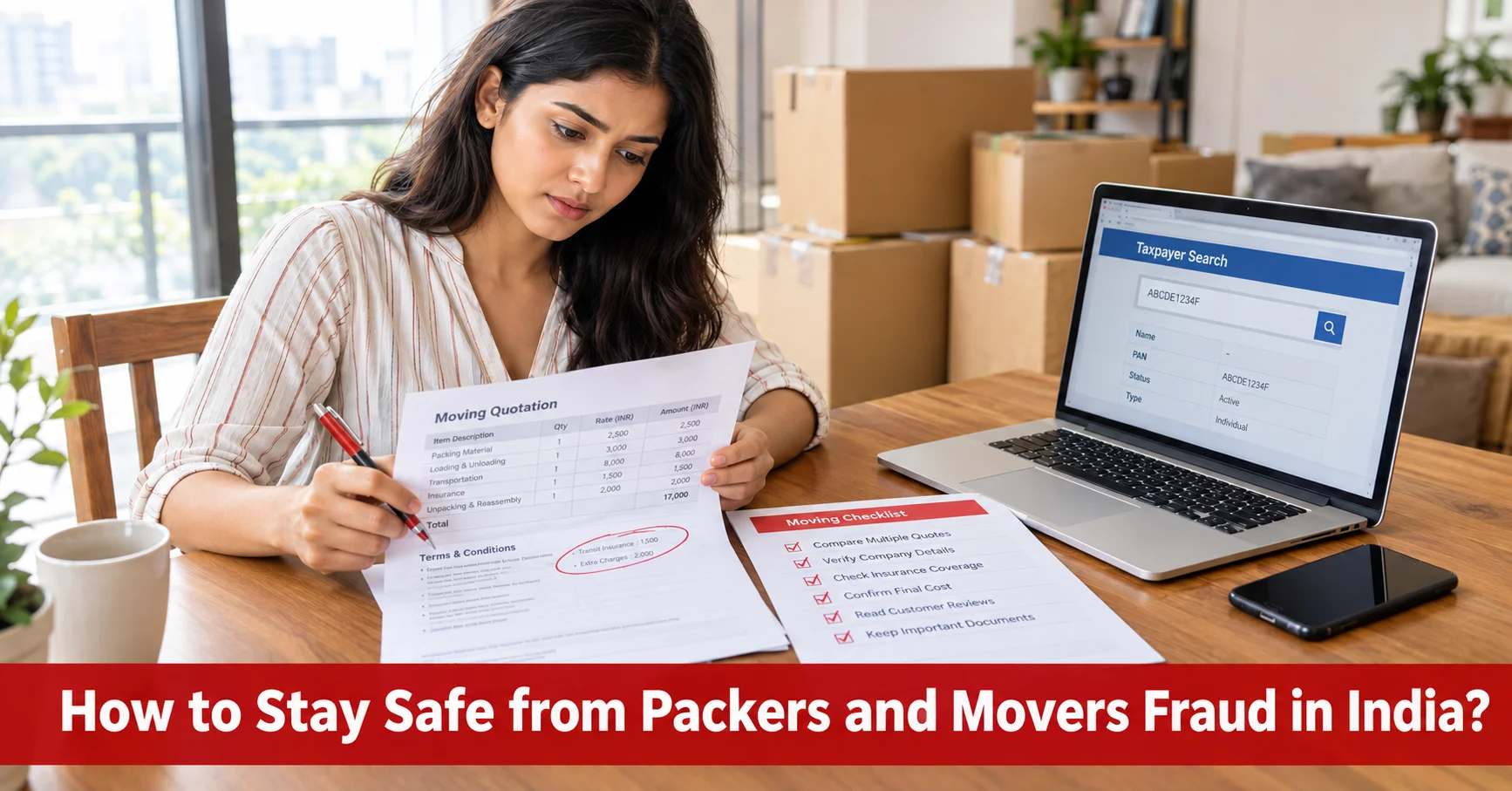
Moving house is one of the few purchases where you hand over almost everything you own to strangers, and pay part of the bill before a single box has moved. Most packers and movers in India run honest businesses. But the structure of the transaction, with an advance up front and your belongings out of sight for days, is exactly what makes packers and movers fraud possible, and it keeps catching people out.
The good news is that these schemes depend on one thing: a customer who pays before verifying. This guide explains how the common schemes work, the warning signs you can spot on the very first phone call, and seven checks to run before you pay anyone an advance. It also covers what to do on moving day and where to complain if something goes wrong.
How Packers and Movers Fraud Usually Works
The details vary, but most complaints fall into five patterns.
The vanishing advance. A company quotes an attractive price and asks for a large payment to "confirm the booking". Once the money is sent, calls go unanswered or the moving date keeps slipping.
The bait and switch. The quote is low, but the crew arrives, loads your goods, and announces that the volume is higher than estimated. The price rises sharply, and because your belongings are already on the truck, you have little leverage. In the worst cases the goods are held until you pay the difference.
The borrowed name. Some operators copy the name, logo or website style of a well-known company, so the business you are speaking to is not the one you researched.
The fake listing. Customers sometimes report that a number shown on a search result or map listing connects to a different operator from the one named. Always check where a number actually leads before you share details or pay.
The insurance that is not there. The mover says your goods are "fully insured", but when something breaks there is no policy, or the policy excludes exactly what was damaged. Some operators offer only a limited liability amount, which may be a small fraction of what your belongings are worth.
None of these schemes works well on a customer who has checked the basics first.
Warning Signs on the First Phone Call
You can learn a great deal before you have paid anything or shared your address. Be cautious if the person you are speaking to does any of the following.
- Quotes a price without asking questions. A genuine operator asks about your home size, floor, lift access, the items you are moving, the distance and the date. A figure given in thirty seconds is a guess designed to win the booking.
- Refuses any kind of survey. Reputable movers offer a short video call or a visit to estimate volume. An operator who refuses all inspection is leaving room to revise the price later.
- Applies pressure. "This rate is only valid today" and "only two slots left" are sales tactics, not logistics.
- Asks for payment to a personal account or in cash. Business payments should go to a business account.
- Is vague about who they are. Different company names on the call, the quote and the payment details are a red flag.
- Is reluctant to put anything in writing. If an operator says "we don't do it that way", take that as your answer.
Check 1: Verify the GST Registration
Ask for the company's GST number and look it up on the government's GST portal using the taxpayer search. Confirm that the registered name matches the name on the quote and that the registration is active. A genuine business gives this number without hesitation. If a mover claims they do not need one, or the number does not match, stop there.
Be realistic about what this proves. A GST number shows the business is registered, not that it behaves well, so treat it as a first filter rather than a guarantee. It also matters practically: if your employer is reimbursing the move, you will need a proper GST invoice, and an unregistered operator cannot issue one.
Check 2: Confirm the Business Actually Exists
A phone number and a website are easy to create. Look for a physical office address and find it on Google Maps. Check that the name, address and phone number are consistent across the website, the maps listing and the GST record. If the address turns out to be a residential flat, an empty plot or a different business, treat that as a warning sign.
Where possible, call the office number rather than only a mobile, and ask to speak to the person who will manage your move. A real operation can tell you who that is. One that cannot is probably a lead seller passing your details to whoever pays.
Check 3: Get a Written, Itemised Quote
A verbal figure on a phone call is not a quote. Ask for a written quotation that breaks out packing materials, labour, the vehicle, distance charges, insurance, GST and any society or lift charges. Ask what happens if the volume of goods turns out larger than estimated, and get the answer in writing.
Keep the WhatsApp or email trail. If a dispute follows, it is your evidence. A useful question to ask is: "Is this the final amount I will pay, assuming the goods match the list I gave you?" If the answer is anything other than yes, find out exactly what could change the price and by how much.
Check 4: Ask for the Insurance Certificate, Not the Promise
Do not accept "everything is insured" as an answer. Ask for the policy document or certificate. Check who the insurer is, what is covered, what is excluded, and how a claim is made. Find out whether the cover applies to the whole value of your goods or only to a capped amount.
If the paperwork does not exist before your goods are loaded, it will not appear after they are damaged. If a mover offers insurance as an optional extra, ask what it costs and what it covers, then decide with the document in front of you.
Check 5: Limit the Advance and Pay Traceably
A modest advance at booking, commonly around a fifth to a third of the total, with the balance due on safe delivery, is a reasonable structure. Be wary of anyone who demands full payment before loading.
Pay by bank transfer or UPI to an account in the registered business name. Avoid cash, and avoid paying into a personal account that does not match the company on the quote. A traceable payment to a named business gives you something to act on if things go wrong. Cash to an individual gives you almost nothing.
Check 6: Treat the Lowest Quote with Suspicion
If you collect three quotes and one is dramatically lower than the rest, do not read it as a bargain. Moving costs are driven by distance, volume, labour and fuel, and those costs are similar for every operator.
A price far below the market is one of the most common signs of packers and movers fraud. It usually means one of two things: charges will be added later, or there is no real insurance or registration behind it. Ask the low bidder to explain, in writing, how they can do the job for so much less. The quality of the answer tells you a lot.
Check 7: Read Reviews Away from the Company's Own Site
Testimonials on a company's website are chosen by the company. Look at Google Maps, JustDial and similar independent listings, and read the critical reviews first. One bad review means little. The same complaint repeated by different people, such as price increases after loading, damaged goods with no response, or a vanished advance, tells you what to expect.
Check how the company responds to criticism. A business that answers complaints calmly and offers a fix is a better bet than one that ignores them or attacks the reviewer. Also treat a page of identical five-star reviews posted within a few days with some scepticism.
The Seven Checks at a Glance
On Moving Day
Even after these checks, protect yourself on the day.
- Photograph your valuable items before packing begins, with date stamps.
- Check that the vehicle and crew match what was agreed, and note the vehicle registration number.
- Never sign a blank or incomplete document.
- Get a goods receipt or consignment note listing what was loaded.
- Keep documents, valuables and medication with you, not in the truck.
- Inspect everything before signing the delivery receipt. Once signed, claims become much harder.
If the Crew Demands More Money After Loading
This is the most stressful version of the scam, because your belongings are already in the truck. Stay calm and avoid any confrontation. Photograph and record the situation, including the vehicle registration number and the crew's details. Ask for the revised price in writing and refer back to your original quote. If you feel threatened, or the crew refuses to release your goods, contact the police; 112 is the national emergency number. The police can tell you whether holding goods to extract extra payment amounts to a criminal matter.
If Something Goes Wrong
If you have already been caught by packers and movers fraud, keep every record: the quote, payment proof, messages and photographs. Then, in rough order of escalation:
- Contact the company in writing and set a deadline for a response.
- Register a grievance with the National Consumer Helpline, toll-free on 1915 (8 AM to 8 PM), on WhatsApp at +91 88000 01915, or through consumerhelpline.gov.in. This is a pre-litigation step and is free.
- If that does not resolve it, you can file a complaint with the District Consumer Commission under the Consumer Protection Act, 2019.
- If you paid through an online channel and were defrauded, report it on cybercrime.gov.in or call 1930 as soon as possible, since early reporting matters.
- If a mover is holding your goods and demanding extra money, a police complaint is appropriate.
This is general information, not legal advice. For a specific dispute, consult a lawyer or your local consumer commission.
Common Questions
Is it normal to pay an advance to a mover?
Yes. A modest advance is standard practice. What matters is the size, whether the payment is traceable, and what you receive in writing in return.
Does a GST number prove a company is honest?
No. It proves registration. Use it as a first filter, then run the other checks.
Can I get my advance back if the mover disappears?
It depends on the agreement and the circumstances. Start with a written demand, then use the consumer helpline, then the consumer commission. A traceable payment and written records make each step easier.
Should I use a comparison platform?
Platforms that screen operators can reduce your risk, but they do not replace your own checks. Ask how they verify movers and what happens if a complaint arises.
Reduce the Risk Before You Start
Running seven checks on every company takes time, and that is the main reason people skip them. Comparison platforms that screen movers in advance can shorten the process. If you are moving within or out of the capital, you can compare screened packers and movers in Delhi this way. The checks above are still worth running yourself, whichever route you take.
The pattern behind nearly every case of packers and movers fraud is the same. The customer paid before verifying, or accepted a promise instead of a document. Verify first, get it in writing, and pay in stages.

.webp)